MCQ 11 Mark
Current flowing through the ideal diode shown in the circuit is __________ .

AnswerB. 10 mA
$\rightarrow $ Here $p-n$ junction diode is in forward bias and resistance of diode is zero,
$\begin{aligned}
\therefore I & =\frac{\Delta V}{R}=\frac{10-9}{0+100}=\frac{1}{100} \\
\therefore I & =0.01 A \\
& =10 \times 10^{-3} A \\
\therefore I & =10 mA
\end{aligned}$
View full question & answer→MCQ 21 Mark
What is the type of the semiconductor, for the energy band diagram shown in the figure?
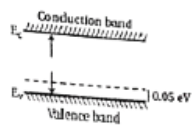
- A
- B
- C
- D
Both and p type semiconductor
AnswerB. $p$-type semiconductor
View full question & answer→MCQ 31 Mark
Give electronic configuration of silicon.
- A
$1 s^1 1 s^2 2 s^2 3 s^2 3 p^2 3 p^6$
- B
$1 s^2 1 s^2 3 s^2 2 p ^4 3 s^2 3 p ^2$
- C
$1 s^2 2 s^2 2 p^6 3 s^2 3 p^2$
- D
$1 s^2 2 s^2 2 p^6 3 s^1 3 p^3$
AnswerB. $1 s^2 2 s^2 2 p ^6 3 s^2 3 p ^2$
View full question & answer→MCQ 41 Mark
Which of the following is not a conductor of electricity ?
MCQ 51 Mark
Give the equation which represents law of gauss for magnetism.
AnswerB. $\oint \vec{B} \cdot d \vec{a}=0$
View full question & answer→MCQ 61 Mark
Electric field of one plane progressive electromagnetic wave is $E_Z=100 \cos$ $\left.\times 10^8 t+4 x\right) Vm ^{-1}$. Then refractive index of medium of propagation would be __________ .
AnswerB. 2.0
$\rightarrow$ Comparing given equation with $E_Z=$ $E _0 \cos (\omega t+k x)$ we get,
$\omega=6 \times 10^8 rad / s$ $k=4 rad / s$
$\rightarrow$ Required refractive index,
$\mu=\frac{c}{v}=\frac{c}{\omega / k}=\frac{c k}{\omega}=\frac{3 \times 10^8 \times 4}{6 \times 10^8}=2$
View full question & answer→MCQ 71 Mark
In the process of forming helium from hydrogen, the mass defect is $0.5 \%$. Wha is the energy produced when helium is formed from 1 kg hydrogen?
( $1 kWh =36 \times 10^5 J$ )
- A
$1.25 kWh$
- B
$1.25 \times 10^6 kWh$
- C
$1.25 \times 10^8 kWh$
- D
$1.25 \times 10^4 kWh$
AnswerC. $1.25 \times 10^8 kWh$
$\rightarrow $ Here mass defect $\Delta m =0.5 \%=5 \times$ $10^{-3}$
$\therefore$ Emitted energy as $E =\Delta m c^2$
$\begin{aligned}
E & =5 \times 10^{-3} \times 9 \times 10^{16 J} \\
& =\frac{45 \times 10^{13}}{36 \times 10^5} kWh \\
& =1.25 \times 10^8 kWh
\end{aligned}$
View full question & answer→MCQ 81 Mark
The atomic number of Helium is 4 and Sulphur $S$ is 32 . The radius of nucleus of sulphur is larger than that of Helium by __________ .
AnswerA. 2
$\begin{array}{l}
\rightarrow R=R_0 A^{1 / 3} \\
\therefore R \propto A^{1 / 3} \\
\therefore \frac{R_{Hc}}{R_s}=\left(\frac{A_{He}}{A_s}\right)^{\frac{1}{s}} \\
\therefore \frac{R_{He}}{R_{s}}=\left(\frac{4}{32}\right)^{\frac{1}{3}} \\
\therefore \frac{R_{\text {He }}}{R_{s}}=\frac{1}{2} \\
\therefore \frac{R_{s}}{R_{He}}=2
\end{array}$
View full question & answer→MCQ 91 Mark
Hydrogen atom excites energy level from $n=3$ to ground state. Number of spectrum lines according to Bohr, is __________ .
AnswerC. 3
$\rightarrow$ Number of lines $=$ $\frac{n(n-1)}{2}=\frac{3(3-1)}{2}=3$
View full question & answer→MCQ 101 Mark
The shortest wavelength of the spectrum line is that of electron being transits into atom to ion from $n=2$ to $n=1$ for __________ .
AnswerD. doubly ionized lithium
$\rightarrow \frac{1}{\lambda}=R Z^2\left[\frac{1}{n_f^2}-\frac{1}{n_i^2}\right]$
R and $\frac{1}{n_f^2}-\frac{1}{n_i^2}$ are constant
$\therefore \frac{1}{\lambda} \propto Z^2$
and $Z=3$ is maximum for doubly ionized lithium in a given atom.
View full question & answer→MCQ 111 Mark
The ratio of the radii of $n=10$ orbit of hydrogen and $Li ^{+2}$ ion is __________ .
AnswerC. 3
$\rightarrow \quad r_{n}=\frac{n^2}{Z} \cdot a_0$
where $a_0=$ Bohr radius $=\frac{h^2 \varepsilon_0}{\pi c^2 m}$
$=0.53$ Å
For H atom $Z =1, n=10$
$\therefore r_{10}=\frac{100}{1} a_0$ and
For $Li ^{+2}$ atom $Z =3, n=10, r= R$
$\begin{array}{l}\therefore R _{10}=\frac{100}{3} a_0 \\ \therefore \frac{r_{10}}{ R _{10}}=3\end{array}$
View full question & answer→MCQ 121 Mark
A berillium particle $(z=4)$ having $5.3 MeV$ energy experience head-on collision with gold atom $(z=79)$. It can move to what closest distance to gold nucleus?
AnswerB. $8.58 \times 10^{-14} m$
$\rightarrow$ Minimum distance,
$\begin{aligned}
r_0 & =\frac{k \times(79 e)(4 e)}{K} \\
& =\frac{9 \times 10^9 \times 79 \times 4 \times\left(1.6 \times 10^{-19}\right)^2}{5.3 \times 10^6 \times 1.6 \times 10^{-19}} \\
& =858.56 \times 10^{-16} \\
& =8.58 \times 10^{-14} m
\end{aligned}$
View full question & answer→MCQ 131 Mark
An electron is at a distance of 10 m from a charge of 10 C . Its total energy is $15.6 \times 10^{-10} J$. Its de-Broglie wavelength at this point is __________ .
$\left(h=6.625 \times 10^{-34} J \cdot s , m _{ e }=9.1 \times 10^{-31} kg, K =9 \times 10^9 SI \right)$
- A
$9.87$ Å
- B
$9.87 fermi$
- C
$8.97$ Å
- D
$8.97 fermi$
AnswerD. 8.97 fermi
$\rightarrow$ Potential energy of an electron,
$\begin{array}{l}
U=-\frac{k q(c)}{r} \\
\therefore U=\frac{9 \times 10^9 \times 10 \times 1.6 \times 10^{-19}}{10} \\
\therefore U=-14.4 \times 10^{-10} J
\end{array}$
Now total energy $E =$ Kinetic energy
$K +$ Potential energy U
$\begin{aligned}
\therefore K & =E-U \\
& =15.6 \times 10^{-10}+14.4 \times 10^{-10} \\
\therefore K & =30 \times 10^{-10} J \\
\text { But } K & =\frac{p^2}{2 m_e} \\
\therefore p & =\sqrt{2 K m_e} \\
\lambda & =\frac{h}{\sqrt{2 K m_e}}
\end{aligned}$
$\begin{aligned} & =\frac{6.625 \times 10^{-34}}{\sqrt{2 \times 30 \times 10^{-10} \times 9.1 \times 10^{-31}}} \\ \therefore \lambda & =8.97 \times 10^{-15} m \\ & =8.97 \text { fermi }\left(1 \text { fermi } 10^{-15} m\right)\end{aligned}$
View full question & answer→MCQ 141 Mark
A particle having rest mass to travel with speed of light in vacuum. Its de-Broglie wavelength will be __________ .
- A
$\frac{h}{m_0 c}$
- B
$0$
- C
$\infty$
- D
$\frac{m_0 c}{h}$
AnswerB. 0
$\begin{array}{l}
\rightarrow \lambda=\frac{h}{m v} \\
\lambda=\frac{h \times \sqrt{1-\frac{v^2}{c^2}}}{m_0 v} \\
\therefore m=\frac{m_0}{\sqrt{1-\frac{v^2}{c^2}}} \\
\lambda=\frac{h \times \sqrt{1-\frac{c^2}{c^2}}}{m_0 v} \quad \therefore v=c \\
\therefore \lambda=0
\end{array}$
View full question & answer→MCQ 151 Mark
In given graph if $V_{02}>V_{01}$ then __________ .
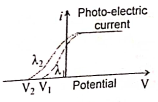
AnswerD. $\lambda_1>\lambda_2$
$\rightarrow V _0=\left(\frac{h}{e}\right) v-\frac{\phi_0}{e}$ and
From graph $\left( V _0\right)_2>\left( V _0\right)_1$
$\begin{array}{l}
\therefore\left(\frac{h}{e}\right) v_2-\frac{\phi_0}{c}>\left(\frac{h}{e}\right) v_1-\frac{\phi_0}{e} \\
\therefore v_2>v_1 \quad\left[\because V_0=\frac{h v}{c}-\frac{\phi_0}{e}\right] \\
\therefore \lambda_2<\lambda_1 \quad\left[\because \lambda \propto \frac{1}{v}\right] \\
\therefore \lambda_1>\lambda_2
\end{array}$
View full question & answer→MCQ 161 Mark
For most of metals threshold frequency lies in which region of electro-magnetic radiation?
MCQ 171 Mark
When ray of light is incident at $58^{\circ}$ glass plate, reflected light is completely plane polarised refractive index of glass plate $=$ __________ .
- A
$1.6$
- B
$1.5$
- C
$1.4$
- D
$1.35$
AnswerA. 1.6
$\rightarrow$ Here angle of polarisation angle $a$ incidence $=\theta_p=58^{\circ}$
$\therefore$ From Brewster's law,
Refractive index of medium $n=4$ $\theta_p$
$\begin{aligned}
\therefore n & =\tan 58^{\circ} \\
\therefore n & =1.6003 \\
& =1.6
\end{aligned}$
View full question & answer→MCQ 181 Mark
__________ can't be explained by ray optics.
- A
- B
- C
- D
Total internal reflection
View full question & answer→MCQ 191 Mark
In a Young's experiment, the distance between two slits is 0.2 mm . If the wavelength of light used in this experiment is 5000 Å, then the distance of 3 rd bright fringes from central maxima will be __________ .
- A
$0.75$
- B
$0.075$
- C
$0.0075$
- D
$0.057$
AnswerC. $0.0075$
$\rightarrow$ For $n ^{\text {th }}$ bright fringe,
$\begin{array}{l}
\text { In } d \sin \theta=n \lambda, \\
n=3, d=0.02 cm, \lambda=5 \times 10^{-5} cm \\
\therefore \sin \theta=\frac{n \lambda}{d}=\frac{3 \times 5 \times 10^{-5}}{0.02} \\
\sin \theta=\frac{0.015}{2}=0.0075 \\
\therefore \sin \theta=0.0075 rad
\end{array}$
View full question & answer→MCQ 201 Mark
Condition for destructive interference is__________ where $n=0,1,2,3, \ldots$
- A
phase difference $=2 n \pi$
- B
phase difference $=(2 n-1) \pi$
- C
phase difference $=(2 n+1) \pi$
- D
phase difference $=(2 n+1) \frac{\pi}{2}$
AnswerC. phase difference $(2 n +1)$
View full question & answer→MCQ 211 Mark
In the wave propagation phenomenon, phase difference of oscillation of two particles having distance A. from each other is __________ .
MCQ 221 Mark
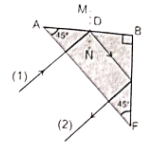
For right-angled prism, ray- 1 is the incident ray and ray as the emergent ray as shown in the figure. Refractive index of the prism is __________ .
- A
$\frac{1}{\sqrt{2}}$
- B
$\frac{\sqrt{3}}{2}$
- C
$\frac{2}{\sqrt{3}}$
- D
$\sqrt{2}$
AnswerD. $\sqrt{2}$
$\rightarrow$ As shown in figure, ray-I inciding at point $D$ of surface $A B$ in prism experiences total internal reflection. $\therefore$ At point $D$, angle of incidence formed with perpendicular MN on surface $A B$ is equal to critical angle $C =45^{\circ}$.
$\begin{aligned} \rightarrow \quad n & =\frac{1}{\sin C}=\frac{1}{\sin 45^{\circ}}=\frac{1}{0.7071} \\ & =1.414=\sqrt{2}\end{aligned}$
$\rightarrow$ Second method :
It is clear from the figure that ray experiences total internal reflection at points D and E . At these points value of angle of incidence is $45^{\circ}$
$45^{\circ}>C$ (critical angle)
$\begin{array}{l}
\Rightarrow \sin 45^{\circ}>\sin C \Rightarrow \frac{1}{\sqrt{2}}>\frac{1}{n} \Rightarrow \\
n \geq \sqrt{2}
\end{array}$
Out of given option for $n \geq \sqrt{2}, n=$ $\sqrt{2}$
View full question & answer→MCQ 231 Mark
The refractive indices of water and glass are 1.2 and 1.5 respectively. What will be the refractive index of glass with respect to water?
- A
$1.6$
- B
$1.4$
- C
$1.0$
- D
$1.25$
AnswerD. 1.25
$\rightarrow$ Refractive index of glass relative to water
$\begin{aligned}
n_{gw} & =\frac{n_g}{n_w} \\
\therefore \quad n_{gw} & =\frac{1.5}{1.2}=1.25
\end{aligned}$
View full question & answer→MCQ 241 Mark
Plane mirror is moving towards you at $5 cm / s$. You can see your image in it So at how much speed image moves towards you?
- A
$5 cm / s$
- B
$2.5 cm / s$
- C
$10 cm / s$
- D
$7.5 cm / s$
AnswerC. $10 cm / s$
$\rightarrow \quad$ Velocity of mirror towards the person,
$\vec{v}_0=5 \hat{i} cm / s$
Velocity of image towards the person,
$\begin{array}{l}
\vec{v}_{i 0}=\vec{v}_1-\vec{v}_0=-5 \hat{i}-5 \hat{i}=-10 \hat{i} \\
\therefore\left|\vec{v}_{i 0}\right|=10 cm / s
\end{array}$
View full question & answer→MCQ 251 Mark
A ray is incident at an angle $38^{\circ}$ with a mirror. The angle between normal and reflected ray is __________ .
- A
$52^{\circ}$
- B
$38^{\circ}$
- C
$90^{\circ}$
- D
$70^{\circ}$
AnswerA. 52
$\rightarrow$ From figure,
$\begin{array}{l}
\quad i+38^{\circ}=90^{\circ} \\
\therefore i=52^{\circ}
\end{array}$
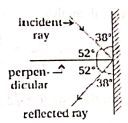
$\rightarrow$ From the law of reflection, angle of reflection $=$ angle of incident
$\begin{array}{l}
\therefore r=i \\
\therefore r=52^{\circ}
\end{array}$ View full question & answer→MCQ 261 Mark
Two cities are 150 km apart. Electric power is sent from one city to another city through copper wires. The fall of potential per km is 8 volt and the average resistance per km is $0.5 \Omega$. The power loss in the wire is __________ .
- A
$19.2 W$
- B
$19.2 kW$
- C
$19.2 J$
- D
$12.2 kW$
AnswerB. 19.2 kW
$\rightarrow$ Total voltage drop $V =150 \times 8=$ 1200 V
Total resistance of wire R
$\begin{array}{l}
=0.5 \times 150 \\
=75 \Omega
\end{array}$
Power loss in the wire,
$\begin{aligned}
\frac{V^2}{R} & =\frac{(1200)^2}{75} \\
& =19200 W \\
& =19.2 kW
\end{aligned}$
View full question & answer→MCQ 271 Mark
When 50 W bulb is connected with 220 V bulb, magnitude of rms current flowing in the bulb will be __________ .
- A
$0.127 A$
- B
$0.227 A$
- C
$ 0.327 A$
- D
$0.427 A$
AnswerB. $0.227 A$
$\begin{array}{l}\rightarrow R =\frac{ V ^2}{ P }=\frac{220 \times 220}{50}=968 \Omega \\ \text { and } I _{ rms }=\frac{ V _{ rms }}{ R }=\frac{220}{968}=0.227 A\end{array}$
View full question & answer→MCQ 281 Mark
For which frequency of $A C$ reactive inductance of 1 Henry inductor will be 1000 $\Omega$ ?
- A
$2000 \pi Hz$
- B
$\frac{500}{\pi} Hz$
- C
- D
$100 \pi Hz$
AnswerC.
$\begin{array}{l}\text { } 159.2 Hz \\ \rightarrow \quad X _{ L }=2 \pi f L \\ \quad 1000=2 \pi f(1)\end{array}$
$f=\frac{1000}{2 \pi}=159.2 Hz$
View full question & answer→MCQ 291 Mark
If angular frequency of an A.C. source used in L-C-R circuit is increased, then inductive reactance __________ and capacitive reactance __________ .
MCQ 301 Mark
The value of capacitive reactance is given by __________ .
- A
$X _C=-\frac{1}{\omega C}$
- B
$X _{ C }=\frac{1}{\omega C}$
- C
$X _{ C }=-\frac{j}{\omega C}$
- D
$X _{ C }=\frac{1}{\sqrt{\omega C}}$
AnswerB. $X _{ C }=\frac{1}{\omega C}$
View full question & answer→MCQ 311 Mark
Find mutual inductance of two coaxial solenoids of equal length 30 cm with innet one surrounded by bigger one. Their area of cross-sections are $20 cm^2$ and 40 $cm ^2$. They have windings of $40 turns / cm$ and $10 turns / cm$.
AnswerC. 3 mH
$\rightarrow$ Total no. of turns in smaller solenoid is $N_1=(40)(30)=1200$ and no. of turns in bigger solenoid is $N _2=(10)$
$(30)=300$
$\rightarrow$ Now, mutual inductance of given system is given by :
$M=\frac{\mu_0 N_1 N_2 a}{l}$
where $a=$ area of cross-section of smaller solenoid.
$\begin{array}{l}\therefore M =\frac{\left(4 \pi \times 10^{-7}\right)(1200)(300)\left(20 \times 10^{-4}\right)}{\left(30 \times 10^{-2}\right)} \\ \therefore M =3.0144 \times 10^{-3} H \\ \therefore M =3.0144 mH \approx 3 mH \end{array}$
View full question & answer→MCQ 321 Mark
Dimensional formula of self inductance is __________ .
- A
$\left[M^1 L^1 T^{-2} A^{-2}\right]$
- B
$\left[M^1 L^{-} T^{-1} A^{-2}\right]$
- C
$\left[M^1 L^2 T^{-2} A^{-2}\right]$
- D
$\left[M^1 L^2 T^{-2} A^{-1}\right]$
AnswerC.
$\begin{array}{l}
\left[ M ^1 L^2 T^{-2} A^{-2}\right] \\ \rightarrow \text { We have }|\varepsilon|= L \left|\frac{d I }{d t}\right| \\ \therefore \text { Unit of } L =\frac{ V _{ S }}{ A }=\frac{ J }{ C } \times \frac{ S }{ A }=\frac{ J }{ A _{ S }} \times \frac{ S }{ A } \\ \therefore \text { Unit of } L =\frac{ J }{\left[ A ^2\right]} \Rightarrow[ L ]=\frac{\left[ M ^1 L^2 T^{-2}\right]}{\left[ A ^2\right]} \\ \therefore[ L ]= M ^1 L^2 T^{-2} A^{-2}\end{array}$
View full question & answer→MCQ 331 Mark
A rod of 5 m length is moving perpendicular to uniform magnetic field of intensity $2 \times 10^{-4} Wb / m ^2$. If the acceleration of rod is $2 ms^{-2}$, the rate of increase of the induced emf is __________ .
AnswerD. $20 \times 10^{-4} V / s$
$\rightarrow$ Magnitude of induced emf $\varepsilon=B^{\prime \prime}$
Taking derivation w.r.t. $t, \frac{d s}{d t}=\frac{d}{d l}$$(B v I)$
B and l are constant
$\therefore \frac{d t}{d t}=B \frac{d v}{d t} l$
$\therefore \frac{d c }{d t}= B a l \quad\left[\because \frac{d v}{d t}=a\right]$
$=2 \times 10^{-4} \times 2 \times 5$
$\therefore \frac{d \varepsilon}{d t}=20 \times 10^{-4} V / s$
View full question & answer→MCQ 341 Mark
The distance between two extreme points of two wings of an Aeroplane is 50 m . It is flying at a speed of $360 km / hr$ in horizontal direction. If the vertical component of earth's magnetic field at that place is $2 \times 10^{-4} Wb m ^{-2}$, the induced emf between these two end points is __________ V.
- A
$0.1$
- B
$1.0$
- C
$0.2$
- D
$0.01$
AnswerB. 1.0
$\begin{aligned}
\rightarrow \quad v & =\frac{360 \times 1000}{3600}=100 ms^{-1}, l=50 m \\
B & =2 \times 10^{-4} Tesla \\
\therefore \varepsilon & =B v l \\
& =2 \times 10^{-4} \times 100 \times 50 \\
& \therefore \varepsilon=1 \text { Volt }
\end{aligned}$
View full question & answer→MCQ 351 Mark
One magnet is moved towards a coil, first speedily and then slowly. Then amount of electric charge induced would be __________ .
AnswerA. equal in both the cases.
$\rightarrow$ Because amount of electric charge induced is $\Delta Q=\frac{\Delta \Phi}{R}$ does not depend on the time interval for $R$ which motion of magnet is carried out.
View full question & answer→MCQ 361 Mark
Magnetic field on equator of Earth is $4 \times 10^{-5} T$. Radius of Earth is 6400 km , then magnetic dipole moment of Earth is about __________ $Am ^2$.
- A
$10^{23}$
- B
$10^{20}$
- C
$10^{16}$
- D
$10^{10}$
AnswerA. $10^{23}$
$\rightarrow$ Magnetic field at equator of Earth,
$\begin{array}{l}
B_{E}=\frac{\mu_0 m}{4 \pi R^3} \\
\therefore m=\frac{4 \pi B_{E} R^3}{\mu_0} \\
\therefore m=\frac{4 \times 10^{-5} \times\left(6.4 \times 10^6\right)^3}{10^{-7}} \\
{\left[\because \frac{\mu_0}{4 \pi}=10^{-7}\right] } \\
\therefore m=1048 \cdot 576 \times 10^{20} \\
\therefore m=1.0 \times 10^{23} \\
\therefore m=10^{23} Am^2
\end{array}$
View full question & answer→MCQ 371 Mark
For a short magnet with magnetic dipole moment $\vec{m}$, its magnetic field at distanced from its centre on its equator is __________ .
- A
$-\frac{\mu_0 m}{4 \pi d^3}$
- B
$\frac{\mu_0 m}{4 \pi d^2}$
- C
$\frac{\mu_0 m}{4 \pi d^3}$
- D
$\frac{\mu_0 m}{2 \pi d^3}$
View full question & answer→MCQ 381 Mark
One magnet is cut perpendicular to its axis and divided into two pieces with the lengths in the ratio $2: 1$. Then ratio of their pole strength is __________ .
- A
$2 : 1$
- B
$1 : 2$
- C
$4 : 1$
- D
$1 : 1$
AnswerD. $1: 1$
$\rightarrow$ Because in this case, cross-sectional area remains same and so pole strength remains same.
View full question & answer→MCQ 391 Mark
An extremely long straight wire, with radius of cross-section a, carries current I. Then ratio of magnetic fields at distances $\frac{a}{2}$ and $2 a$ from its axis would be __________ .
- A
$\frac{1}{4}$
- B
- C
$\frac{1}{2}$
- D
AnswerD. 1
$\rightarrow$ For first point, $B_i=\frac{\mu_0 I }{2 \pi a^2}(r)$
$\therefore B_i=\frac{\mu_0 I}{2 \pi a^2}\left(\frac{a}{2}\right)=\frac{\mu_0 I}{4 \pi a} \ldots(1)$
$\rightarrow$ For second point, $B _0=\frac{\mu_0 I }{2 \pi a^2}$
$\therefore B_0=\frac{\mu_0 I}{2 \pi(2 a)}=\frac{\mu_0 I}{4 \pi a} \ldots(2)$
$\rightarrow$ From equation (1) and (2), $\frac{B_1}{B_0}=1$
View full question & answer→MCQ 401 Mark
If proton moves with velocity $10 \hat{i} m / s ^{-1}$ in magnetic field having magnitude $5 \hat{j}$ T. magnetic force acting on it is __________ N .
- A
$5 \times 10^{-18}$
- B
$2 \times 10^{-18}$
- C
$8 \times 10^{-18}$
- D
$10 \times 10^{-1} 8$
AnswerC. $8 \times 10.18$
$\begin{aligned}
\rightarrow \overrightarrow{F} & =q(\vec{v} \times \overrightarrow{B}) \\
& =1.6 \times 10^{-19}(10 \hat{i} \times 5 \hat{j}) \\
& =1.6 \times 10^{-19}(50 \hat{k}) \\
\therefore \overrightarrow{F} & =8 \times 10^{-1} 8 \hat{k}
\end{aligned}$
View full question & answer→MCQ 411 Mark
Current carrying loop of radius $r$ is placed normal to uniform magnetic field $\overrightarrow{ B }$. If current flowing is $I$, then magnetic force acting on it will be __________ .
AnswerC. zero
$\rightarrow$ Axis of loop and magnetic field are parallel. Hence, $\theta=0^{\circ}$
$\begin{array}{l}
\therefore F=BI / \sin \theta, \sin 0^{\circ}=0 \\
\therefore F=0
\end{array}$
View full question & answer→MCQ 421 Mark
A particle having 2 C charge passes through magnetic field of $4 k T$ and some uniform electric field with velocity $25 \hat{j}$. If the Lorentz force acting on it is 400 N , find the electric field in this region.
- A
$200 \hat{i}$
- B
$200 \hat{k}$
- C
$1007 \hat{i}$
- D
$10 \hat{j}$
AnswerC. $100 \hat{i}$
$\rightarrow$ Lorentz force $\overrightarrow{ F }= q [\overrightarrow{ E }+(\vec{v} \times \overrightarrow{ B })]$ Here, $q=2 C , \vec{v}=25 \hat{j} ms^{-1}, \overrightarrow{B}=$ $4 \hat{k} T$,
$\begin{array}{l}
\quad \overrightarrow{F}=400 \hat{i} \\
\therefore 400 \hat{i}=2[\overrightarrow{E}+(25)(4)(\hat{j} \times \hat{k})] \\
\therefore 400 \hat{i}=2 \overrightarrow{E}+200 \hat{i} \\
\therefore 2 \overrightarrow{E}=200 \hat{i} \\
\therefore \overrightarrow{E}=100 \hat{i} Vm^{-1}
\end{array}$
View full question & answer→MCQ 431 Mark
Write SI unit of resistance and its dimensional formula.
- A
$VA ^{-1}\left[ M ^1 L^2 T^{-2} A^{-3}\right]$
- B
$V ^{-1} A,\left[ M ^1 L^2 T^{-3} A^{-2}\right]$
- C
$VA ^{-1},\left[ M ^1 L^2 T^{-3} A^{-2}\right]$
- D
$VA,\left [ M ^1 L^2 T^{-3} A^{-2}\right]$
AnswerB. $VA ^{-1},\left[ M ^1 L^2 T^{-3} A^{-2}\right]$
View full question & answer→MCQ 441 Mark
ampere $\times$ second $=$ __________ .
View full question & answer→MCQ 451 Mark
Two plates of parallel plate capacitor are joined inside with metal rod. The capacitance of a capacitor is __________ .
AnswerD. infinite
$\rightarrow$ For a metal K - infinite
$\therefore$ New capacitance $C^{\prime}= KC =$ intinite $\times C$
$\therefore C^{\prime}=\text { intinite }$
View full question & answer→MCQ 461 Mark
A particle having mass $m$ and charge $q$ is at rest. On applying a uniform electric field E on it, it starts moving. What is its kinetic energy when it travels a distant y in the direction of force ?
- A
$q E^2 y$
- B
$q E y^2$
- C
$q Ey$
- D
$q^2 E y$
AnswerC. qEy
$\rightarrow$ Work $W=F d$
$\begin{array}{l}\quad \Delta K=q E Y \quad[\because W=\Delta K] \\\therefore K-K_0=q E Y \\\therefore K=q E Y \quad\left[\because K_0=0\right]\end{array}$
View full question & answer→MCQ 471 Mark
Electric force on an electron, in an electric field is __________ .
- A
in the direction of electric field
- B
- C
in the direction, opposite to electric field
- D
perpendicular to electric field
AnswerC. in the direction, opposite to electric field
View full question & answer→MCQ 481 Mark
An electric dipole is placed in an uniform electric field of a point charge, the __________ .
- A
the resultant force acting on the dipole is always zero.
- B
the resultant force acting on the dipole may be zero.
- C
torque acting on it may be zero.
- D
torque acting on it is always zero.
AnswerA. the resultant force acting on the dipole is always zero.
$\rightarrow $ In a uniform electric field, force on charge $+q$ of dipole is $\overrightarrow{ F }_1=\overrightarrow{ E }_q$ and on $-q$ of dipole, it is $\overrightarrow{ F }_2=-\overrightarrow{ E }_{ q }$. Since $F _1= F _2$ but their directions are opposite, net force on dipole is always zero.
View full question & answer→MCQ 491 Mark
In which of the following case, attraction is maximum between two charged sphered separated by 2 mm distance?
- A
$+2 q$ and $-2 q$
- B
$+2 q$ and $+2 q$
- C
$-2 q$ and $-2 q$
- D
$-1 q$ and +41
AnswerA. $+2 q$ and $-2 q$
$\rightarrow$ There is repulsion between like charges hence (B) and (C) are not correct and for maximum attraction spheres should have equal charges of opposite signs.
View full question & answer→MCQ 501 Mark
Positive charge inside $2^{ He ^4}$ atom is __________ .
AnswerB. $2 \times 1.6 \times 10^{-19} c$
View full question & answer→