Carbon, silicon and Germanium atoms have four valence electrons each. Their valence and conduction band are separated by energy band gaps represented by $(E) .(E)$ and $(E)$ respectively. Which one of the following relationship is true in their case
[CBSE PMT 2005]


Download our appand get started for free
Experience the future of education. Simply download our apps or reach out to us for more information. Let's shape the future of learning together!No signup needed.*
Similar Questions
- 1A hole in a $P$-type semiconductor isView Solution
- 2View SolutionThe addition of antimony atoms to a sample of intrinsic germanium transforms it to a material which is
- 3When forward bias is applied to a $P-N$ junction, then what happens to the potential barrier $V_B$, and the width of charge depleted region $x$View Solution
- 4$P$-type semiconductor is formed whenA. As impurity is mixed in $S i$B. $A$ Impurity is mixed in $S i$C. $B$ impurity is mixed in $G e$D. $P$ impurity is mixed in $G e$View Solution
- 5The correct curve between voltage gain $\left(A_v\right)$ and load resistance $\left(R_L\right)$ isView Solution
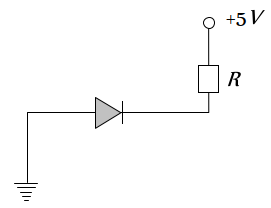
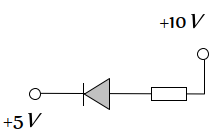
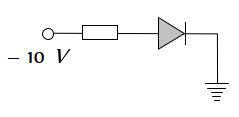
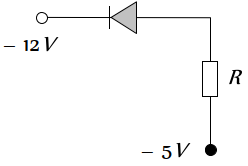
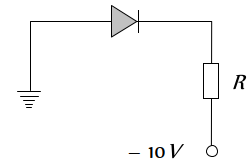
- 6View SolutionIn the given figure, which of the diodes are forward biased ?
- 7In the depletion region of an unbiased $P-N$ junction diode there areView Solution
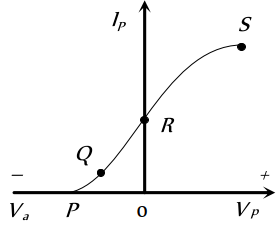
- 8View SolutionThe point representing the cut off grid voltage on the mutual characteristic of triode is
- 9The grid voltage of any triode valve is changed from $-1$ volt to $-3$ volt and the mutual conductance is $3 \times 10^{-4} mho$. The change in plate circuit current will beView Solution
- 10A semiconductor is cooled from $T_1 K$ to $T_2 K$. Its resistanceView Solution