Question

Cathode rays are similar to visible light rays in that

(a) They both can be deflected by electric and magnetic fields

(b) They both have a definite magnitude of wavelength

(b) They both have a definite magnitude of wavelength

(d) They both can expose a photographic plate

Answer

(d) They both can expose a photographic plate

Need a full question paper?

Generate a complete, print-ready paper with questions like this in minutes — across 16+ boards, with answer keys.

Start Generating Free

Similar questions

Two thin wire rings each having a radius R are placed at  a distance d apart with their axes coinciding. The charges on the two rings are +q  and -q. The potential difference between the centres of the two rings is

(a) Zero  

(b)

(c)

(d)

The heat developed in an electric wire of resistance R by a current I for a time t is

(a)   

(b)

(c)

(d)

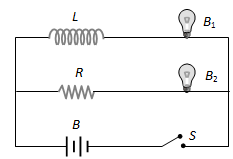
An inductor, L a resistance R and two identical bulbs, and    are connected to a battery through a switch S as shown in the figure. The resistance R is the same as that of the coil that makes L. Which of the following statements gives the correct description of the happenings when the switch S is closed

(a) The bulb B2 lights up earlier than B1 and finally both the bulbs shine equally bright

(b) B1 light up earlier and finally both the bulbs acquire equal brightness

(c) B2 lights up earlier and finally B1 shines brighter than B2

(d) B1 and B2 light up together with equal brightness all the time

_________ Charge is produced by friction.
According to the quantum theory of light, the energy of light is carried in discrete units called:
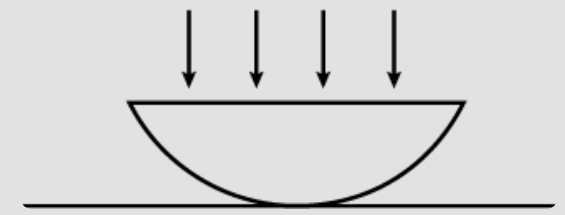
A thin slice is cut out of a glass cylinder along a plane parallel to its axis. The slice is placed on a flat glass plae as shown in figure. The observed interference fringes from this combination shall be:

A parallel plate capacitor has an electric field of   between the plates. If the charge on the capacitor plate is 1μC, the force on each capacitor plate is

(a) 0.5 N

(b) 0.05 N

(c) 0.005 N

(d) None of these

An eye specialist prescribes spectacles having a combination of convex lens of focal length 40 cm in contact with a concave lens of focal length 25 cm. The power of this lens combination in diopters is

(a) + 1.5

(b) – 1.5

(c) + 6.67

(d) – 6.67

Why high temperature is required for Nuclear fusion?
 For television broadcasting the frequency employed is normally: