MCQ
Cathode rays are similar to visible light rays in that
  • A
    They both can be deflected by electric and magnetic fields
  • B
    They both have a definite magnitude of wavelength
  • C
    They both can ionise a gas through which they pass
  • They both can expose a photographic plate
Answer

Correct option: D.
They both can expose a photographic plate
d
(d)Light consists of photons and cathode rays consists of electrons. However both effect the photographic plate.

Need a full question paper?

Generate a complete, print-ready paper with questions like this in minutes — across 16+ boards, with answer keys.

Start Generating Free

Similar questions

The intensity of the electric field required to keep a water drop of radius $10^{-5}$ Cm just suspended in air when charged with one electron is approximately (g = 10 newton/kg e = $1.6\times 10^{-19}$ coulomb) 
A cylindrical conductor has uniform cross-section. Resistivity of its material increase linearly from left end to right end. If a constant current is flowing through it and at a section distance x from left end, magnitude of electric field intensity is E, which of the following graphs is correct
A hollow metallic sphere of radius $R$ is given a charge $Q$. Then the potential at the centre is
In a medium the speed of light wave decreases to $0.2$ times to its speed in free space The ratio of relative permittivity to the refractive index of the medium is $x: 1$. The value of $x$ is $...........$ (Given speed of light in free space $=3 \times 10^8 m s ^{-1}$ and for the given medium $\mu_{ r }=1$ )
A loop is moulded by a constant length current carrying wire and placed in external magnetic field, then torque acts on it does not depends upon

$(a)$ Shape of loop

$(b)$ Area of loop.

$(c)$ Current in loop

$(d)$ External magnetic field.


In electrolytes, the mobile charges are:
A cell of emf $6\, V$ and resistance $0.5\, ohm$ is short circuited. The current in the cell is ............... $amp$
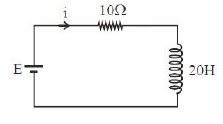
A $20\, Henry$ inductor coil is connected to a $10\, ohm$ resistance in series as shown in figure. The time at which rate of dissipation of energy (Joule’s heat) across resistance is equal to the rate at which magnetic energy is stored in the inductor, is
The acceleration of the moon just before it strikes the earth in the previous question is:
Two metal spheres, one of radus $R$ and the other of radius $2 R$ respectively have the same surface charge density $\sigma$. They are brought in contact and separated. What will be the new surface charge densities on them?