Question
Cathode rays constitute a stream of:
  1. Electrons.
  2. Protons.
  3. Positive ions.
  4. Negative ions.

Answer

  1. Electrons.
Explanation:

Cathode rays consist of a stream of fast moving electrons.

Need a full question paper?

Generate a complete, print-ready paper with questions like this in minutes — across 16+ boards, with answer keys.
Start Generating Free

Similar questions

Read the passage given below and answer the following questions from 1 to 5.Following are properties of vectors
a) Two vectors A and B are said to be equal if, and only if, they have the same magnitude and the same direction.
b) Multiplying a vector A with a positive number λ gives a vector whose magnitude is changed by the factor λ but the direction is the same as that of A:
$|\ \lambda\text{ A }|=\lambda\text{ A }|$
c) The null vector also results when we multiply a vector A by the number zero. Properties of 0 are
A + 0 = A
λ 0 = 0
0 A = 0
d) Subtraction of vectors can be defined in terms of addition of vectors. We define the difference of two vectors A and B as the sum of two vectors A and –B :
A – B = A + (–B).
  1. Two vectors A and B are said to be equal if:
  1. they have the same magnitude
  2. they have the same direction
  3. they have the same magnitude and the same direction
  4. None of these
  1. Multiplying a vector A with a positive number will impact:
  1. Change in magnitude
  2. Change in direction
  3. Change in both magnitude and the same direction
  4. None of these
  1. What is null vector?
  1. How we can perform subtraction of two vectors?
  1. Enlist any 4 properties of vectors.
A ladder is resting with one end on a vertical wall and the other end on a horizontal floor. Is it more likely to slip when a man stands near the bottom or near the top?
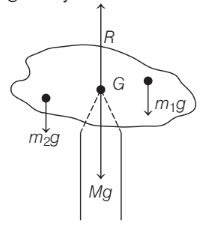
Read the passage given below and answer the following questions from 1 to 5. Torque and Centre of Gravity Torque is also known as moment of force or couple. When a force acts on a particle, the particle does not merely move in the direction of the force but it also turns about some point. So, we can define the torque for a particle about a point as the vector product of position vector of the point where the force acts and with the force itself. In the given figure, balancing of a cardboard on the tip of a pencil is done. The point of support, G is the centre of gravity.
  1. If the $F_{net, ext} $is zero on the cardboard, it means:
  1. $R = Mg$
  2. $m_1g = Mg$
  3. $m_2g = Mg$
  4. $ \text{R}=\frac{\text{m}_1}{\text{g}}$
  1. Choose the correct option.
  1. $\tau \text{Mg about CG =0}$
  2. $\tau \text{Rabout CG =0}$
  3. Net $\tau$ due to $m_1 g, m_2 g...., m_ng$ about $CG = 0$
  4. All of the above
  1. The centre of gravity and the centre of mass of a body coincide, when:
  1. g is negligible
  2. g is variable
  3. g is constant
  4. g is zero
  1. If value of g varies, the centre of gravity and the centre of mass will:
  1. coincide
  2. not coincide
  3. become same physical quantities
  4. None of the above
  1. A body lying in a gravitational field is in stable equilibrium, if:
  1. vertical line through CG passes from top
  2. horizontal line through CG passes from top
  3. vertical line through CG passes from base
  4. horizontal line through CG passes from base
A child has near point at 10cm. What is the maximum angular magnification the child can have with a convex lens of focal length 10cm?
You are holding a cage containing a bird. Do you have to make less effort if the bird flies from its position in the cage and manages to stay in the middle without touching the walls of the cage? Does it make a difference whether the cage is completely closed or it has rods to let air pass?
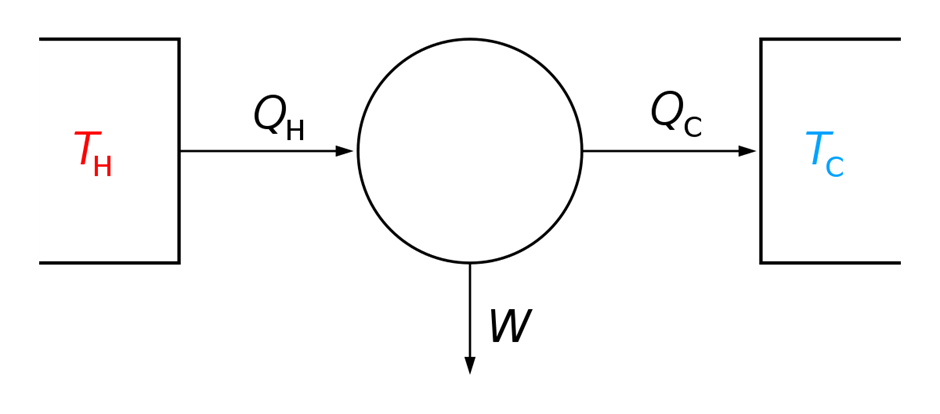
Read the passage given below and answer the following questions from (i) to (v) Carnot principles are only for the cyclical devices like heat engines, which state that the efficiency of an irreversible heat engine is always less than the efficiency of a reversible one operating between the same two reservoirs. The efficiencies of all reversible heat engines operating between the same two reservoirs are the same.
  1. In a Carnot cycle, the working medium rejects heat at a ________ temperature.
    1. Higher
    2. Lower
    3. constant
    4. none of these
  2. Which of the following is NOT a state variable?
    1. work
    2. internal energy.
    3. entropy
    4. all of the above
  3. The efficiency of reversible heat engine is:
    1. $1 +(T_2/T_1)$
    2. $(T_1/T_2)+1$
    3. $(T_1 /T_2)- 1$
    4. $1 - (T_2 / T_1)$
  4. Other factors remaining constant, if the temperature of the source is increased, the efficiency of the Carnot engine will:
    1. decrease
    2. increase
    3. constant
    4. increase or decrease depending upon temperature ratio
  5. Over the complete Carnot cycle, entropy:
    1. increase
    2. decrease
    3. constant
    4. first increase and then decrease
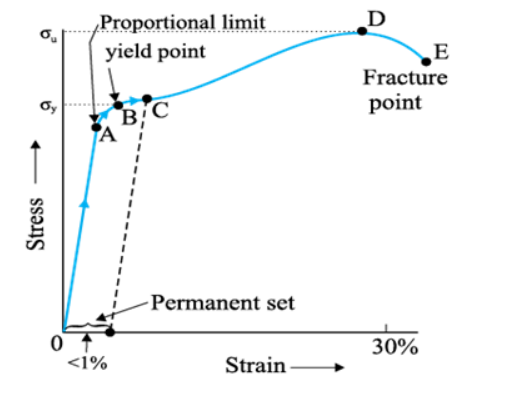
Read the passage given below and answer the following questions from 1 to 5. For small deformations within elastic limit the stress and strain are proportional to each other. This is known as Hooke’s law. Thus, stress α strain Stress = k × strain Where k is the proportionality constant and is known as modulus of elasticity. Hooke’s law is an empirical law and is found to be valid for most materials. However, there are some materials which do not exhibit this linear relationship.

 In the region from A to B, stress and strain are not proportional. Nevertheless, the body still returns to its original dimension when the load is removed. The point B in the curve is known as yield point (also known as elastic limit) and the corresponding stress is known as yield strength $(\sigma _y)$ of the material. If the load is increased further, the stress developed exceeds the yield strength and strain increases rapidly even for a small change in the stress. The portion of the curve between B and D shows this. When the load is removed, say at some point C between B and D, the body does not regain its original dimension. In this case, even when the stress is zero, the strain is not zero. The material is said to have a permanent set. The deformation is said to be plastic deformation. The point D on the graph is the ultimate tensile strength $(\sigma _u)$ of the material. Beyond this point, additional strain is produced even by a reduced applied force and fracture occurs at point E. If the ultimate strength and fracture points D and E are close, the material is said to be brittle. If they are far apart, the material is said to be ductile.
  1. Stress is directly proportional to strain this is valid:
  1. Above elastic limit
  2. Within elastic limit
  3. Above plastic limit
  4. None of these
  1. SI unit of modulus of elasticity is:
  1. $N/m^2$
  2. N
  3. No unit
  4. None of these
  1. Define modulus of elasticity.
  1. State hooks law.
  1. Write note on stress strain curve for ductile material.
The power delivered in the plate circular of a diode is 1.0W when the plate voltage is 36V. Find the power delivered if the plate voltage is increased to 49V. Assume Langmuir-Child equation to hold.