$C{H_3}CN\xrightarrow{{Na + {C_2}{H_5}OH}}X$ The compound $X$ is
Medium


Download our appand get started for free
Experience the future of education. Simply download our apps or reach out to us for more information. Let's shape the future of learning together!No signup needed.*
Similar Questions
- 1View SolutionA nitrogen containing organic compound gave an oily liquid on heating with bromine and potassium hydroxide solution. On shaking the product with acetic anhydride, an antipyretic drug was obtained. The reactions indicate that the starting compound is
- 2View SolutionWhich of the following does not reduce Tollen’s reagent
- 3View SolutionAniline is usually purified by
- 4(image) $\xrightarrow{{\begin{array}{*{20}{c}}View Solution
{AlC{l_3} + C{H_3} - C - Cl} \\
{\,\,\,\,\,\,\,\,\,\,\,\,\,\,\,\,\,\,\,\,\,\,||\,\,\,} \\
{\,\,\,\,\,\,\,\,\,\,\,\,\,\,\,\,\,\,\,\,\,\,O\,\,\,}
\end{array}}}$ major product
- 5The decreasing order of reactivity of $m-$ nitrobromobenzene $(I), 2, 4, 6-$ trinitrobromo-benzene $(II), p-$ nitrobromobenzene $(III)$, and $2,4-$ dinitrobromobenzene $(IV),$ towards $OH^-$ ions isView Solution
- 6View SolutionWhich of the following is capable of forming a zwitter ion
- 7Product $(A)$ isView Solution

- 8View SolutionThe unshared pair of electrons on a cyanide ion can acts as
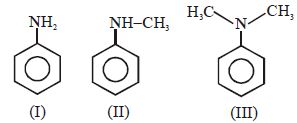
- 9View SolutionWhich of the following is correct order for basic strength
- 10Following is a confirmatory test for aromatic primary amines. Identify reagent $(A)$ and $(B)$View Solution
