The capacitance of a parallel plate capacitor is $5\, \mu F$ . When a glass slab of thickness equal to the separation between the plates is introduced between the plates, the potential difference reduces to $1/8$ of the original value. The dielectric constant of glass is
Easy


Download our appand get started for free
Experience the future of education. Simply download our apps or reach out to us for more information. Let's shape the future of learning together!No signup needed.*
Similar Questions
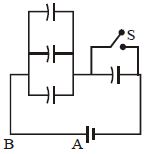
- 1Four capacitors of capacitance $10\,mF$ and a battery of $200\,V$ are arranged as shown. How much charge will flow through $AB$ after the switch $S$ is closed .....$\mu C$View Solution
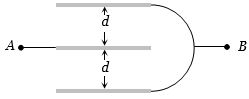
- 2Three plates of common surface area $A$ are connected as shown. The effective capacitance will beView Solution
- 3What is the potential energy of the equal positive point charges of $1\,\mu C$ each held $1\, m$ apart in airView Solution
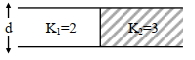
- 4A capacitor of $10 \mu \mathrm{F}$ capacitance whose plates are separated by $10 \mathrm{~mm}$ through air and each plate has area $4 \mathrm{~cm}^2$ is now filled equally with two dielectric media of $\mathrm{K}_1=2, \mathrm{~K}_2=3$ respectively as shown in figure. If new force between the plates is $8 \mathrm{~N}$. The supply voltage is . . . .. . .V.View Solution
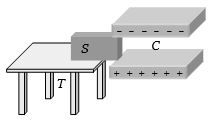
- 5A frictionless dielectric plate $S$ is kept on a frictionless table $T$. A charged parallel plate capacitance $C$ (of which the plates are frictionless) is kept near it. The plate $S$ is between the plates. When the plate $S$ is left between the platesView Solution
- 6The potential at a point $x$ (measured in $μ\ m$) due to some charges situated on the $ x$-axis is given by $V(x)$ =$\frac{{20}}{{{x^2} - 4}}$ $volt$ The electric field $E$ at $x = 4\ μ m$ is given byView Solution
- 7If identical charges $( - q)$ are placed at each corner of a cube of side $b$, then electric potential energy of charge $( + q)$ which is placed at centre of the cube will beView Solution
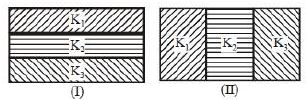
- 8Two identical parallel plate capacitors, of capacitance $C$ each, have plates of area $A$, separated by a distance $d$. The space between the plates of the two capacitors, is filled with three dielectrics, of equal thickness and dielectric constants $K_1$ , $K_2$ and $K_3$ . The first capacitor is filled as shown in fig. $I$, and the second one is filled as shown in fig. $II$. If these two modified capacitors are charged by the same potential $V$, the ratio of the energy stored in the two, would be ( $E_1$ refers to capacitor $(I)$ and $E_2$ to capacitor $(II)$)View Solution
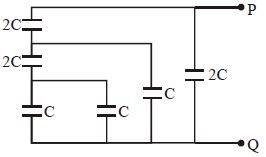
- 9The value of equivalent capacitance of the combination shown in figure, between points $P$ and $Q$ isView Solution
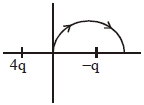
- 10A two point charges $4 q$ and $-q$ are fixed on the $x-$axis at $x=-\frac{d}{2}$ and $x=\frac{d}{2},$ respectively. If a third point charge $'q'$ is taken from the origin to $x = d$ along the semicircle as shown in the figure, the energy of the charge willView Solution