Two parallel plate capacitors $C_1$ and $C_2$ each having capacitance of $10 \mu F$ are individually charged by a $100\,V$ $D.C.$ source. Capacitor $C _1$ is kept connected to the source and a dielectric slab is inserted between it plates. Capacitor $C _2$ is disconnected from the source and then a dielectric slab is inserted in it. Afterwards the capacitor $C_1$ is also disconnected from the source and the two capacitors are finally connected in parallel combination. The common potential of the combination will be $.........V.$ (Assuming Dielectric constant $=10$ )
JEE MAIN 2023, Diffcult
Download our app for free and get started

Download our appand get started for free
Experience the future of education. Simply download our apps or reach out to us for more information. Let's shape the future of learning together!No signup needed.*
Similar Questions
- 1Consider a sphere of radius $R$ having charge $q$ uniformly distributed inside it. At what minimum distance from its surface the electric potential is half of the electric potential at its centre?View Solution
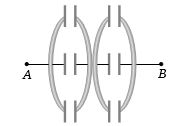
- 2All six capacitors shown are identical, Each can withstand maximum $200\, volts$ between its terminals. The maximum voltage that can be safely applied between $A$ and $B$ is.....$V$View Solution
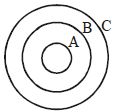
- 3Charges $Q, 2Q$ and $-Q$ are given to three concentric conducting shells $A, B$ and $C$ respectively as shown the ratio of charges on inner and outer surfaces of shell $C$ will beView Solution
- 4A condenser of capacitance $10\,\mu F$ has been charged to $100\,volts$. It is now connected to another uncharged condenser in parallel. The common potential becomes $40\,volts$. The capacitance of another condenser is......$\mu F$View Solution
- 5A $500\,\mu F$ capacitor is charged at a steady rate of $100\, \mu C/sec$. The potential difference across the capacitor will be $10\, V$ after an interval of.....$sec$View Solution
- 6If an $\alpha$-particle and a proton are accelerated from rest by a potential difference of 1 megavolt then the ratio of their kinetic energy will beView Solution
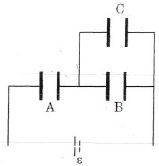
- 7Three capacitors $A,B$ and $C$ are connected with battery $emf\, \varepsilon $. All capacitors are identical initially. If dielectric slab is inserted between plates of capacitor $A$ slowy with help of external force thenView Solution
- 8In space of horizontal $EF$ ($E = (mg)/q$) exist as shown in figure and a mass $m$ attached at the end of a light rod. If mass $m$ is released from the position shown in figure find the angular velocity of the rod when it passes through the bottom most positionView Solution

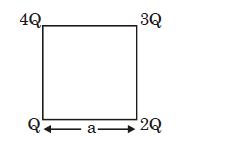
- 9View SolutionElectrostatic potential energy of given system will be
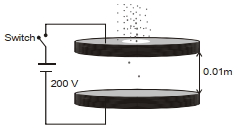
- 10Two large circular discs separated by a distance of $0.01 m$ are connected to a battery via a switch as shown in the figure. Charged oil drops of density $900 kg m ^{-3}$ are released through a tiny hole at the center of the top disc. Once some oil drops achieve terminal velocity, the switch is closed to apply a voltage of $200 V$ across the discs. As a result, an oil drop of radius $8 \times 10^{-7} m$ stops moving vertically and floats between the discs. The number of electrons present in this oil drop is (neglect the buoyancy force, take acceleration due to gravity $=10 ms ^{-2}$ and charge on an electron ($e$) $=1.6 \times 10^{-19} C$ )View Solution