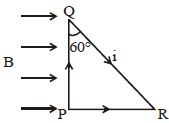
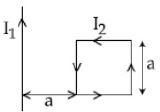
For the circuit shown in figure, the direction and magnitude of the force on $PQR$ is :-
Easy


Download our appand get started for free
Experience the future of education. Simply download our apps or reach out to us for more information. Let's shape the future of learning together!No signup needed.*
Similar Questions
- 1Two charged particles, having same kinetic energy, are allowed to pass through a uniform magnetic field perpendicular to the direction of motion. If the ratio of radii of their circular paths is $6: 5$ and their respective masses ratio is $9: 4$. Then, the ratio of their charges will be.View Solution
- 2A galvanometer of $25 \,\Omega$ resistance can read a maximum current of $6\,mA$. It can be used as a voltmeter to measure a maximum of $6\, V$ by connecting a resistance to the galvanometer. Identify the correct choice in the given answersView Solution
- 3Consider the two idealised systems $(i)$ a parallel plate capacitor with large plates and small separation and $(ii)$ a long solenoid of length $L >> R$, radius of cross-section. In $(i)\, E$ ideally treated as a constant between plates and zero outside. In $(ii)$ magnetic field is constant inside the solenoid and zero outside. These idealised assumptions, however, contradict fundamental laws as belowView Solution
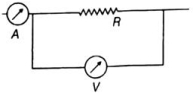
- 4In the adjoining circuit diagram, the readings of ammeter and voltmeter are $2\, A$ and $120 \,V$, respectively. If the value of $R$ is $75\, \Omega$, then the voltmeter resistance will be $\Omega$View Solution
- 5A uniform conducting wire of length is $24 {a}$, and resistance ${R}$ is wound up as a current carrying coil in the shape of an equilateral triangle of side $'a'$ and then in the form of a square of side $'a'.$ The coil is connected to a voltage source ${V}_{0}$. The ratio of magnetic moment of the coils in case of equilateral triangle to that for square is $1: \sqrt{y}$ where $y$ is ..... .View Solution
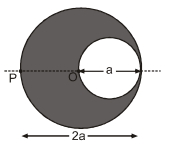
- 6A cylindrical cavity of diameter a exists inside a cylinder of diameter $2$a shown in the figure. Both the cylinder and the cavity are infinitely long. A uniform current density $J$ flows along the length. If the magnitude of the magnetic field at the point $P$ is given by $\frac{N}{12} \mu_0$ aJ, then the value of $N$ is :View Solution
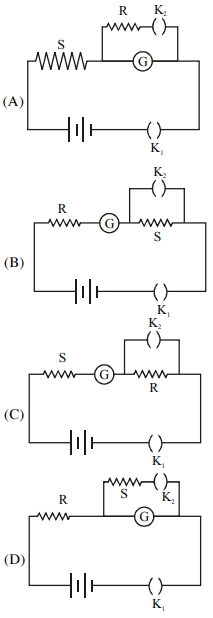
- 7In the circuit diagrams $(A, B, C$ and $D$) shown below, $R$ is a high resistance and $S$ is a resistance of the order of galvanometer resistance $G$. The correct circuit, corresponding to the half deflection method for finding the resistance and figure of merit of the galvanometer, is the circuit labelled asView Solution
- 8A rigid square loop of side $a$ and carrying current $I_2$ is laying on a horizontal surface near a long current $I_1$ wire in the same plane as shown in figure. The net force on the loop due to the wire will beView Solution
- 9View SolutionIf a charged particle goes unaccelerated in a region containing electric and magnetic fields
- 10View SolutionWhich of the following statements regarding magnetic lines of force is correct?