A particle of mass $m$ and charge $q$ moves with a constant velocity $v$ along the positive $x$ direction. It enters a region containing a uniform magnetic field $B$ directed along the negative $z$ direction, extending from $x = a$ to $x = b$. The minimum value of $v$ required so that the particle can just enter the region $x > b$ is
Medium
Download our app for free and get started
The radius $r$ of the circular path is given by (see Fig.)
$\frac{\mathrm{mv}^{2}}{\mathrm{r}}=\mathrm{qvB}$
or $v=\frac{q B}{m}(r)$
$\therefore \mathrm{v}_{\min }=\frac{\mathrm{qB}}{\mathrm{m}}\left(\mathrm{r}_{\min }\right)=\frac{\mathrm{qB}}{\mathrm{m}}(\mathrm{b}-\mathrm{a})$
which is choice $( 2)$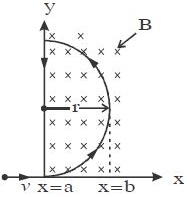

Download our appand get started for free
Experience the future of education. Simply download our apps or reach out to us for more information. Let's shape the future of learning together!No signup needed.*
Similar Questions
- 1A long solenoid of radius $2\, cm$ has $100\, turns/cm$ and carries a current of $5\,A$. A coil of radius $1\, cm$ having $100\, turns$ and a total resistance of $20\,\Omega $ is placed inside the solenoid coaxially. The coil is connected to a galvanometer. If the current in the solenoid is reversed in direction, find the charge flown through the galvanometerView Solution
- 2The cyclotron frequency of an electron gyrating in a magnetic field of $1\, T$ is approximatelyView Solution
- 3A current loop consists of two identical semicircular parts each of radius $R,$ one lying in the $x-y$ plane and the other in $x-z$ plane. If the current in the loop is $i.$ The resultant magnetic field due to the two semicircular parts at their common centre isView Solution
- 4A moving coil galvanometer has resistance $50\,\Omega $ and it indicates full deflection at $4\,mA$ current. A voltmeter is made using this galvanometer and a $5\,k\Omega $ resistance. The maximum voltage, that can be measured using this voltamenter, will be close to ......$V$View Solution
- 5A particle of specific charge $(q/m)$ is projected from the origin of coordinates with initial velocity $[ui - vj]$. Uniform electric magnetic fields exist in the region along the $+y$ direction, of magnitude $E$ and $B.$ The particle will definitely return to the origin once ifView Solution
- 6An infinitely long wire, located on the $z$-axis, carries a current $/$ along the $+z$-direction and produces the magnetic field $\vec{B}$. The magnitude of the line integral $\int \vec{B} \cdot d l$ along a straight line from the point $(-\sqrt{3} a, a, 0)$ to $(a, a, 0)$ is given by [ $\mu_0$ is the magnetic permeability of free space.]View Solution
- 7View SolutionTwo wires of same length are shaped into a square and a circle. If they carry same current, ratio of the magnetic moment is
- 8A galvanometer of resistance, $G,$ is shunted by a resistance $S$ $ohm$. To keep the main current in the circuit unchanged, the resistance to be put in series with the galvanometer isView Solution
- 9View SolutionIf we double the radius of a coil keeping the current through it unchanged, then the magnetic field at any point at a large distance from the centre becomes approximately
- 10A current of $200\ \mu \mathrm{A}$ deflects the coil of a moving coil galvanometer through $60^{\circ}$. The current to cause deflection through $\frac{\pi}{10}$ radian is:View Solution