Question
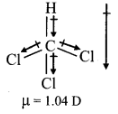
$CHCl_3$ is polar Explain.

Answer

In $CHCl_3,$ the dipoles are not equal and do not cancel each other. Hence, $CHCl_3$ is polar with a non$-$zero dipole moment.
Image
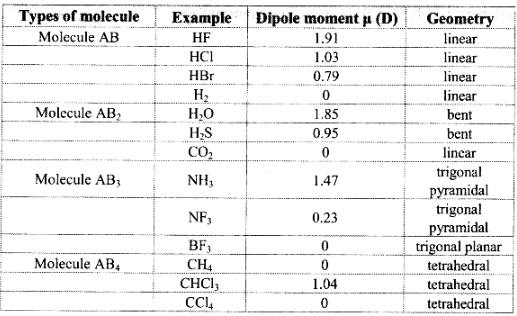
Note: Dipole moments and geometry of some molecules are given in the following table:
Image

Need a full question paper?

Generate a complete, print-ready paper with questions like this in minutes — across 16+ boards, with answer keys.
Start Generating Free

Similar questions

How are the saturated $\left( sp ^3\right)$ carbon atoms in a molecule classified based on the number of other carbon atoms bonded to it? Give an example that has all the four types of carbon atoms.
Explain the following steps with respect to the process of crystallization.
i. Preparation of a saturated solution
ii. Hot filtration
iii. Cooling of the filtrate
iv. Filtration
An inorganic compound contained 24.75% potassium and 34.75% manganese and some other common elements. Give the empirical formula of the compound. (K = 39 u, Mn = 54.9 u, O = 16 u)
Urea $[(NH_2)_2CO]$ is prepared by reacting ammonia with carbon dioxide.
$2NH_{3(g)} + CO_{2(g)} \rightarrow (NH_2)_2CO_{(aq)} + H_2O_{(l)}$
In one process, $637.2 g \ of \ NH_3$ are treated with $1142 g \ of \ CO_2.$
$i.$ Which of the two reactants is the limiting reagent?
$ii.$ Calculate the mass of $(NH_2)_2CO$ formed.
$iii.$ How much excess reagent (in grams) is left at the end of the reaction?
Give a basic idea about IUPAC nomenclature system and comment on IUPAC names of straight chain alkanes.
Explain with the help of a diagram how accuracy depends upon the sensitivity or least count of the measuring equipment.
Describe inductive effect in detail.
Predict the block, periods and groups to which the following elements belong.
$i. Mg (Z = 12) \ \ ii. V (Z = 23) \ \ iii. Sb (Z = 51) \ \ iv. Rn (Z = 86) \ \ v. Na (Z = 11) \ \ vi. Cl (Z = 17)$
What is chromatography? Explain the principle behind it.
