Question
Describe inductive effect in detail.

Answer

Inductive effect:
$i.$ When an organic molecule has a polar covalent bond in its structure, polarity is induced in adjacent carbon$-$ carbon single bonds too. This effect is called as inductive effect.
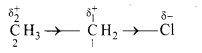
$ii.$ For example, in chloroethane molecule, the covalent bond between $‘C \ ’$ and $‘Cl \ ’$ is a polar covalent bond whereas $C-2$ and $C-1$ bond $(C-C$ bond$)$ is expected to be nonpolar covalent bond. But, this bond acquires some polarity as chlorine is more electronegative than carbon. Chlorine pulls the bonding pair of electrons towards itself. Thus, the chlorine atom acquires a fractional negative charge, while the $C-1$ carbon atom acquires a fractional positive charge. As $C-1$ is further bonded to $C-2,$ the positive polarity of $C-1$ pulls the shared pair of electrons of the $C-2 – C-l$ bond more towards itself. As a result, a smaller positive charge is developed on $C-2.$ Thus, the electron density gets displaced towards the chlorine atom not only along the $[C-1 – Cl]$ bond, but also along the $[C-2 – C-1]$ bond due to the inductive effect of $Cl.$ This is represented as follows:
Image
$iii.$ The arrow head shown in the centre of the bond represents inductive effect. The direction of the arrow head indicates the direction of the permanent electron displacement along the sigma bond in the ground state.
$iv.$ The inductive effect of an influencing group is transmitted along a chain of $C-C$ bonds. However, this effect decreases rapidly with the increase in the number of intervening $C-C$ single bonds and it becomes negligible beyond three $C-C$ bonds.
$CH _3-\stackrel{\delta_3^{+}}{ C } H _2 \rightarrow-\stackrel{\delta_2^{+}}{ C } H _2 \rightarrow-\stackrel{\delta_1^{+}}{ C } H _2 \rightarrow-\stackrel{\delta-}{ a }$ Where, $\delta_1^{-}>\delta_2^{-}>\delta_3^{-}$
$v.$ The direction of the inductive effect of a bonded group depends upon whether electron density of the bond is withdrawn from the bonded carbon or donated by the bonded carbon. On the basis of this ability, the groups/substituents are classified as either electron withdrawing $($accepting$)$ or electron donating $($releasing$)$ groups with respect to hydrogen.
e.g. In chloroethane, $Cl$ withdraws electron density from the carbon chain and is electron withdrawing. Therefore, chlorine is said to exert an electron withdrawing inductive effect or negative inductive effect $(-I$ effect$)$ on the carbon chain.
$vi. \ a.$ Substituents or groups that shows $-I$ effect $: -Cl, -NO_2, -CN, -COOH, -COOR, -OAr,$ etc.
$b.$ Substituents or groups that shows $+I$ effect: Alkyl groups such as $-CH_3, -CH_2CH_3,$ etc.

Need a full question paper?

Generate a complete, print-ready paper with questions like this in minutes — across 16+ boards, with answer keys.

Start Generating Free

Similar questions

Urea $[(NH_2)_2CO]$ is prepared by reacting ammonia with carbon dioxide.
$2NH_{3(g)} + CO_{2(g)} \rightarrow (NH_2)_2CO_{(aq)} + H_2O_{(l)}$
In one process, $637.2 g \ of \ NH_3$ are treated with $1142 g \ of \ CO_2.$
$i.$ Which of the two reactants is the limiting reagent?
$ii.$ Calculate the mass of $(NH_2)_2CO$ formed.
$iii.$ How much excess reagent (in grams) is left at the end of the reaction?
Explain the calculation of the formal charge on oxygen atoms in case of $O_3 ($ozone$)$ molecule.
Explain in brief: Nuclear reactor
Give IUPAC rules for naming substituted benzene.
In a chemical laboratory, Priyal was asked to isolate an organic compound from its aqueous solution. She added ethyl acetate to the given sample, separated the organic layer and kept it for evaporation. At the end of her practical, Priyal found few crystals in the beaker which she kept for evaporation. Answer the following questions:
i. In the above passage, which method was used by Priyal for separation? State its principle.
ii. Why do you think the organic compound dissolved in ethyl acetate?
iii. Illustrate the method of separation used in the passage with an example.
Explain in brief: Use of graphs in analytical chemistry.
Explain with the help of a diagram how accuracy depends upon the sensitivity or least count of the measuring equipment.
Explain hyperconjugation in propene.
Describe the process of thin layer chromatography (TLC) and separation of components in it.
Explain cleansing mechanism of soaps and detergents.