Question
Check whether $6^{ n }$ can end with the digit ' 0 '(zero) for any natural number n .

Answer

$6^n$$
\Rightarrow \quad(2 \times 3)^n
$
It can be observed that 5 is not in the prime factorisation of 6 . Hence for any value of $n, 6^n$ will not be divisible by 5 .
$\therefore 6^{ n }$ cannot end with 0 for any natural no. $n$.

Need a full question paper?

Generate a complete, print-ready paper with questions like this in minutes — across 16+ boards, with answer keys.
Start Generating Free

Similar questions

In a class, there are 18 girls and 16 boys. The class teacher wants to choose one pupil for class monitor. What she does, she writes the name of each pupil on a card and puts them into a basket and mixes thoroughly. A child is asked to pick one card from the basket. What is the probability that the name written on the card is:
  1. The name of a girl.
  2. The name of a boy.
For what values of p are the roots of the equation $4x^2 + px + 3 = 0$ real and equal?
Prove the trigonometric identity: $\frac{1+\cos \theta-\sin ^2 \theta}{\sin \theta(1+\cos \theta)}=\cot \theta$
In a lottery there are 10 prizes and 25 blanks. What is the probability of getting a prize?
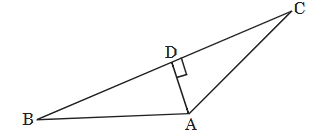
In figure, if $AD \perp BC,$ then prove that $AB ^2+ CD ^2= BD ^2+ AC ^2$.
Image
Write down the decimal expansions of the following rational numbers by writing their denominators in the form $2^m \times 5^n,$ where, m, n are non-negative integers.
$\frac{14588}{625}$
In $\triangle ABC , D$ and $E$ are the points on the sides AB and AC respectively such that DE||BC. If AD = 6x - 7, DB = 4x - 3, AE = 3x - 3 and EC = 2x - 1, find the value of x.
If A + B = 90° and $\tan\text{A}=\frac{3}{4},$ what is cot B?

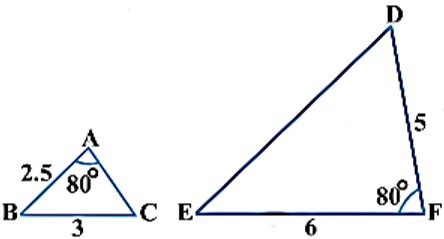
State the pair of triangles in the figure below are similar. Write the similarity criterion used by you for answering the question and also write the pair of similar triangles in the symbolic form:
Image

In a $\triangle\text{ABC}$ right angled at B, $\angle\text{A}=\angle\text{C.}$ Find the values of.
$\sin\text{A}\cos\text{C}+\cos\text{A}\sin\text{C}$