Questions

2 Marks Questions

🎯

Test yourself on this topic

17 questions · timed · auto-graded

Question 12 Marks
Given that $\sqrt{2}$ is irrational, prove that $(5+3 \sqrt{2})$ is an irrational number.
Answer
Suppose $(5+3 \sqrt{2})=\frac{p}{q}$Now assume $(5+3 \sqrt{2})$ is a rational number.
Therefore $p$ and $q$ should be co$-$prime numbers.
$(5+3 \sqrt{2})=\frac{p}{q}$
$\Rightarrow \frac{p}{q}-5=3 \sqrt{2}$
$\Rightarrow \frac{p}{3 q}-\frac{5}{3}=\sqrt{2}$
$\Rightarrow \frac{p-5}{3 q}=\sqrt{2}$
Since $\sqrt{2}$ is irrational number.
Thus the assumption is incorrect and hence $(5+3 \sqrt{2})$ is an irrational number.
Hence proved.
View full question & answer
Question 22 Marks
Find how many integers between $200$ and $500$ are divisible by $8.$
Answer
The first number that is divisible by $8$ between $200$ and $500$ is $208$ and the last number that is divisible by $8$ are $496.$
So, the sequence will be $208,216,224.....496.$
Common difference $d=8$
First term $a=208$
Let there be $n$ terms is the sequence
Using the formula $a_n=a+(n-1) d$
Where $a_n=496, a=208$ and $d=8$$496=208+(n-1)(8)$
$(n-1) 8=288$
$n-1=36$
$n=37$
Hence, between $200$ and $500$ there are $37$ integers that are divisible by $8.$
View full question & answer
Question 32 Marks
Write down the decimal expansion of $\frac{76}{6250}$, without actual division.
Answer
$\frac{76}{6250}=\frac{76}{5^5 \times 2}$Here,
$\frac{76}{6250}$ is in the form of $\frac{ p }{ q }$ and $q$ is in the form of $2^n 5^m$ where $n$ and $m$ are non $-$ negative integers.
Hence $\frac{76}{6250}$ has terminating decimal expression.
Now,
$\frac{76}{6250}=\frac{76}{5^5 \times 2}=\frac{76 \times 2^4}{5^5 \times 2 \times 2^4}=\frac{76 \times 16}{10^5}=\frac{1216}{100000}$
$=0.01216$
Thus the decimal expansion of $\frac{76}{6250}$ is $0.01216 .$
View full question & answer
Question 42 Marks
Express 5050 as product of its prime factors. Is it unique?
Answer
5050 can be factored as,$
5050=2 \times 5 \times 5 \times 101
$
We can write it as $2 \times 5^2 \times 101$
Here all the factors are prime numbers and can be expressed as product of its prime numbers.
So, Yes it is unique.
View full question & answer
Question 52 Marks
Show that $(\sqrt{3}+\sqrt{5})^2$ is an irrational number.
Answer
Let $(\sqrt{3}+\sqrt{5})^2$ is a rational number.
$\Rightarrow(\sqrt{3}+\sqrt{5})^2=\frac{p}{q}$
Where $p, q$ are co$-$prime
Using $(a+b)^2=a^2+b^2+2 a b$ we get,
$(\sqrt{3})^2+(\sqrt{5})+2 \sqrt{3} \sqrt{5}=\frac{p}{q}$
$\Rightarrow 3+5+2 \sqrt{15}=\frac{p}{q}$
$\Rightarrow 8+2 \sqrt{15}=\frac{p}{q}$
$\Rightarrow 2 \sqrt{15}=\frac{p}{q}-8$
$\Rightarrow \sqrt{15}=\frac{1}{2}\left(\frac{p}{q}-8\right)$
$\Rightarrow \sqrt{15}=\left(\frac{p}{2 q}-4\right)$
The $\text{RHS}$ is the difference of two rational numbers.
Therefore $\text{LHS}$ will also be rational.
But we know that $\sqrt{15}$ is irrational.
So our assumption is wrong.
Hence, $(\sqrt{3}+\sqrt{5})^2$ is an irrational number.
View full question & answer
Question 62 Marks
Find the least positive integer which on diminishing by $5$ is exactly divisible by $36$ and $54.$
Answer
Finding the $\text{LCM}$ of $36$ and $54 ,36=2 \times 2 \times 3 \times 3$
$54=2 \times 3 \times 3 \times 3$
$\text { LCM }=2 \times 2 \times 3 \times 3 \times 3=108$
Now it is given that the number is diminished by $5 .$
This means the least positive will be:
$5+(\text { LCM}$ of $36 $ and $54)$
$= 5+108$
$= 113$
Hence, $113$ is the least positive integer which on diminishing by $5$ is exactly divisible by $36$ and $54.$
View full question & answer
Question 72 Marks
Explain why $1 \times 2 \times 3 \times 4 \times 5 \times 6 \times 7+5$ is a composite number?
Answer
We can write $1 \times 2 \times 3 \times 4 \times 5 \times 6 \times 7+5$ as
$\Rightarrow 5(1 \times 2 \times 3 \times 4 \times 6 \times 7+1)$
$=5 \times 1009$
Hence we can say that the given number has at least one factor other than $1$ and number itself.$
\Rightarrow(5,1009,1,5045)$
Therefore $1 \times 2 \times 3 \times 4 \times 5 \times 6 \times 7+5$ is a composite number.
View full question & answer
Question 82 Marks
What can you say about the prime factorization of the denominator of the rational number 0.134 when written in the form $\frac{p}{q}$. Is it of form $2^m \times 5^n$ ? If yes, write the values of $m$ and $n$.
Answer
Let $x =0.134$Now, $100 x=134.134$Subtract eqn (1) from (2) We get,
$999 x=134$
$x=\frac{134}{999}$
$x=\frac{134}{9(111)}$
$x=\frac{134}{3^2(111)}$
The above expression can-not be written as $2^m \times 5^n$.
View full question & answer
Question 92 Marks
Euclid's algorithm, find the HCF of 240 and 228.
Answer
We know, by Euclid's Division Lemma
$a=b q+r, 0 \leq r < b$
Applying Euclid's Lemma,
Step 1 : Since $240>228$, we apply the division lemma to 240 and 228 , to get $240=228 \times 1+12$Step 2 : Since the remainder $12 \neq 0$, we apply the division lemma to 228 and 12 , to get $228=12 \times 19+0$
The remainder has now become zero.
Since the divisor at this stage is 12 , the HCF is 12.
View full question & answer
Question 102 Marks
Prove that $\sqrt{3}+\sqrt{2}$ is irrational.
Answer
Let $\sqrt{3}$ is a rational number.
So, two integers $a$ and $b$ can be found so that $\sqrt{3}=\frac{a}{b}$Assume that a and are co$-$prime.
$\Rightarrow a=\sqrt{3} b$
Squaring both the sides,
$\Rightarrow a^2=3 b^2$
So, $a^2$ is divisible by $3$ and it can be said that a is divisible by $3 .$
Let $a^2=3 c$, where $c$ is an integer.
$a^2=3 b^2$
$\Rightarrow(3 c)^2=3 b^2 \Rightarrow b^2=3 c^2$
So, $b^2$ is divisible by $3$ and it can be said that $b$ is divisible by $3 .$
View full question & answer
Question 112 Marks
Find the smallest positive rational number by which $\frac{1}{7}$ should be multiplied so that its decimal expansion terminates after 2 places of decimal.
Answer
Decimal expansion of a any rational number terminates if the denominator of the rational number is in the form $2^n 5^m$
Let the number multiplied by $\frac{1}{7}$ be $x$,
$\frac{1}{7} \times x=\frac{1}{2^n 5^m}$
$\therefore x=\frac{7}{2^n 5^m}$
Now here when $n=2$ and $m=0$
$x=\frac{7}{2^2 5^0}=\frac{7}{4}$
When $n=0, m=2$
Now if we put $n=2$ and $m=2$,
We have $x=\frac{7}{2^2 5^2}=\frac{7}{100}$
Hence we can see that $\frac{7}{100}$ is smallest possible rational number we multiply by $\frac{1}{7}$ so that the decimal expansion will terminate after 2 decimal places.
View full question & answer
Question 122 Marks
Show that $8^n$ cannot end with the digit zero for any natural number $n$.
Answer
The prime factorization should have 2 and 5 as a common factor for a number to end with the digit zero.
$8^n=(2 \times 2 \times 2)^n$ does not have 5 in its prime factorization.
Hence, $8^n$ cannot end with the digit zero for any natural number $n$.
View full question & answer
Question 132 Marks
Find the $\text{HCF}$ and $\text{LCM}$ of $72$ and $120.$
Answer
The prime factorisation of $72$ and $120$ , respectively, is given by:$72=2 \times 2 \times 2 \times 3 \times 3=2^3 \times 3^2$
$120=2 \times 2 \times 2 \times 3 \times 5=2^3 \times 3^1 \times 5^1$
$\operatorname{LCM}(72,120)=360$
The common prime factors of $72$ and $120$ are $2, 2, 2$ and $3.$
Hence, the $\text{HCF}$ of $72$ and $120$
$=2 \times 2 \times 2 \times 3=24 .$
$\operatorname{HCF}(72,120) =24$
View full question & answer
Question 142 Marks
Show that $6^{ n }$ can not end with digit 0 for any natural number ' $n$ '.
Answer
If any digit has the last digit 10 that means it is divisible by 10 .
The factor of $10=2 \times 5$,
So value of $6^{ n }$ should be divisible by 2 and 5 .
Both $6^{ n }$ is divisible by 2 but not divisible by 5 .
So, it can not end with 0 .
View full question & answer
Question 152 Marks
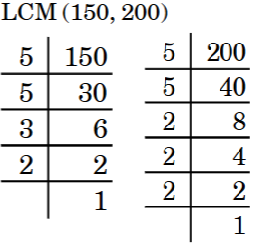
Find the LCM of 150 and 200
Answer
Image
$
\begin{aligned}
150 & =2^1 \times 3^1 \times 5^2 \\
200 & =2^3 \times 5^2 \\
\operatorname{LCM}(150,200) & =2^3 \times 3^1 \times 5^2 \\
& =8 \times 3 \times 25=600
\end{aligned}
$

View full question & answer
Question 162 Marks
Check whether $6^{ n }$ can end with the digit ' 0 '(zero) for any natural number n .
Answer
$6^n$$
\Rightarrow \quad(2 \times 3)^n
$
It can be observed that 5 is not in the prime factorisation of 6 . Hence for any value of $n, 6^n$ will not be divisible by 5 .
$\therefore 6^{ n }$ cannot end with 0 for any natural no. $n$.
View full question & answer
Question 172 Marks
Use Euclid's division algorithm to find the HCF of 255 and 867.
Answer
By using Euclid's division leema$
a=bq+r
$where, $a > b$
So, $a=867$ and $b=255$$
867=255 \times 3+102
$here, $r \neq 0$, Hence, $a=255$ and $b=102$
Now, $255=102 \times 2+51$
Here, $r \neq 0$, Hence, $a=102$ and $b=51$$
102=51 \times 2+0
$
Here, $r =0$
So, $\operatorname{HCF}$ of $(867,251)=51$
View full question & answer
2 Marks Questions - Maths STD 10 Questions - Vidyadip