MCQ
Chemical equations convey quantitative information on the
  • A
    Type of atoms/molecules taking part in the reaction
  • B
    Number of atoms/molecules of the reactants and products involved in the reaction
  • Relative number of moles of reactants and products involved in the reaction
  • D
    Quantity of reactant consumed and quantity of product formed
Answer

Correct option: C.
Relative number of moles of reactants and products involved in the reaction
(c) Chemical reaction quantitatively depend on the reactant and product molecule.

Need a full question paper?

Generate a complete, print-ready paper with questions like this in minutes — across 16+ boards, with answer keys.

Start Generating Free

Similar questions

The enthalpy of the reaction,

${H_2}(g) + \frac{1}{2}{O_2}(g) \to {H_2}O(g)$ is $\Delta {H_1}$ and that of

${H_2}(g) + \frac{1}{2}{O_2}(g) \to {H_2}O(l)$ is $\Delta {H_2}$. Then

The major product $[B]$ in the following sequence of reactions is

$\begin{array}{*{20}{c}}
  {C{H_3} - C = CH - C{H_2}C{H_3}} \\ 
  {|\,\,\,\,\,\,\,\,\,\,\,\,\,\,\,\,\,\,\,\,\,\,\,\,\,\,\,\,\,\,\,\,} \\ 
  {CH{{(C{H_3})}_2}\,\,\,\,\,\,\,\,\,\,} 
\end{array}\xrightarrow[{(ii)\,{H_2}{O_2},O{H^ - }}]{{(i)\,{B_2}{H_6}}}[A]$$\xrightarrow[\Delta ]{{dil.\,{H_2}S{O_4}}}[B]$

The $\Delta H_f^o$ for $C{O_2}(g),\,CO(g)$ and ${H_2}O(g)$ are $-393.5, -110.5$ and $-241.8\,kJ\,mol^{-1}$ respectively. The standard enthalpy change (in $kJ$) for the reaction $C{O_2}(g) + {H_2}(g) \to $ $CO(g) + {H_2}O(g)$ is
Select the molecule which has only one $\pi - {\rm{bond}}$
$4.0\, L$ of an ideal gas is allowed to expand isothermally into vacuum until the total volume is $20\, L.$ The amount of heat absorbed in this expansion is $.....\,L\,atm$
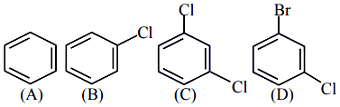
The correct decreasing order of densities of the following compounds is:
In certain matters, lithium differs from other alkali metals, the main reason for this is:
Which of the following is correct $IUPAC$ name
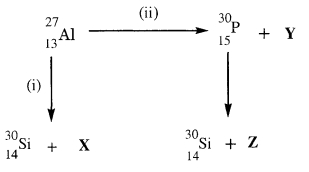
Bombardment of aluminum by $\alpha$-particle leads to its artificial disintegration in two ways, $(i)$ and $(ii)$ as shown. Products ${X},$ ${Y}$ and ${Z}$ respectively are,
The enthalpy change $(\Delta H)$ for the reaction, $N_2 (g) + 3H_2 (g) \to 2NH_3(g)$ is $-92.38\, kJ$ at $298\, K$. The internal energy change $\Delta U$ at $298\, K$ is .............. $\mathrm{kJ}$