Question
Choose the correct alternative $(s)$

Answer

Get the step-by-step solution for this question inside the Vidyadip app.

Get the answer in the app

Need a full question paper?

Generate a complete, print-ready paper with questions like this in minutes — across 16+ boards, with answer keys.
Start Generating Free

Similar questions

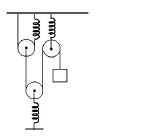
Assuming all pulleys, springs and string massless. Consider all surface smooth. Choose the correct statement $(s)$
The angle between $(\overrightarrow A - \overrightarrow B )$ and $(\overrightarrow A \times \overrightarrow B )$ is $(\overrightarrow{ A } \neq \overrightarrow{ B })$
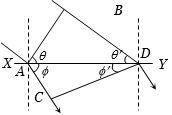
In the adjoining diagram, a wavefront $AB$, moving in air is incident on a plane glass surface $XY$. Its position $CD$ after refraction through a glass slab is shown also along with the normals drawn at $A$ and $D$. The refractive index of glass with respect to air ($\mu = 1$) will be equal to
A train is running at a constant speed of $90 \,km / h$ on a straight track. A person standing at the top of a boggey moves in the direction of motion of the train such that he covers 1 meters on the train each second. The speed of the person with respect to ground is .........
A mixture consists of two radioactive material $A_1$ and $A_2$ with half lives of $20\,s$ and $10\,s$ respectively . Initially the mixture has $40\,g$ of $A_1$ and $160\,g$ of $A_2$ . The amount of the two in the mixture will become equal after..........$sec$
A satellite is launched into a circular orbit of radius $R$ around the earth. A second satellite is launched into an orbit of radius $(1.01)R$. The period of the second satellite is larger than that of the first one by approximately ........... $\%$
Consider two thermometers $T_1$ and $T_2$ of equal length, which can be used to measure temperature over the range $\theta_1$ to $\theta_2$. $T_1$ contains mercury as the thermometric liquid, while $T_2$ contains bromine. The volumes of the two liquids are the same at the temperature $\theta_1$. The volumetric coefficients of expansion of mercury and bromine are $18 \times 10^{-5} \,K ^{-1}$ and $108 \times 10^{-5} \,K ^{-1}$, respectively. The increase in length of each liquid is the same for the same increase in temperature. If the diameters of the capillary tubes of the two thermometers are $d_1$ and $d_2$, respectively. Then, the ratio of $d_1: d_2$ would be closest to
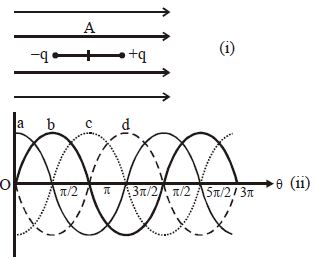
The electric dipole is situated in an electric field as shown in figure. The dipole and electric field vare both in the plane of paper. The dipole is rotated about an axis perpendicular to the paper at point $A$ in anticlockwise direction. If the angle of rotation is measured with respect to the direction of the electric field then the torque for different values of the angle of rotation $\theta $ will be as represented in Fig. $(ii)$
A liquid of density $\rho $ is coming out of a hose pipe of radius $a$ with horizontal speed $v$ and hits a mesh. $50\%$ of the liquid passes through the mesh unaffected. $25\%$ looses all of its momentum and $25\%$ comes back with the same speed. The resultant pressure on the mesh will be
The forbidden energy band gap in conductors, semiconductors and insulators are $E{G_1},\,E{G_2}$and $E{G_3}$ respectively. The relation among them is