MCQ
The angle between $(\overrightarrow A - \overrightarrow B )$ and $(\overrightarrow A \times \overrightarrow B )$ is $(\overrightarrow{ A } \neq \overrightarrow{ B })$
  • A
    $120$
  • B
    $45$
  • $90$
  • D
    $60$

Answer

Correct option: C.
$90$
c
$\overrightarrow{ A }, \overrightarrow{ B }, \overrightarrow{ A }-\overrightarrow{ B }$ are in same plane. $\overrightarrow{ A } \times \overrightarrow{ B }$ is perpendicular to the plane of $\vec{A}, \vec{B}$ and $\vec{A}-\vec{B}$ then angle between $\vec{A}-\vec{B}$ and $\overrightarrow{ A } \times \overrightarrow{ B }$ is $90^{\circ}$.

Need a full question paper?

Generate a complete, print-ready paper with questions like this in minutes — across 16+ boards, with answer keys.
Start Generating Free

Similar questions

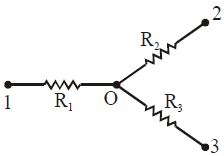
.............. $A$ the current flowing through the resistance $R_2$ of the circuit shown in fig if the resistance are equal to $R_1 = 20\  \Omega, R_2 = 30 \ \Omega$ and $R_3 = 60 \ \Omega$ and potentials of points $1, 2$ and $3$ are equal to $V_1= 20\, V,$ $V_2 = 30\ V$ and $V_3 = 60\ V$
In a decaying $L-R$ circuit, the time after which energy stored in the inductor reduces to one-fourth of its intitial value is
Frequency of a sonometer wire is $n.$ Now its tension is increased $4$ times and its length is doubled then new frequency will be
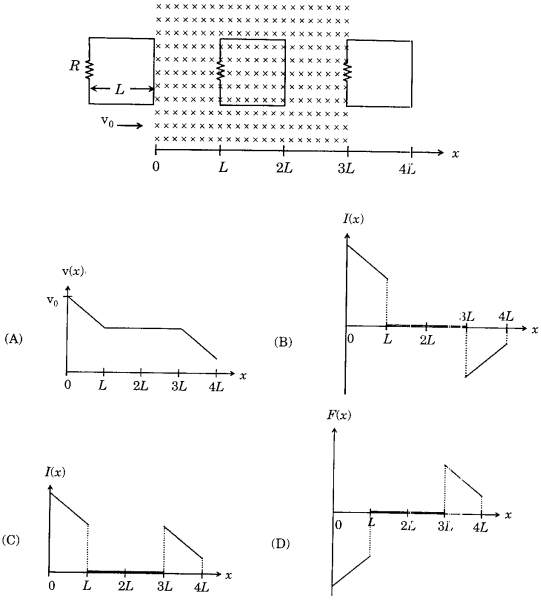
A rigid wire loop of square shape having side of length $L$ and resistance $R$ is moving along the $x$-axis with a constant velocity $\mathrm{v}_0$ in the plane of the paper. At $t=0$, th $\geqslant$ right edge of the loop enters a region of length $3 L$ where there is a uniform magnetic field $B_{i)}$ into the plane of the paper, as shown in the figure. For sufficiently large $v_0$, the loop eventually crosses the region. Let $x$ be the location of the right edge of the loop. Let $\mathrm{v}(x), I(x)$ and $F(x)$ represent the velocity of the loop, current in the loop, and force on the loop, respectively, as a function of $x$. Counter-clockwise current is taken as positive.

(image)

Which of the following schematic plot($s$) is(are) correct? (Ignore gravity)
At time $t=0$, a disk of radius $1 m$ starts to roll without slipping on a horizontal plane with an angular acceleration of $\alpha=\frac{2}{3} rad s ^{-2}$. A small stone is stuck to the disk. At $t=0$, it is at the contact point of the disk and the plane. Later, at time $t=\sqrt{\pi} s$, the stone detaches itself and flies off tangentially from the disk. The maximum height (in $m$ ) reached by the stone measured from the plane is $\frac{1}{2}+\frac{x}{10}$. The value of $x$ is. . . . . . .[Take $g=10 m s ^{-2}$.]
Sand is being dropped on a conveyor belt at the rate of 2M kg/s. The force (in newton) necessary to keep the belt moving with a constant velocity v m/s will be
In an isochoric process if ${T_1} = {27^o}C$ and ${T_2} = {127^o}C,$ then ${P_1}/{P_2}$ will be equal to
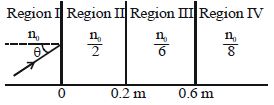
A light beam is travelling from Region $I$ to Region $IV$ (refer figure). The refractive index in Region $I, II, III$ and $IV$ are ${n_0},\frac{{{n_0}}}{2},\frac{{{n_0}}}{6}$ and $\frac{{{n_0}}}{8}$, respectively. The angle of incidence $\theta $ for which he beam just misses entering Region $IV$ is
In a double slit experiment with monochromatic light, fringes are obtained on a screen placed at some distance from the plane of slits. If the screen is moved by $5 \times 10^{-2} \,m$ towards the slits, the change in fringe width is $3 \times 10^{-3} \,cm$. If the distance between the slits is $1 \,mm$, then the wavelength of the light will be_______ $nm$
A horizontal conductor is oriented north south and carries some current. $A$ positively charged particle located vertically above it and having a velocity directed north ward experiences an upward force.What is the direction of the force if this charged particle were located to the east of the conductor and had a velocity directed towards the conductor