Question
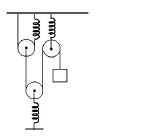
Assuming all pulleys, springs and string massless. Consider all surface smooth. Choose the correct statement $(s)$
Answer

$x=\frac{y_{1}}{2}+2 y_{2}+2 y_{3}$       $...(1)$

$\Delta \mathrm{T}=\mathrm{ma}$       $...(2)$

$2 \Delta \mathrm{T}=\mathrm{Ky}_{2}$           $...(3)$

$2 \Delta \mathrm{T}=\mathrm{Ky}_{3}$           $...(4)$

$\frac{\Delta \mathrm{T}}{2}=\mathrm{Ky}_{1}$           $...(5)$

Solving eqn.

$x=\Delta T\left(\frac{33}{4 K}\right)$

$w^{2}=\left(\frac{4 K}{33}\right)$

Need a full question paper?

Generate a complete, print-ready paper with questions like this in minutes — across 16+ boards, with answer keys.
Start Generating Free

Similar questions

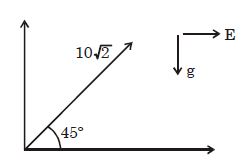
A particle of mass $1\ gm$ and charge $ - 0.1\,\mu C$ is projected from ground with a velocity $10\sqrt 2 $ at an $45^o$ with horizontal in the area having uniform electric field $1\ kV/cm$ in horizontal direction. Acceleration due to gravity is $10\ m/s^2$ in vertical downward direction. Select $INCORRECT$ statement
The true statement is
A radioactive nuclei with decay constant $0.5/s$ is being produced at a constant rate of $100\, nuclei/s$. If at $t\, = 0$ there were no nuclei, the time when there are $50\, nuclei$ is
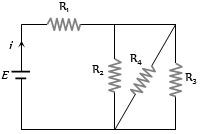
In the circuit given $E = 6.0 \,V, R_1 = 100\, ohms, R_2 = R_3 = 50\, ohms, R_4 = 75\, ohms$. The equivalent resistance of the circuit, in $ohms$, is
Two similar thin equi-convex lenses, of focallength feach, are kept coaxially in contact with each other such that the focallength of the combination is $\mathrm{F}_{1}$. When the space between the two lenses is filled with gyoern(which has the same refractive index ( $\mu =1.5$ ) as that of glass then the equivalent focal length is $\mathrm{F}_{2} .$ The ratio $\mathrm{F}_{1}: \mathrm{F}_{2}$ will be


If a source of electromagnetic radiation having power $15 kW$ produces $10^{16}$ photons per second, the radiation belongs to a part of spectrum is.(Take Planck constant $h =6 \times 10^{-34}\,Js$ )
The oscillation of a body on a smooth horizontal surface is represented by the equation $x= Acos$$\omega t$ 

where $x=$ displacement at time $t$

$\omega =$ frequency of oscillation

Which one of the following graphs shows correctly the variation $a$ with $t$ ?

Here $a=$ acceleration at time $t$

$T=$ time period
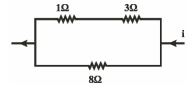
Power dissipated across the $8 \Omega$ resistor in the circuit shown here is 2 W . The power dissipated in watt units across the $3 \Omega$ resistor is
Image
One of the two identical conducing wires of length $L$ is bent in the form of a circular loop and the other one into a circular coil of $N$ identical turns. If the same current is passed in both, the ratio of the magnetic field at the central of the loop $(B_L)$ to that at the centre of the coil $(B_C),$; $.\,\frac {B_L}{B_C}$ will be
A body of mass $1\, kg$ starts moving from rest at $t = 0$, in $a$ circular path of radius $8 \,m$. Its kinetic energy varies as a function of time as : $K.E. = 2t^2$ Joules, where $t$ is in seconds. Then