Question
Choose the correct answer from the given four options.
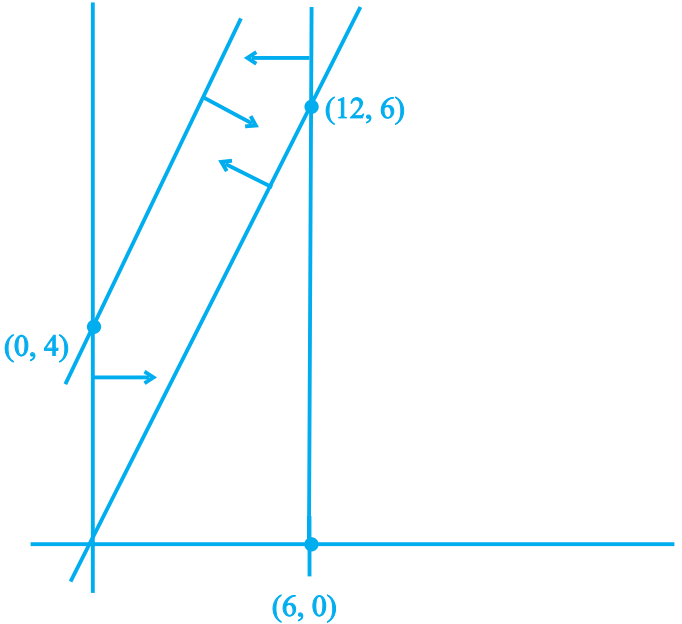
Let F = 3x - 4y be the objective function. Maximum value of F is:

  1. 0.
  2. 8.
  3. 12.
  4. -18.

Answer

  1. 12.

Solution:

The feasible region as shown in the figure, has objective function F = 3x - 4y

Corner points
Corresponding value of Z = 3x - 4y
(0, 0)
(12, 6)
(0, 4)
0
12 (maximum)
-16 (minimum)

Hence, the maximum value of F is 12.

Need a full question paper?

Generate a complete, print-ready paper with questions like this in minutes — across 16+ boards, with answer keys.

Start Generating Free

Similar questions

Let $f$ be a continuous function defined on $[0,1]$ such that $\int_0^1 f^2(x) d x=\left(\int_0^1 f(x) d x\right)^2$. Then, the range of $f$
Linear programming used to optimize mathematical procedure and is:
  1. Subset of mathematical programming
  2. Dimension of mathematical programming
  3. Linear mathematical programming
  4. All of above
Given that $\int\limits^{\infty}_0\frac{\text{x}^2}{(\text{x}^2+\text{a}^2)(\text{x}^2+\text{b}^2)(\text{x}^2+\text{c}^2)}\text{ dx}=\frac{\pi}{2(\text{a}+\text{b})(\text{b}+\text{c})(\text{c}+\text{a})},$ the value of $\int\limits^\infty_0\frac{1}{(\text{x}^2+4)(\text{x}^2+9)},$ is:
  1. $\frac{\pi}{60}$
  2. $\frac{\pi}{20}$
  3. $\frac{\pi}{40}$
  4. $\frac{\pi}{80}$
If $A=\left[\begin{array}{ll}\alpha & 2 \\ 2 & \alpha\end{array}\right]$ and $\left|A^3\right|=27$, then the value of $\alpha$ is
Maximum area of a parallelogram inscirbed in a triangle $ABC$ is (given $A$ is also one of the vertex of parallelogram) equal to

(where symbols have their usual meaning in $\Delta\,ABC$ )

Let $P=\left[\begin{array}{ccc}1 & 0 & 0 \\ 4 & 1 & 0 \\ 16 & 4 & 1\end{array}\right]$ and $I$ be the identity matrix of order $3$ . If $\left.Q=q_{i j}\right]$ is a matrix such that $P^{50}-Q=I$, then $\frac{q_{31}+q_{32}}{q_{21}}$ equals
If $\vec{\text{a}}=2\hat{\text{i}}-3\hat{\text{j}}-\hat{\text{k}}$ and $\vec{\text{b}}=\hat{\text{i}}+4\hat{\text{j}}-2\hat{\text{k}},$ then $\vec{\text{a}}\times\vec{\text{b}}$ is:
  1. $10\hat{\text{i}}+2\hat{\text{j}}+11\hat{\text{k}}$
  2. $10\hat{\text{i}}+3\hat{\text{j}}+11\hat{\text{k}}$
  3. $10\hat{\text{i}}-3\hat{\text{j}}+11\hat{\text{k}}$
  4. $10\hat{\text{i}}-2\hat{\text{j}}-10\hat{\text{k}}$
If for $x \geq 0, y=y(x)$ is the solution of the differential equation $(\mathrm{x}+1) \mathrm{d} \mathrm{y}=\left((\mathrm{x}+1)^{2}+\mathrm{y}-3\right) \mathrm{d} \mathrm{x}, \mathrm{y}(2)=0$ then $y(3)$ is equal to
Write $\cot ^{-1}\left(\frac{1}{\sqrt{x^{2}-1}}\right), x>1$ in the simplest form.
$\int_0^{\pi /4} {[\sqrt {\tan x} + \sqrt {\cot x} ]\,dx} $ equals