Question
Choose the correct answer from the given four options.

The feasible solution for a LPP is shown in. Let Z = 3x - 4y be the objective function.
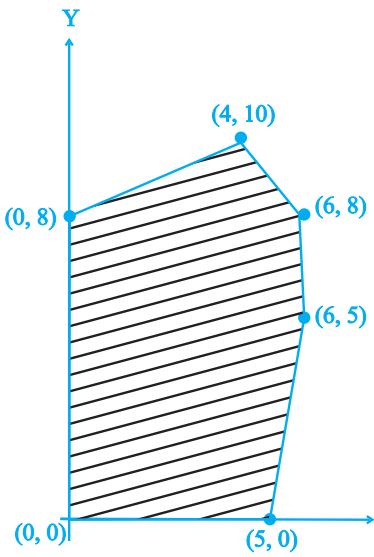
Maximum of Z occurs at:

  1. (5, 0)
  2. (6, 5)
  3. (6, 8)
  4. (4, 10)

Answer

  1. (5, 0)

Solution:

Corner points
Corresponding value of Z = 3x - 4y
(0, 0)
(5, 0)
(6, 5)
(6, 8)
(4, 10)
(0, 8)
0
15 (Maxmimum)
-2
-14
-28
-32

Hence, maximum of Z occurs at (5, 0) and its maximum value is 27.

Need a full question paper?

Generate a complete, print-ready paper with questions like this in minutes — across 16+ boards, with answer keys.

Start Generating Free

Similar questions

Choose the correct answer from the given four options.

Eight coins are tossed together. The probability of getting exactly 3 heads is:

  1. $\frac{1}{256}$

  2. $\frac{7}{32}$

  3. $\frac{5}{32}$

  4. $\frac{3}{32}$

Choose the correct answer from the given four options.
Suppose a random variable X follows the binomial distribution with parameters n and p, where 0 < p < 1. If $\frac{\text{P}(\text{x}=\text{r})}{\text{P}(\text{x}=\text{n}–\text{r})}$ is independent of n and r, then p equals:
${x^x}$ has a stationary point at
If the domain of the function $f(x)=\sin ^{-1}\left(\frac{x-1}{2 x+3}\right)$ is $R-(\alpha, \beta)$ then $12 \alpha \beta$ is equal to :
Minimum integral value of $\alpha$ for which graph of $f(x) = ||x -2| -\alpha|-5$ has exactly four $x-$intercepts-
A biased coin with probability $p,\,\,0 < p < 1,$ of heads is tossed until a head appears for the first time. If the probability that the number of tosses required is even is $\frac{2}{5},$ then $p = $
Choose the correct answer from the given four options.
A and B are two students. Their chances of solving a problem correctly are $\frac{1}{3}$ and $\frac{1}{4},$respectively. If the probability of their making a common error is, $\frac{1}{20}$ and they obtain the same answer, then the probability of their answer to be correct is:
  1. $\frac{1}{12}$
  2. $\frac{1}{40}$
  3. $\frac{13}{120}$
  4. $\frac{10}{13}$
If $\vec{\text{a}}$ is any vector, then $\big(\vec{\text{a}}\times\hat{\text{i}}\big)^2+\big(\vec{\text{a}}\times\hat{\text{j}}\big)^2+\big(\vec{\text{a}}\times\hat{\text{k}}\big)^2=$
  1. $\vec{\text{a}}^2$
  2. $2\vec{\text{a}}^2$
  3. $3\vec{\text{a}}^2$
  4. $4\vec{\text{a}}^2$
Between the following two statements :

Statement $-I$ : Let $\overrightarrow{\mathrm{a}}=\hat{\mathrm{i}}+2 \hat{\mathrm{j}}-3 \hat{\mathrm{k}}$ and $\vec{b}=2 \hat{i}+\hat{j}-\hat{k}$. Then the vector $\vec{r}$ satisfying $\overrightarrow{\mathrm{a}} \times \overrightarrow{\mathrm{r}}=\overrightarrow{\mathrm{a}} \times \overrightarrow{\mathrm{b}}$ and $\overrightarrow{\mathrm{a}} \cdot \overrightarrow{\mathrm{r}}=0$ is of magnitude $\sqrt{10}$.

Statement $-II$ : In a triangle $A B C, \cos 2 A+\cos 2 B$ $+\cos 2 \mathrm{C} \geq-\frac{3}{2}$

Z = 6x + 21y, subject to $ \text{x}+2\text{y}\geq3,\text{x}+4\text{y}\geq4,3\text{x}+\text{y}\geq3,\text{x}\geq0,\text{y}\geq0.$ The minimum value of Z occurs at.
  1. $(4,0)$
  2. $(28,8)$
  3. $\Big(2,\frac{7}{2}\Big)$
  4. $(0,3)$