Question
Choose the correct answer from the given four options.
The feasible solution for a LPP is shown in. Let Z = 3x - 4y be the objective function.
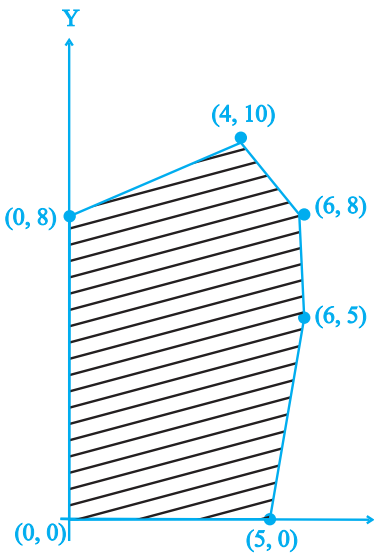
Minimum of Z occurs at:
  1. (0, 0)
  2. (0, 8)
  3. (5, 0)
  4. (4, 10)

Answer

  1. (0, 8)

Solution:

Corner points
Corresponding value of Z = 3x - 4y
(0, 0)
(5, 0)
(6, 5)
(6, 8)
(4, 10)
(0, 8)
0
15 - 2
-14
-28
-32 (Minimum)

Hence, the minimum of Z occurs at (0, 8) and its minimum value is (-32).

Need a full question paper?

Generate a complete, print-ready paper with questions like this in minutes — across 16+ boards, with answer keys.

Start Generating Free

Similar questions

Let $f^{\prime}(x)=\frac{192 x^3}{2+\sin ^4 \pi x}$ for all $x \in R$ with $f\left(\frac{1}{2}\right)=0$. If $m \leq \int_{1 / 2}^1 f(x) d x \leq M$, then the possible values of $m$ and $M$ are
A unit vector perpendicular to the plane containing the vectors $i - j + k$ and $ - i + j + k$ is
For the curve $\sqrt x + \sqrt y = 1,{{dy} \over {dx}}$ at $\left( {{1 \over 4},{1 \over 4}} \right)$ is
The maximum value of  $xy $ when $x + 2y = 8$ is
$\int_{}^{} {\frac{{dx}}{{(1 + {x^2})\sqrt {1 - {x^2}} }} = } $
The corner points of the bounded feasible region are $(0,1),(0,7),(2,7),(6,3)(6,0)(1,0)$ For the objective function $\mathrm{Z}=3 x-y$

$(i)$ At which point, $Z$ is minimum?

$(ii)$ At which point, $Z$ is maximum ?

$(iii)$ The maximum value of $\mathrm{Z}$ is $\ldots \ldots \ldots$

$(iv)$ The minimum value of $\mathrm{Z}$ is $\ldots \ldots \ldots$

Let $f(x)=\alpha x^2-2+\frac{1}{x}$, where $\alpha$ is a real constant. The smallest $\alpha$ for which $f(x) \geq 0$ for all $x > 0$ is
Integration of $\left(\sqrt{x}+\frac{1}{\sqrt{x}}\right)$ with respect to $x$ :
$\lim _{n \rightarrow \infty} \frac{3}{n}\left\{4+\left(2+\frac{1}{n}\right)^2+\left(2+\frac{2}{n}\right)^2+\ldots+\left(3-\frac{1}{n}\right)^2\right\}$ is equal to
Let the solution curve $y = y ( x )$ of the differential equation $\quad \frac{d y}{d x}-\frac{3 x^5 \tan ^{-1}\left(x^3\right)}{\left(1+x^6\right)^{\frac{3}{2}}} y=2 x$ $\exp \frac{x^3-\tan ^{-1} x^3}{\sqrt{(1+x)^6}}$ pass through the origin. Then $y (1)$ is equal to: