Question
Choose the correct answer
If $\theta$ is the angle between two vectors $\vec{\text{a}}\ \text{and}\ \vec{\text{b}},\ \text{then}\ \vec{\text{a}}\cdot\vec{\text{b}}\geq0$ only when,
  1. $0<\theta<\frac{\pi}{2}$
  2. $0\leq\theta\leq\frac{\pi}{2}$
  3. $0<\theta<\pi$
  4. $0\leq\theta\leq\pi$​​

Answer

Let $\theta$ be the angle between two vectors $\vec{\text{a}}\ \text{and}\ \vec{\text{b}}.$Then, without loss of generality, $\vec{\text{a}}\ \text{and}\ \vec{\text{b}}$ are non-zero vectors so that $|\vec{\text{a}}|\ \text{and}\ \Big|\vec{\text{b}}\Big|$ are positive
It is known that $\vec{\text{a}}\cdot\vec{\text{b}}=|\vec{\text{a}}| \Big|\vec{\text{b}}\Big|\cos\theta.$
$\therefore\vec{\text{a}}\cdot\vec{\text{b}}\geq0$
$\Rightarrow|\vec{\text{a}}| \Big|\vec{\text{b}}\Big|\cos\theta\geq0$
$\Rightarrow\cos\theta\geq0\ \ \ \Big[\big|\vec{\text{a}}\big|\ \text{and}\ \Big|\vec{\text{b}}\Big|\ \text{are positive}\Big]$
$\Rightarrow0\leq\theta\leq\frac{\pi}{2}$
Hence, $\vec{\text{a}}.\vec{\text{b}}\geq0\ \text{when}\ 0\leq\theta\leq\frac{\pi}{2}.$
The correct answer is B.

Need a full question paper?

Generate a complete, print-ready paper with questions like this in minutes — across 16+ boards, with answer keys.

Start Generating Free

Similar questions

Let R be a relation on the set N of natural numbers denoted by nRm ⇔ n is a factor of m (i.e. n | m). Then, R is:
  1. Reflexive and symmetric.
  2. Transitive and symmetric.
  3. Equivalence.
  4. Reflexive, transitive but not symmetric.
The eqution of the plane $\vec{\text{r}}=\hat{\text{i}}-\hat{\text{j}}+\lambda(\hat{\text{i}}+\hat{\text{j}}+\hat{\text{k}})+\mu(\hat{\text{i}}-2\hat{\text{j}}+3\hat{\text{k}})$ in scalar product from is:
  1. $\vec{\text{r}}.(5\hat{\text{i}}-2\hat{\text{j}}-3\hat{\text{k}})=7$
  2. $\vec{\text{r}}.(5\hat{\text{i}}+2\hat{\text{j}}-3\hat{\text{k}})=7$
  3. $\vec{\text{r}}.(5\hat{\text{i}}-2\hat{\text{j}}+3\hat{\text{k}})=7$
  4. $\text{None of these}$
A line OP where O = (0, 0, 0) makes equal angles with ox, oy, oz. The point on OP, which is at a distance of 6 units from O is:
Domain of $\cos ^{-1}[x]$ (where [.] denotes G.I.F.) is
Let $S$ be the set of all real numbers and let $R$ be a relation on $S$ defined by $a R b \Leftrightarrow a^2+b^2=1$. Then, $R$ is
If $x^y = e^{x-y}$ then $\frac{\text{dy}}{\text{dx}}$ is:
If $\text{x}=2\text{ at},\text{y}=\text{at}^2,$ where a is a constant, then $\frac{\text{d}^2\text{y}}{\text{dx}^2}\text{ at}\ \text{x}=\frac{1}{2}$ is:
  1. $\frac{1}{2}\text{a}$
  2. 1
  3. 2a
  4. None of these
If $\vec{\text{a}} $ lies in the plane of vectors $\vec{\text{b}}$ and $\vec{\text{c}},$ then which of the following is correct?
  1. $\big[\vec{\text{a}}\vec{\text{b}}\vec{\text{c}}\big]=0$
  2. $\big[\vec{\text{a}}\vec{\text{b}}\vec{\text{c}}\big]=1$
  3. $\big[\vec{\text{a}}\vec{\text{b}}\vec{\text{c}}\big]=3$
  4. $\big[\vec{\text{b}}\vec{\text{c}}\vec{\text{a}}\big]=1$
Choose the correct answer from the given four options.

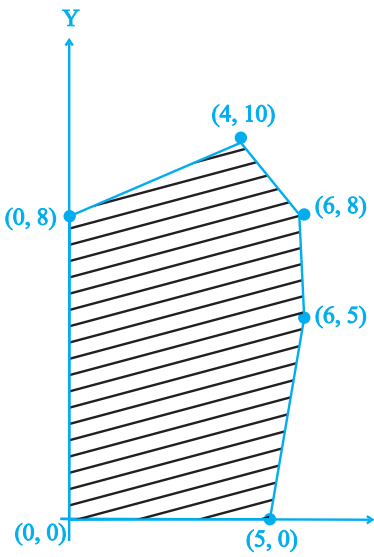
The feasible solution for a LPP shown in Fig. 12.12. Let z = 3x - 4y be objective functio. (Maximum value of Z + Minimum value of Z) is equal to:
The function $\text{f(x)}=\frac{4-\text{x}^2}{4\text{x}-\text{x}^3}$
  1. Discontinuous at only one point.
  2. Discontinuous exactly at two points.
  3. Discontinuous exactly at three points.
  4. None of these.