Question
Choose the correct answer.$\text{F}=\frac{\text{K.}(\text{q}_1\times\text{q}_2)}{\text{r}^2}$
This is given by which law?

Answer

  1. Coulomb’s law
Explanation:
$\text{F}=\frac{\text{K.}(\text{q}_1\times\text{q}_2)}{\text{r}^2}$
is given by Coulomb’s Law.

Need a full question paper?

Generate a complete, print-ready paper with questions like this in minutes — across 16+ boards, with answer keys.
Start Generating Free

Similar questions

${ }_{90}^{232} Th$ an isotope of thorium decays in ten stages emitting six $a-$particles and four $b-$particles in all. The end product of the decay is
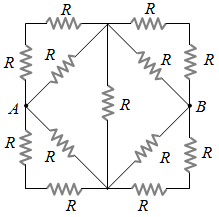
Thirteen resistances each of resistance $R$ ohm are connected in the circuit as shown in the figure below.  The effective resistance between $A$ and $B$ is
A charge moving with velocity v in X-direction is subjected to a field of magnetic induction in the negative X-direction. As a result, the charge will(a) Remain unaffected(b) Start moving in a circular path Y-Z plane(c) Retard along X-axis(d) Move along a helical path around X-axis


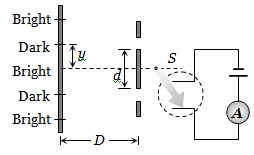
In the following arrangement $y = 1.0\ mm, d = 0.24\ mm$ and $D = 1.2 m.$ The work function of the material of the emitter is $2.2\ eV.$ The stopping potential $V$ needed to stop the photo current will be
Those atoms which have the same atomic number but different mass number are called :
Some charge is being given to a conductor. Then its potential:
The continuous X-rays spectrum produced by an X-ray machine at constant voltage has(a) A maximum wavelength(b) A minimum wavelength(c) A single wavelength(d) A minimum frequency
   
   
If a torch is used in place of monochromatic light in Young’s experiment what will happens(a) Fringe will appear for a moment then it will disappear(b) Fringes will occur as from monochromatic light(c) Only bright fringes will appear (d) No fringes will appear


When a glass rod is rubbed with silk, it(a) Gains electrons from silk(b) Gives electrons to silk(c) Gains protons from silk(d) Gives protons to silk
   
   
A moving coil galvanometer has a resistance of 50 Ω and gives full scale deflection for 10 mA. How could it be converted into an ammeter with a full scale deflection for 1A(a) 50/99 Ω  in series(b) 50/99 Ω in parallel(c) 0.01 Ω in series(d) 0.01 Ω in parallel