Question
Some charge is being given to a conductor. Then its potential:

Answer

  1. remains same throughout the conductor.
Explanation:
Given that some charge is given to a conductor then the whole charge is distributed over its surface only. Inside of conductor, electric field is zero whereas potential is same as on the surface. Hence, throughout the conductor, potential is same i.e, the whole conductor is equipotential.

Need a full question paper?

Generate a complete, print-ready paper with questions like this in minutes — across 16+ boards, with answer keys.
Start Generating Free

Similar questions

Photoelectric effect is the phenomenon in which?
In a circuit, the current lags behind the voltage by a phase difference of $\frac{\pi}{2}$ the circuit will contain which of the following: 
In which of the following decay the structure of the nucleus does not change ?
The hysteresis cycle for the material of permanent magnet is:
An $X-$ray tube is operating at $50\ kV$ and $20\ mA $. The target material of the tube has a mass of $1.0\ kg$ and specific heat $495 J\ kg ^{-1}{ }^{\circ} C ^{-1}$. One percent of the supplied electric power is converted into $X -$rays and the entire remaining energy goes into heating the target. Then
Assertion : $ A P-N$ photodiode is made from a semiconductor for which $E_g = 2.8 eV$. This photo diode will not detect the wavelength of $6000 \ nm.$
Reason    : A $PN$ photodiode detect wavelength $l$ if $\frac{\mathrm{hc}}{\lambda}>\mathrm{E}_{\mathrm{e}}$.
A non-conducting solid sphere of radius R is uniformly charged. The magnitude of the electric field due to the sphere at a distance r  from its centre(a) Increases as r increases for r < R(b) Decreases as r  increases for 0 < r < ∞(c) Decreases as r  increases for R < r < ∞(d) a, c
   
   
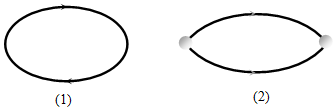
Below figures $(1)$ and $(2)$ represent lines of force. Which is correct statement
When two identical capacitors are in series have $3 \mu F$  capacitance and when parallel $12\mu F. $ What is the capacitance of each
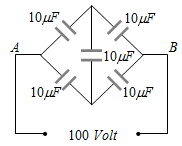
Five capacitors of $10\  \mu F$ capacity each are connected to $\text{a d.c.}$ potential of $100$ volts as shown in the adjoining figure. The equivalent capacitance between the points $A$ and $B$ will be equal to