Choose the $CORRECT$ option
Medium


Download our appand get started for free
Experience the future of education. Simply download our apps or reach out to us for more information. Let's shape the future of learning together!No signup needed.*
Similar Questions
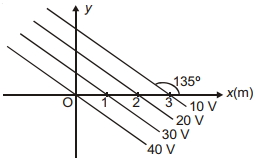
- 1View SolutionFigure shows a set of equipotential surfaces. The magnitude and direction of electric field that exists in the region is .........
- 2An empty thick conducting shell of inner radius $a$ and outer radius $b$ is shown in figure.If it is observed that the inner face of the shell carries a uniform charge density $-\sigma$ and the surface carries a uniform charge density $ '\sigma '$View Solution
If the inner surface of the shell is earthed, then identify the correct statement(s)
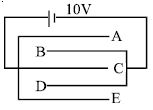
- 3Five identical capacitor plates are arranged such that they make capacitors each of $2\ \mu F$. The plates are connected to a source of $emf$ $10\ V$. The charge on plate $C$ is......$ \mu C$View Solution
- 4Eight drops of mercury of equal radii possessing equal charges combine to form a big drop. Then the capacitance of bigger drop compared to each individual small drop is........$times$View Solution
- 5View SolutionThree identical capacitors are combined differently. For the same voltage to each combination, the one that stores the greatest energy is
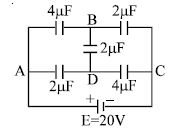
- 6View SolutionThe figure shows a diagonal symmetric arrangement of capacitors and a battery.Identify the correct statements.
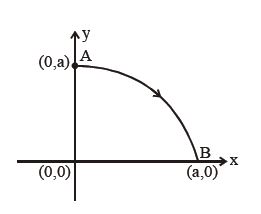
- 7Electric field at a place is $\overrightarrow {E\,} = {E_0}\hat i\,V/m$ . A particle of charge $+q_0$ moves from point $A$ to $B$ along a circular path find work done in this motion by electric fieldView Solution
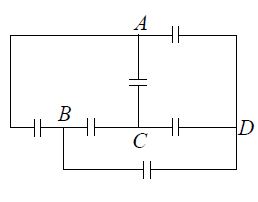
- 8Choose the correct statement for the given capacitor arrangement. (All the $6$ capacitor are of same capacitance)View Solution
- 9Minimum number of capacitors of $2\,\mu F$ capacitance each required to obtain a capacitor of $5\,\mu F$ will beView Solution
- 10A $600\,pF$ capacitor is charged by $200\,V$ supply. It is then disconnected from the supply and is connected to another uncharged $600\,pF$ capacitor. Electrostatic energy lost in the process is $.........\,\mu J$.View Solution