MCQ
Choose the wrong option.
  • A
    Inertial mass is a measure of difficulty of accelerating a body by an external force whereas the gravitational mass is relevant in determining the gravitational force on it by an external mass.
  • B
    That the gravitational mass and inertial mass are equal is an experimental result.
  • C
    That the acceleration due to gravity on earth is the same for all bodies is due to the equality of gravitational mass and inertial mass.
  • Gravitational mass of a particle like proton can depend on the presence of neighouring heavy objects but the inertial mass cannot.
Answer

Correct option: D.
Gravitational mass of a particle like proton can depend on the presence of neighouring heavy objects but the inertial mass cannot.
Key concept:
  1. Inertial mass: It is the mass of the material body, which measures its inertia.
  2. Gravitational Mass: It is the mass of the material body, which determines the gravitational pull acting upon it. According to the principle of equivalence, Gravitational mass of proton is equivalent to its inertial mass and is independent of presence of neighboring heavy objects.
  3. Important point: Comparison between inertial and gravitational mass:
  • Both are measured in the same units.
  • Both are scalars.
  • Both do not depend on the shape and state of the body.
  • Inertial mass is measured by applying Newton’s second law of motion whereas gravitational mass is measured by applying Newton’s law of gravitation.
  • Spring balance measures gravitational mass and inertial balance measure inertial mass.

Need a full question paper?

Generate a complete, print-ready paper with questions like this in minutes — across 16+ boards, with answer keys.

Start Generating Free

Similar questions

A fly wheel is accelerated uniformly from rest and rotates through $5 \,rad$ in the first second. The angle rotated by the fly wheel in the next second, will be.........$rad$
A particle starts with an initial velocity of $10.0\,ms ^{-1}$ along $x$-direction and accelerates uniformly at the rate of $2.0\,ms ^{-2}$. The time taken by the particle to reach the velocity of $60.0\,ms ^{-1}$ is $.......\,s$
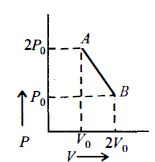
$n\, moles$ of an ideal gas undergo a process $A \to B$ as shown in the figure. Maximum temperature of the gas during the process is
A particle is projected vertically upwards from $O$ with velocity $v$ and a second particle is projected at the same instant from $P$ (at a height h above $O$) with velocity $v$ at an angle of projection $\theta$ . The time when the distance between them is minimum is
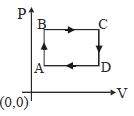
The figure shows $P-V$ diagram of a thermodynamic cycle. Which corresponding curve is correct?
A particle is moving on a circular path with constant speed $v$. It moves between two points $A$ and $B$. which subtends an angle $60^{\circ}$ at the centre of circle. The magnitude of change in its velocity and change in magnitude of its velocity during motion from $A$ to $B$ are respectively ..........
The $K.E.$ of a body can be increased maximum by doubling its:
The time period of an earth-satellite in circular orbit is independent of:
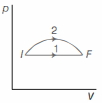
An ideal gas undergoes change in its state from the initial state $I$ to the final state $F$ via two possible paths as shown below. Then,
The area of cross-section of a wire of length $1.1$ metre is $1$ $mm^2$. It is loaded with $1 \,kg.$ If Young's modulus of copper is $1.1 \times {10^{11}}\,N/{m^2}$, then the increase in length will be ......... $mm$ (If $g = 10\,m/{s^2})$