Question
Clarify the relationship between average cost and marginal cost through schedule and figures.

Answer

 
  • Introduction :
    • When any firm produce the product then it is necessary to know about poi unit cost and total cost for the production.
    • For taking decision regarding production any firm has to know the average cost and marginal cost.
    • Per unit average cost is average cost but marginal cost shows production cost of additional units.
    • On the basis of average cost and marginal cost firm takes decision of production for long run and short run respectively.
    • It means that firm continues its long run production, if he recovers the average cost.
    • But in short run, for the firm, if the price of the product is more than marginal cost but less than average cost then also keep the production.
    • But if the price is not same as marginal cost then he stops the production. In short, for any firm the decision regarding long and short run production.
    • It is based on the relationship between average cost and marginal cost.
  • Meaning of Average Cost :
  • Average cost can be known by dividing the total production cost by units of production (product). Average cost is per unit average production cost.
  • Meaning of Marginal Cost :
  • When one more unit is added to units of production or reduced from the units of production the change in cost of production is called marginal cost.
  • Relationship between Average cost and Marginal cost :
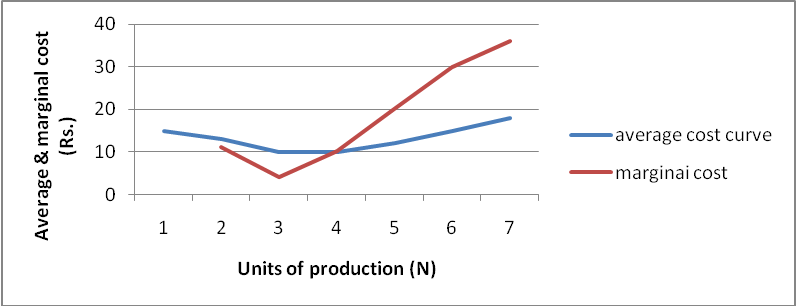
  • Relationship between Average cost and Marginal cost can be explained through following schedule and figure.
Unit of
Production
(N)
Total Cost
(TC)
(Rs)
Average Cost
(AC)
(Rs)
Marginal
Cost (MC)
(Rs)
conclusion
$1$
$2$
$3$
$4$
$5$
$6$
$7$
$15$
$26$
$30$
$40$
$60$
$90$
$126$
$15$
$13$
$10$
$10$
$12$
$15$
$18$

-
$11$
$4$
$10 \rightarrow$ 
$20$
$30$
$36$
$AC$ and $MC$
Both Decrease
$AC = MC$ Minimum
$AC$ and $MC$ both increase
    • In above figure, on $OX$ axis units of production and $OY$ axis average cost and marginal cost are given.
    • On the basis of above schedule we get average cost curve and marginal cost curve.
    • From the figure we can see that the average cost curve is $U$ shape and marginal cost curve cost is hockey shape.
    • As per given schedule, in the starting increasing product rule operates so average both cost are decreasing.
    • At the fourth unit of production $AC=MC$ and at point $M$ average cost is minimum after that decreasing product to rule operate and average cost and marginal cost both are showing increasing trend.
  • Relationship between Average cost and marginal cost :
    • $MC < AC :$
  • When average cost $(AC)$ decreases, Marginal Cost $(MC)$ also decreases, but marginal cost falls faster than $AC$ and $AC$ curve is above and $MC$ curve is below.
  • In the beginning the law of increasing return operates and as more and more units are produced.
  • Marginal cost reduces.
  • But in average cost the total cost is decided by all units and therefore $AC$ reduces at a slow pace.
    • $MC > AC :$
  • When average cost increases marginal cost also increases.
  • But the reduction in marginal cost is father than in average cost.
  • So, $AC$ is seen below and $MC$ is seen above because after the optimum level of production, the law of decreasing return applies and as production increases, marginal cost increases but this loss is divided amongst all earlier units in $AC$ and therefore, it increases at a slow speed.
    • $MC = AC :$
  • When the marginal cost falls and raises again it cuts across the $AC$ curve.
  • At this point average cost is minimum.
  • Therefore, when average cost is minimum,$ AC$ and $MC$ are equal.
  • When MC crosses $AC$, it is the minimum average cost because as Average Variable Cost ($AVC$) increases, marginal cost goes up.
  • But when the effect of reduction of average fixed cost ($AFC$) and increase in $AVC$ are equal, average cost becomes minimum.
  • At this point, marginal cost curve crosses average cost curve after this point, both $MC$ and $AC$ increases.
    • In production, when law of constant return applies, at all stages of production average cost and marginal cost curves are equal. Both curves are same and parallel to the baseline.
    • From the point $MC$ rises and where it crosses $AC$, marginal cost increases but average cost decreases.

Need a full question paper?

Generate a complete, print-ready paper with questions like this in minutes — across 16+ boards, with answer keys.

Start Generating Free