Question
Classify the objects or materials given below as opaque, transparent or translucent and luminous or non-luminous:
Air, water, a piece of rock, a sheet of aluminium, a mirror, a wooden board, a sheet of polythene, a $CD$, smoke, a sheet of plane glass, fog, a piece of red hot iron, an umbrella, a lighted fluorescent tube, a wall, a sheet of carbon paper, the fame of a gas burner, a sheet of cardboard, a lighted torch, a sheet of cellophane, a wire mesh, kerosene stove, sun, firefly, moon.
Answer

Get the step-by-step solution for this question inside the Vidyadip app.

Get the answer in the app

Need a full question paper?

Generate a complete, print-ready paper with questions like this in minutes — across 16+ boards, with answer keys.

Start Generating Free

Similar questions

Rahul and Sonia were playing with blocks and each of them made a train out of them. Both of them thought of measuring the length of the train using their handspan. By that time Rahul's friend Anupam came and suggested them to measure with a measuring tape for fair result.
$(a)$ What is a handspan?
$(b)$ Why Anupam asked both of them to use measuring tape?
$(c)$ What value of Anupam is shown here?
Which of the following plants have you seen? Of those that you have seen, which one have flowers?
Grass, maize, wheat, chilli, tomato, tulsi, pipal, shisham, banyan, mango, jamun, guava, pomegranate, papaya, banana, lemon, sugarcane, potato, groundnut
Give examples to explain the difference between changes that can or cannot be reversed.
Select leaves showing reticulate venation and those showing parallel venation from the list given below and write them in the tabular form:
Peepal, neem, grass, mustard, methi, dhania (coriander), rose, tulsi, mango, sugarcane, maize, mint, wheat, rice.
If a plant has fibrous root, what type of venation do its leaves have?
Name the food needed:
  1. For strong bones and teeth.
  2. To prevent scurvy.
  3. To avoid constipation.
  4. For warmth.
  5. For growth.
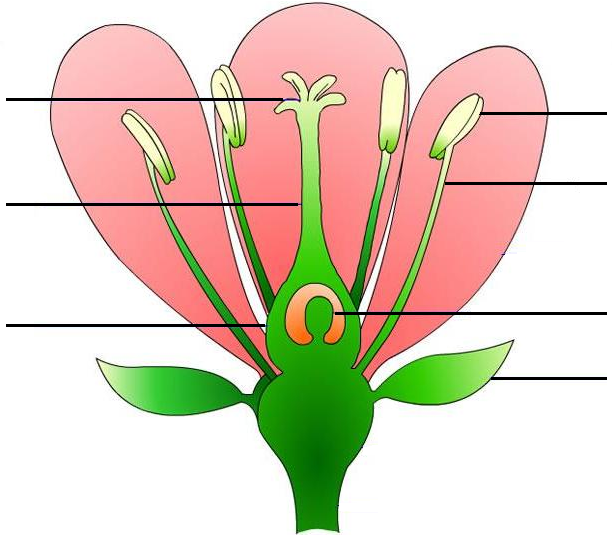
Given below is a diagram of a flower. Study it carefully and label the parts as indicated.
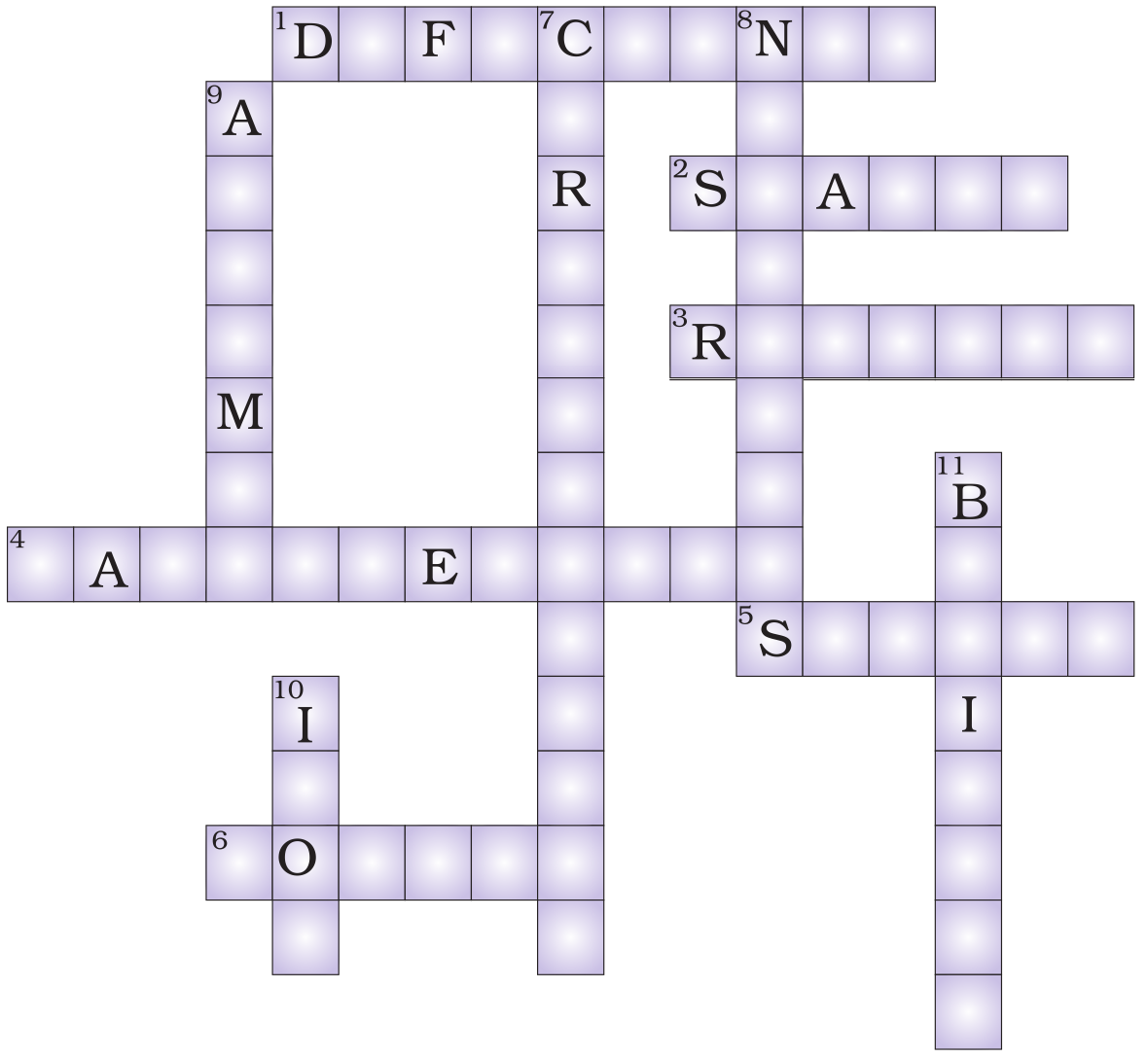
Solve the crossword puzzle given as figure from the clues given below.

Across:
  1. Lack of nutrients in our diet over a long period causes these diseases $(10)$
  2. Rice and potato are rich in this type of carbohydrate $(6)$
  3. Deficiency disease in bones making it become soft and bent $(7)$
  4. The diet that provides all the nutrients that our body needs, in right quantities, along with adequate amount of roughage and water $(8, 4)$
  5. Deficiency disease with bleeding gums $(6)$
  6. Disease caused due to deficiency of iodine $(6)$
Down:
  1. Starch and sugar in our food are rich in this type of energy giving nutrient $(13)$
  2. The term given to the useful components of food $(9)$
  3. The disease caused by deficiency of iron in diet $(7)$
  4. Green leafy vegetables, liver and apples are rich in this mineral $(4)$
  5. Deficiency disease caused due to lack of Vitamin $B1$ in the diet $(8)$
During summer holidays, a group of children collected a lump of salt, green grass, broken glass piece, a small thermocol box, pen, iron nail, glass marbles, hair, naphthalene ball, a piece of sugar candy (mishri) and tried to group them on the basis of properties given in Table below. Help them in filling the Table.
Name of the material Appearance (Hard/ Soft) Transparency (Transparent/ Transucent/ Opaque) Floats/ Sinks in water Soluble/ Insouble in water
- - - - -
Draw:
  1. a leaf.
  2. a taproot.
  3. a flower.
you have studied for Table.