Question
Cloudy nights are warmer than the nights with clean sky. Explain.

Answer

During night, the earth's surface radiates infrared radiation of larger wavelength. Gas molecules in the air absorb some of this energy and radiate energy of their own in all directions. Also, water molecules, like the vapour that makes the clouds, absorb more frequencies of infrared energy than clear air does.
Both these factors contribute to the fact that clouds radiate more heat in all directions (including the earth) than clear air does. In turn, this makes the overall temperature on the earth warmer when there is a cloud cover. The heat energy radiated by the earth is reflected back to earth. Due to this, cloudy nights are warmer than the nights with clean sky.
Need a full question paper?

Generate a complete, print-ready paper with questions like this in minutes — across 16+ boards, with answer keys.

Start Generating Free

Similar questions

When tall buildings are constructed on earth, the duration of day-night slightly increases. Is it true?
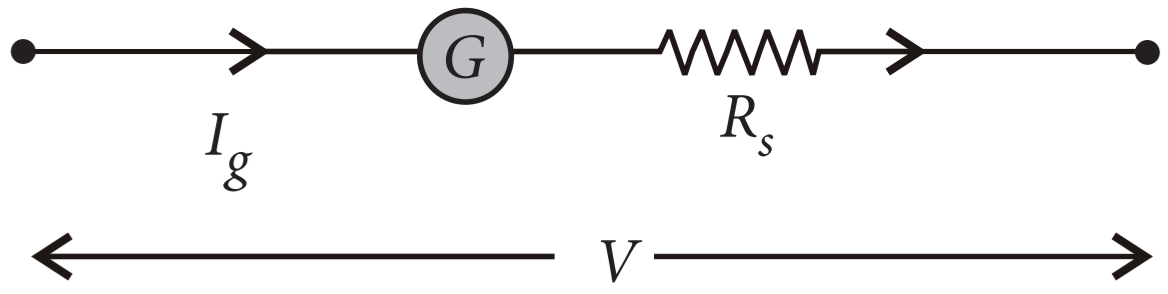
A galvanometer can be converted into voltmeter of given range by connecting a suitable resistance $R,$ in series with the galvanometer, whose value is given by, $\text{R}_\text{s}=\frac{\text{V}}{\text{I}_\text{g}}-\text{G}$
where vis the voltage to be measured, $lg$ is the current for full scale deflection of galvanometer and $G$ is the resistance of galvanometer.

Series resistor$(R,)$ increases range of voltmeter and the effective resistance of galvanometer. It also protects the galvanometer from damage due to large current. Voltmeter is a high resistance instrument and it is always connected in parallel with the circuit element across which potential difference is to be measured. An ideal voltmeter has infinite resistance. In order to increase the range of voltmeter $n$ times the value of resistance to be connected in series with galvanometer is $R_s = (n - 1)G.$
  1. $10\ mA$ current can pass through a galvanometer of resistance $25\Omega$ What resistance in series should be connected through it, so that it is converted into a voltmeter of $100V$?
  1. $0.975\Omega$
  2. $99.75\Omega$
  3. $975\Omega$
  4. $9975\Omega$
  1. There are $3$ voltmeter $A, B, C$ having the same range but their resistance are $15000\Omega,10000\Omega,$ and $5000\Omega$ respectively. 'Tile best voltmeter amongst them is the one whose resistance is
  1. $5000\Omega$
  2. $10000\Omega$
  3. $15000\Omega$
  4. all are equally good.
  1. A milliammeter of range 0 to $25\ mA$ and resistance of $10\Omega$ is to be converted into a voltmeter with a range of 0 to $25V.$ 'Tile resistance that should be connected in series will be:
  1. $930\Omega$
  2. $960\Omega$
  3. $990\Omega$
  4. $1010\Omega$
  1. To convert a moving coil galvanometer $\ce{(MCG)}$ into a voltmeter:
  1. $A$ high resistance $R$ is connected in parallel with $\ce{MCG}.$
  2. $A$ low resistance $R$ is connected in parallel with $\ce{MCG}.$
  3. $A$ low resistance $R$ is connected in series with $\ce{MCG}.$
  4. $A $ high resistance $R$ is connected in series with $\ce{MCG}.$
  1. To increase the current sensitivity of a moving coil galvanometer, we should decrease:
  1. Zero.
  2. Low.
  3. High.
  4. Infinity.
Distance between two successive bright or dark fringes is called fringe width.
$\beta=\text{Y}_\text{n+1}-\text{Y}_\text{n}=\frac{(\text{n}+1)\lambda\text{D}}{\text{d}}-\frac{\text{n}\lambda\text{D}}{\text{d}}=\frac{\lambda\text{D}}{\text{d}}$
Fringe width is independent of the order of the maxima. If whole apparatus is immersed in liquid of refractive index $\mu$ then $\beta=\frac{\lambda\text{D}}{\mu\text{d}} \ ($fringe width decreases$)$. Angular fringe width $(\theta)$ is the angular separation between two consecutive maxima or minima
$\theta=\frac{\beta}{\text{D}}=\frac{\lambda}{\text{d}}$
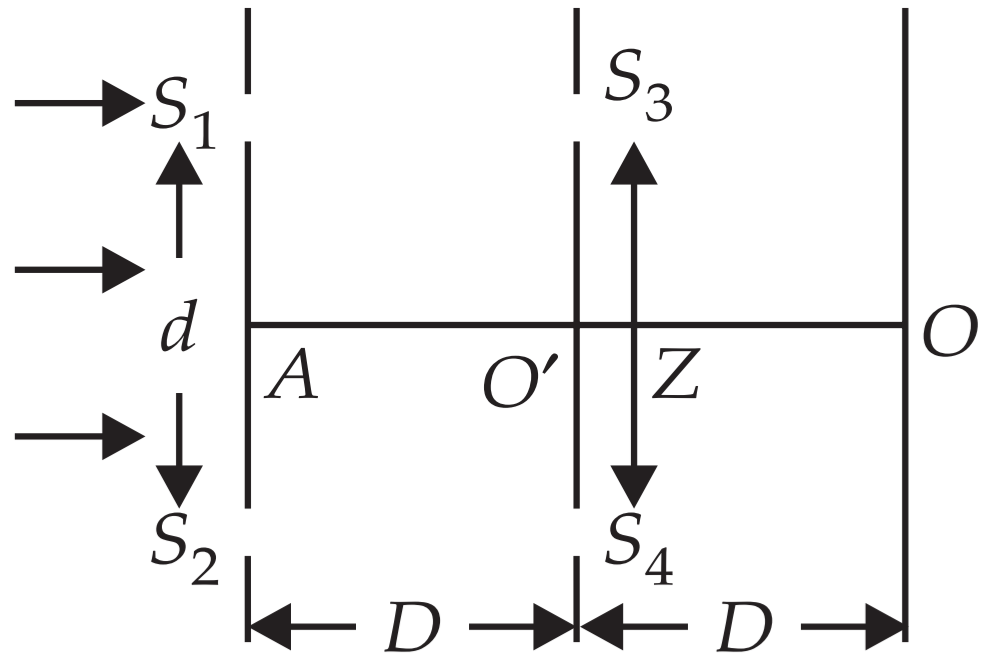
ln the arrangement shown in figure, slit $S_3$ and $S_4 $ are having a variable separation $Z$. Point $O$ on the screen is at the common perpendicular bisector of $S_1,S_2$ and $S_3,S_4.$
  1. The maximum number of possible interference maxima for slit separation equal to twice the wavelength in Young's double $-$ slit experiment, is:
  1. Does not move at all.
  2. Gets displaced from its earlier position.
  3. Becomes coloured.
  4. Disappears.
  5. ln a two slit experiment with white light, a white fringe is observed on a screen kept behind the slits. When the screen is moved away by $0.05m,$ this white fringe.
  6. Remain unaltered.
  7. Become wider.
  8. Become narrower.
  9. Disappear.
  10. When the complete Young's double slit experiment is immersed in water, the fringes.
  11. Unchanged
  12. Halved
  13. Doubled
  14. Quadrupled
  15. ln Young's double slit experiment, if the separation between the slits is halved and the distance between the slits and the screen is doubled, then the fringe width compared to the unchanged one will be.
  16. Wider
  17. Brighter
  18. Narrower
  19. Darker
  20. ln Young's double $- $ slit experiment if yellow light is replaced by blue light, the interference fringes become.
  21. Infinite
  22. Five
  23. Three
  24. Zero
What is nuclear force? Write its properties. What do you mean by stability of a nucleus ?
The radius of a thin hollow metal sphere (spherical shell) is 30 cm . And there is a charge of 500 $\mu C$ on that spherical shell. Find the electric field intensity at a distance.(i) 1 meter, (ii) 30 cm , (iii) 10 cm , from the centre of the cell.
A bar magnet has a length of $8\ cm$. The magnetic field at a point at a distance $3\ cm$ from the centre in the broadside$-$on position is found to be $4 \times 10^{-6} T$. Find the pole strength of the magnet.
In an electromagnetic wave both the electric and magnetic fields are perpendicular to the direction of propagation, that is why electromagnetic waves are transverse in nature. Electromagnetic waves carry energy as they travel through space and this energy is shared equally by the electric and magnetic fields. Energy density of an electromagnetic waves is the energy in unit volume of the space through which the wave travels.
(i) The electromagnetic waves propagated perpendicular to both $\vec{E}$ and $\vec{B}$. The electromagnetic waves travel in the direction of
(a) $\vec{E} \cdot \vec{B}$
(b) $\vec{B} \cdot \vec{E}$
(c) $\vec{E} \times \vec{B}$
(d) $\vec{B} \times \vec{E}$

(ii) Fundamental particle in an electromagnetic wave is
(a) photon (b) phonon (c) electron (d) proton

(iii) Electromagnetic waves are transverse in nature is evident by
(a) diffraction (b) interference (c) polarisation (d) reflection

OR

The electric and magnetic fields of an electromagnetic waves are
(a) in opposite phase and parallel to each other
(b) in phase and parallel to each other.
(c) in phase and perpendicular to each other
(d) in opposite phase and perpendicular to each other

(iv) d) in opposite phase and perpendicular to each other
(a) frequency (b) wavelength (c) velocity (d) all these depend on each other
A short magnet oscillates in an oscillation magnetometern with a time period of 0.10s where the earth's horizontal magnetic field is $24\mu\text{T}.$ A downward current of 18 A is established in a vertical wire placed 20cm east of the magnet. Find the new time period.
A metal rod is placed along the axis of a solenoid carrying a high-freqμency alternating current. It is found that the rod gets heated. Explain why the rod gets heated.
 A magnetic field can be produced by moving, charges or electric currents. The basic equation governing the magnetic field due to a current distribution is the Biot-Savart law. Finding the magnetic field resulting from a current distribution involves the vector product, and is inherently a calculas problem when the distance from the current to the field point is continuously changing. According to this law, the magnetic field at a point due to a current element of length $\text{d}\vec{\text{I}}$ carrying current I, at a distance r from the element is $\text{dB}=\frac{\mu_0}{4\pi}\frac{\text{I}(\text{d}{\vec{\text{I}}\times\vec{\text{r}}})}{\text{r}^3}$Biot-Savart law has certain similarities as well as difference with Coloumb's law for electrostatic field e.g., there is an angle dependence in Biot-Savart law which is not present in electrostatic case.
  1. The direction of magnetic field $\text{d}\vec{\text{B}}$ due to a current element $\text{Id}\vec{\text{l}}$ at a point of distance $\vec{\text{r}}$ from it, when a current I passes through a long conductor is in the direction
  1. Of position vector $\vec{\text{r}}$ of the point.
  2. Of current element $\text{Id}\vec{\text{l}}$
  3. Perpendicular to both $\text{d}\vec{\text{l}}$ and $\vec{\text{r}}$
  4. Perpendicular to $\text{d}\vec{\text{l}}$ only.
  1. The magnetic field due to a current in a straight wire segment of length Lat a point on its perpendicular bisector at a distance r (r >> L)
  1. Decreases as $\frac{1}{\text{r}}$
  2. Decreases as $\frac{1}{\text{r}^2}$
  3. Decreases as $\frac{1}{\text{r}^3}$
  4. approaches a finite limit as $\text{r}\rightarrow\infty$
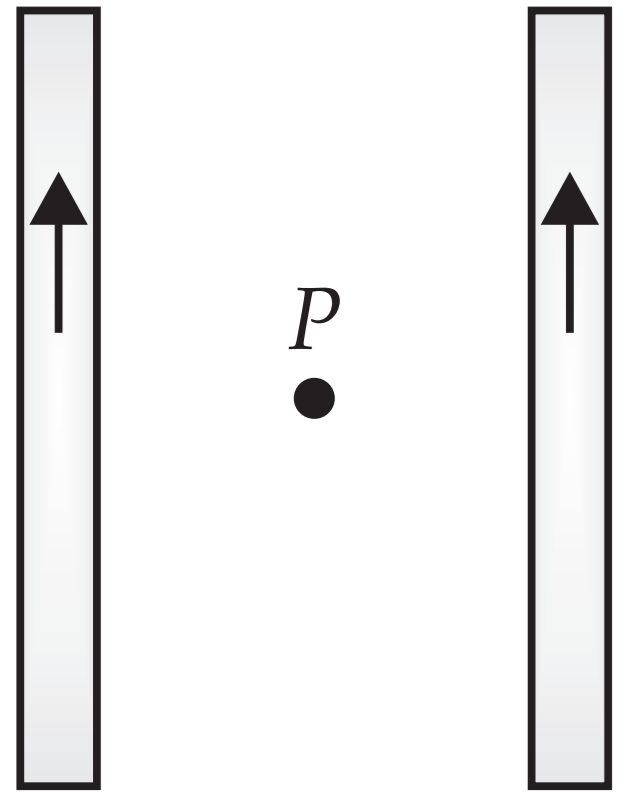
  1. Two long straight wires are set parallel to each other. Each carries a current i in the same direction and the separation between them is 2r. The intensity of the magnetic field midway between them is:
  1. $\mu_0\frac{\text{i}}{\text{r}}$
  2. $4\mu_0\frac{\text{i}}{\text{r}}$
  3. $\text{Zero}$
  4. $\mu_0\frac{\text{i}}{\text{4r}}$
  1. A long straight wire carries a current along the z-axis for any two points in the x - y plane. Which of the following is always false?
  1. The magnetic fields are equal.
  2. The directions of the magnetic fields are the same.
  3. The magnitudes of the magnetic fields are equal.
  4. The field at one point is opposite to that at the other point.
  1. Biot-Savart law can be expressed alternatively as:
  1. Coulomb's Law.
  2. Ampere's circuital law.
  3. Ohm's Law.
  4. Gauss's Law.