Question
Column AColumn B (New Terminology)
(1) D.P.D.(a) Osmotic potential
(2) O.E(b) Pressure potential
(3) T.P(c) Water potential

Answer

Column AColumn B (New Terminology)
(1) D.P.D.(c) Water potential
(2) O.E(a) Osmotic potential
(3) T.P(b) Pressure potential

Need a full question paper?

Generate a complete, print-ready paper with questions like this in minutes — across 16+ boards, with answer keys.
Start Generating Free

Similar questions

Read the following and answer any four questions from (i) to (v) given below:
Rohan, a 13 year old school student, has been diagnosed with AIDS. He often complains of fever, nausea, headache and lethargy. Doctor advised some drugs to prolong his life.
  1. What could be the most likely mode of transmission of disease to Rohan?
  1. Artificial insemination.
  2. Sexual intercourse with infected partner.
  3. Sexual intercourse with infected partner.
  4. Use of contaminated blade.
  1. Name the drug prescribed for treatment of this disease.
  1. Zidovudine.
  2. Taxol.
  3. Vinblastine.
  4. Both (a) and (c).
  1. Assertion: AIDS is an incurable STD.
Reason: AIDS virus attacks helper T-lymphocytes.
  1. Both assertion and reason are true, and reason is the correct explanation of assertion.
  2. Both assertion and reason are true, but reason is not the correct explanation of assertion.
  3. Assertion is true, but reason is false.
  4. Both assertion and reason are false.
  1. AIDS cannot be diagnosed by:
  1. ELISA.
  2. PCR.
  3. Western blotting.
  4. VDRL.
  1. AIDS can be transmitted by:
  1. Sharing towels.
  2. Kissing.
  3. Sharing contaminated needles.
  4. All of these.
Read the following and answer any four questions from (i) to (v) given below:
Haemophilia is a sex linked disease which is also known as bleeder's disease as the patient will continue to bleed even from a minor cut since he or she does not possess the natural phenomenon of blood clotting due to absence of anti -haemophilic globulin or factor VIII and plasma thromboplastin factor IX essential for it. As a result of continuous bleeding the patient may die of blood loss. Colour blindness is another type of sex linked trait in which the eye fails to distinguish red and green colours. Vision is however, not affected and the colour blind can, lead a normal life, reading, writing and driving (distinguishing traffic lights by their position).
  1. If a haemophilic man marries a woman whose father was haemcphihc and mother was normal then which of the following holds true for their progenies?
  1. Of the total number of daughters, 50% daughters are carrier and $50 \%$ are haemophilic.
  2. All the daughters are haemophilic.
  3. All sons are haemophilic and all daughters are normal.
  4. All sons are normal, all daughters are carriers.
  1. A man whose father was colourblind and mother was normal marries a woman whose father was haemophilic and mother was normal. Which of the following is true for their progenies? [Note: Percentage is from the total number of progenies]
  1. $25 \%$ female progenies carry the gene for both haemophilia and colourblindness.
  2. $25 \%$ male progenies carry only the gene of colourblindness.
  3. $25 \%$ female progenies carry only the gene of colourblindness.
  4. $25 \%$ male progenies and 25% female progenies carry the gene of haemophilia.
  1. Which of the following statements is incorrect regarding haemophilia?
  1. It is a dominant disease.
  2. A single protein involved in clotting of blood is affected.
  3. It is recessive disease.
  4. It is Mendelian disorder.
  1. Anup is having colourblindness and is married to Soni who is normal. What is the chance that their son will have the disease?
  1. $100 \%$
  2. $50 \%$
  3. $25 \%$
  4. $0 \%$
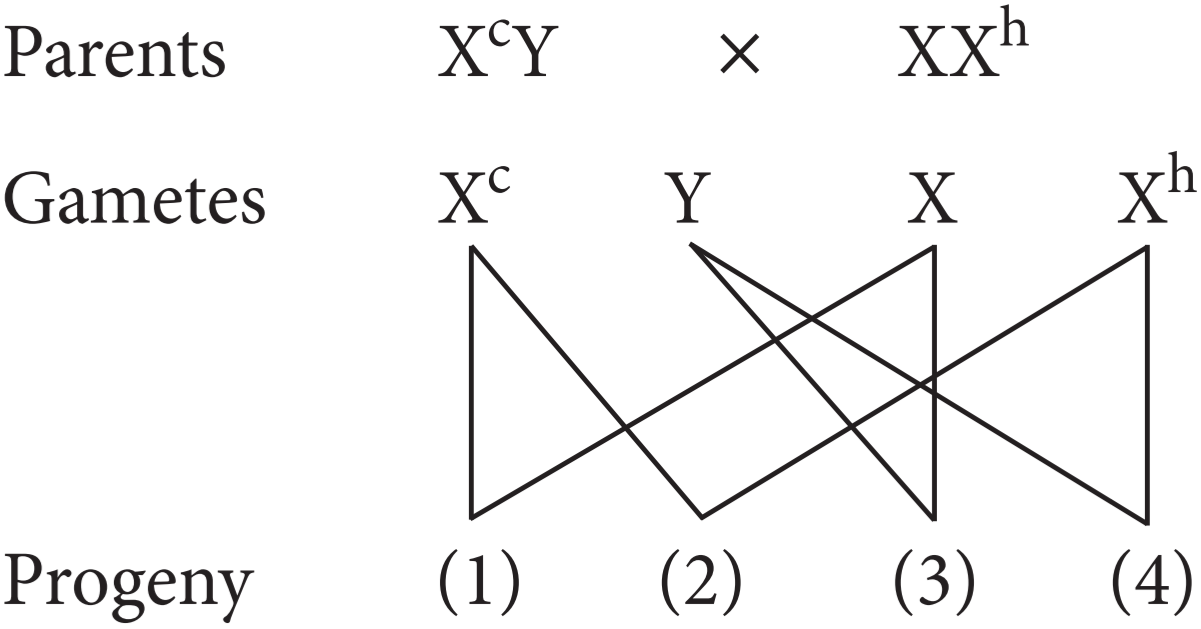
  1. Refer to the given cross?


Select the correct option regarding $1, 2, 3$ and $4$.
  1. The options are as follow:
  1. Colourblind carrier female.
  2. Colourblind haemophilic female.
  3. Normal male.
  4. Haemophilic male
  1. The options are as follow:
  1. Colourblind people
  2. Haemophilic female.
  3. Normal male
  4. Haemophilic male
  1. The options are as follow:
  1. Colourblind female
  2. Colourblind and haemophilic female
  3. Normal male
  4. Normal male.
  1. The options are as follow:
  1. Colourblind carrier female.
  2. Normal female.
  3. Normal male.
  4. Haemophilic male.
Distinguish between: Primary sex organs and Secondary sex organs.
Distinguish between: Phase of cell division and Phase of cell enlargement
Distinguish between : Neutrophils and Eosionophils.
Read the following and answer any four questions from (i) to (v) given below:
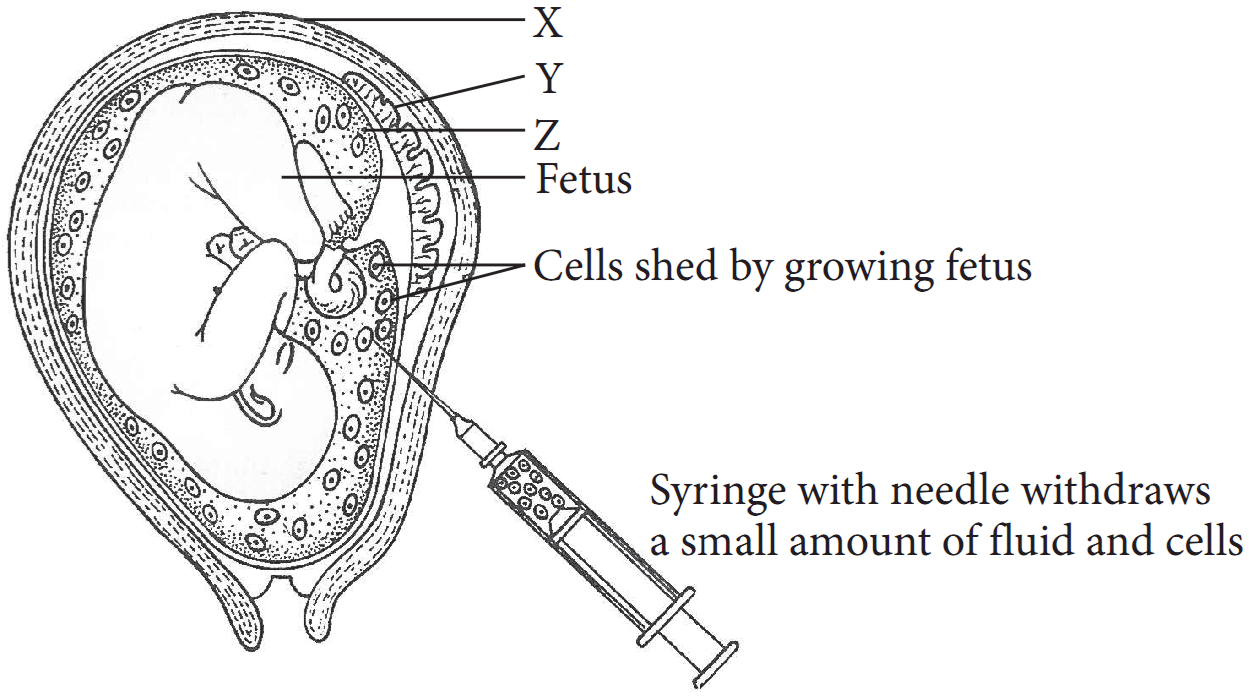
A technique known as amniocentesis is used to determine fetal abnormalities. This test chromosomal pattern in amniotic fluid. However, this technique is legally banned now.
  1. Identify X and Y in the above given figure.
S. No
X
Y
(a)
Amnion
Chorion
(b)
Uterine wall
Placenta
(c)
Placenta
Uterine wall
(d)
Uterine wall
Amnion
  1. What is the function of Z?
  1. Z is an amniotic fluid which prevents dessication of an embryo.
  2. Z is yolk sac which functions as site of early blood cell formation.
  3. Z is amnion, which takes part in placenta formation.
  4. None of these
  1. Which of the following diseases can not be diagnosed by amniocentesis?
  1. Down's syndrome.
  2. Sickle cell disease.
  3. Jaundice.
  4. Cystic fibrosis.
  1. Assertion: Amniocentesis is legally banned for sex determination.
Reason: Amniocentesis was being misused for aborting normal female fetus.
  1. Both assertion and reason are true, and reason is the correct explanation of assertion.
  2. Both assertion and reason are true, but reason is not the correct explanation of assertion.
  3. Assertion is true, but reason is false.
  4. Both assertion and reason are false.
  1. Which of these is a non-invasive technique of detecting fetal disorder?
  1. Fetoscopy.
  2. Chorionic villi sampling.
  3. Amniocentesis.
  4. Ultrasound imaging.
Read the following and answer any four questions from (i) to (v) given below:
Growth of a population with time shows specific and predictable patterns. Two types of growth pattern of population are exponential and logistic growth. When resources in the habitat are unlimited each species has the ability to realise fully its innate potential to grow in number. Then the population grows in exponential fashion. When the resources are limited growth curve shows an initial slow rate and then it accelerates and finally slows giving the growth curve which is sigmoid.
  1. Which of the following statement is incorrect?
  1. Exponential growth occurs in organism such as lemmings.
  2. Logistic growth is more realistic.
  3. Exponential growth has two phases lag and log.
  4. ln logistic growth, population passes well beyond the carrying capacity of ecosystem.
  1. Which of the following equations correctly represents the exponential population growth curve?
  1. $\text{dN}/\text{dt}=\text{rN}$
  2. $\text{dN}/\text{dt}=\text{rN}\Big(\frac{\text{K-N}}{\text{K}}\Big)$
  3. $\text{N}_\text{t}=\text{N}_\text{o}\text{e}^\text{rt}$
  4. Both (a) and (c).
  1. Which of the following equations correctly represents Verhulst-Pearl logistic growth?
  1. $\text{dN}/\text{dt}=\text{rN}\Big(\frac{\text{K-N}}{\text{K}}\Big)$
  2. $\text{dN}/\text{dt}=\frac{\text{rN}}{\text{K}}$
  3. $\text{dN}/\text{dt}=\frac{\text{N}(\text{K}-\text{N})}{\text{K}}$
  4. $\text{dN}/\text{dt}=\frac{\text{r}(\text{K}-\text{N})}{\text{K}}$
  1. The population growth is generally described by the following equation:
$\frac{\text{dN}}{\text{dt}}=\text{rN}\Big(\frac{\text{K}-\text{N}}{\text{K}}\Big)$

What does 'r' represent in the given equation?
  1. Population density at time 't'.
  2. Intrinsic rate of natural increase.
  3. Carrying capacity.
  4. The base of natural logarithm.
  1. Study the population growth curves (A and B) in the given graph and select the incorrect option.
  1. Curve 'A: shows exponential growth, represented by equation $\frac{\text{dN}}{\text{dt}}=\text{rN}$.
  2. Curve 'B' shows logistic growth, represented by equation $\frac{\text{dN}}{\text{dt}}=\text{rN}\Big(\frac{\text{K}-\text{N}}{\text{K}}\Big)$
  3. Exponential growth curve is considered as more realistic than the logistic growth curve.
  4. Curve 'A' can also be represented by equation $\text{N}_\text{t}=\text{N}_\text{o}\text{e}^\text{rt}$.
Distinguish between : Systolic blood circulation and Diastolic blood circulation.
Read the following and answer any four questions from (i) to (v) given below:
Embryo develops at the micropylar end of the embryo sac, where the zygote is situated. Most zygotes divided only after certain amount of endosperm is formed. The early stages of embryo development are similar in both monocotyledons and dicotyledons. The zygote gives rise to the proembryo and subsequently to the globular heart-shaped and mature embryo. A typical dicotyledonous embryo consists of an embryonal axis and two cotyledons. Embryo of monocotyledons possess only one cotyledon.
  1. True embryo develops as a result of fusion of:
  1. Two polar nuclei of embryo sac.
  2. An egg cell and a male gamete.
  3. Synergid and male gamete.
  4. A male gamete and antipodals.
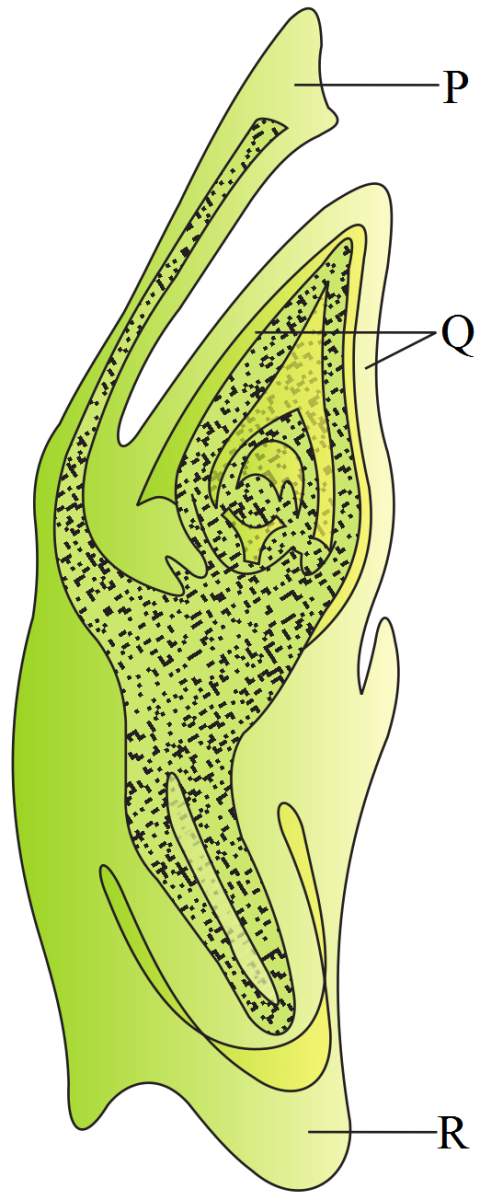
  1. Refer to the given diagram of the embryo of an angiospermous plant with parts labelled P, Q and R. Select the correct statement(s) regarding this.
  1. Part 'P' supplies nutrition to the developing embryo.
  2. Part 'Q' is the protective sheath of radicle and root cap.
  3. Part 'R' is the protective sheath of shoot apex and leaf primordia.
  4. The embryo shown in the diagram is present in members of Family Poaceae.
  1. (IV) only.
  2. (II) and (III) only.
  3. (I) and (IV) only.
  4. (I), (II), (III) and (IV).
  1. Which of the given statements are true?
  1. During the development of a dicot embryo, heart-shaped embryo is followed by globular embryo.
  2. The part of embryonal axis above the level of cotyledons is epicotyl, while the part below the level of cotyledons is hypocotyl.
  3. Monocot seeds possess a single cotyledon, represented by scutellum.
  1. (I) and (II).
  2. (II) and (III).
  3. (I) and (III).
  4. (I), (II) and (III).
  1. Consider the following parts of an embryonal axis of a dicot seed.
  1. Hypocotyl.
  2. Epicotyl.
  3. Radicle.
  4. Plumule.
In which of the following the above parts are correctly arranged from top to base?
  1. (III) → (I) → (II) → (IV).
  2. (II) → (I) → (III) → (IV).
  3. (IV) → (II) → (I) → (III).
  4. (III) → (IV) → (II) → (I).
  1. In grass family, the cotyledon, is called:
  1. Epiblast.
  2. Plumule.
  3. Scutellum.
  4. Perisperm.
Read the following and answer any four questions from (i) to (v) given below:
Study the two cases carefully regarding the pattern of inheritance of disease.
Case
Mother
Father
Children
Case I
With disease
Normal
Sons always with diseases
Case II
With disease
Normal
Sons and daughters could show disease
  1. Which of the following diseases is not an example of case I?
  1. Haemophilia.
  2. Colour blindness.
  3. Aa, AA, Aa, Aa, aa
  4. Night blindness.
  1. Which of the following is impossible for a case I?
  1. Carrier mother to pass the gene to her son.
  2. Diseased father to pass the gene to his daughter.
  3. Diseased father to pass the gene to his son.
  4. Carrier mother to pass the gene to her daughter.
  1. If inheritance pattern of disease is as case II and both parents are carrier of disease what are the chances of pregnancy resulting in an affected child?
  1. 25%
  2. 100%
  3. 0%
  4. 50%
  1. Disease that follows inheritance pattern as case I is linked with?
  1. Autosomes.
  2. X chromosome.
  3. Y chromosome
  4. Chromosome 21.
  1. Study the given pedigree chart showing the inheritance pattern as case II.


Study the given pedigree chart showing the inheritance pattern as case II.
  1. Aa, aa, aa, AA, aa
  2. Aa, aa, Aa, AA, Aa
  3. Aa, Aa, aa, AA, AA
  4. Aa, AA, Aa, Aa, aa