Question
| Column I | Column II |
| 1. Vibrio | a. Rod-shaped |
| 2. Bacillus | b. Spherical |
| 3. Spirillum | c. Spiral shaped |
| d. Comma or kidney-shaped |
| Column I | Column II |
| 1. Vibrio | a. Rod-shaped |
| 2. Bacillus | b. Spherical |
| 3. Spirillum | c. Spiral shaped |
| d. Comma or kidney-shaped |
| Column I | Column II |
| 1. Vibrio | d. Comma or kidney-shaped |
| 2. Bacillus | a. Rod-shaped |
| 3. Spirillum | c. Spiral shaped |
Generate a complete, print-ready paper with questions like this in minutes — across 16+ boards, with answer keys.
| i. | Descending limb of Henle’s loop | a. | Reabsorption of salts only |
| ii. | Proximal convoluted tubule | b. | Reabsorption of water only |
| iii. | Ascending limb of Henle’s loop | c. | Conditional reabsorption of sodium ions and water |
| iv. | Distal convoluted tubule | d. | Reabsorption of ions, water and organic nutrients |
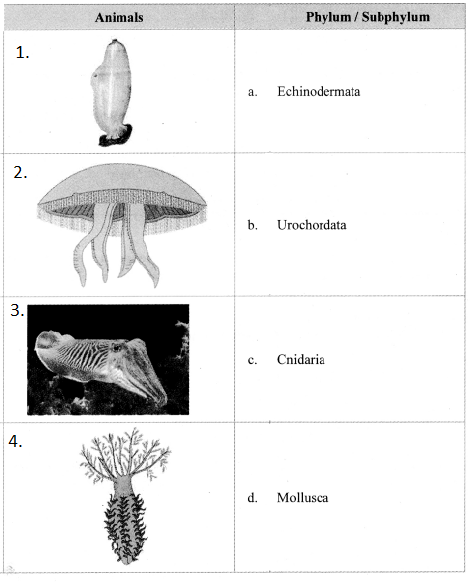
| Column I | Column II |
| 1. Bryophyta | (a) 70 genera and 1000 living species |
| 2. Pteridophyta | (b) 32 genera and 80 species |
| 3. Gymnospermae | (c) 960 genera and 25000 species |
| (d) 400 genera and 11000 species |
| Column – I | Column – II |
| 1. Saprophyte | (a) Symbiotic association of fungi with plants roots |
| 2. Parasite | (b) Decomposition of dead |
| 3. Lichens | (c) Living on living plants or animals |
| 4. Mycorrhiza | (d) Symbiotic association of algae and fungi |
| Kingdom | Examples |
| 1. Monera | a. Riccia |
| 2. Protista | b. Cyanobacteria |
| 3. Plantae | c. Rhizopus |
| 4. Fungi | d. Diatoms |
| Column I | Column II | |
| i. | Cardiac Sphincter Pyloric | a. Regulates the flow of food from stomach to small intestine. |
| ii. | sphincter | b. Controls the passage of food from oesophagus into the stomach. |
| iii. | Gastro-oesophageal sphincter | c. Prevents back flow of food from stomach to oesophagus. |
| Column I | Column II |
| 1. Protoxylem | (a) Xylem with larger vessels |
| 2. Endarch Xylem | (b) Protoxylem arranged towards pith |
| 3. Metaxylem | (c) Metaxylem arranged towards pith |
| 4. Exarch xylem | (d) First formed xylem vessels |
| Column I | Column II |
| 1. Herbarium | (a) It is a place having a collection of preserved plants and animals |
| 2. Key | (b) A list that enumerates methodically all the species found in an area with brief description aiding identification |
| 3. Museum | (c) It is a place where dried and pressed plant specimens mounted on sheets are kept |
| 4. Catalogue | (d) A booklet containing a list of characters and their alternates which are helpful in identification of various taxa. |
| Column I | Column II |
| 1. Mitochondria | (a) Synthesis of protein |
| 2. Nucleus | (b) Photosynthesis |
| 3. Chloroplast | (c) Respiration |
| 4. Ribosomes | (d) Nucleoplasm |