Question
Comment on the statement that elements of the first transition series possess many properties different from those of heavier transition elements.

Answer

There are the following differences in the properties of first transition series elements and heavy transition elements : 
(i) Elements of the first transition series generally show +2 and +3 oxidation states, whereas in heavier transition elements, higher oxidation states are more stable.
(ii) The elements of the first transition series do not have metal-metal (M-M) bond which is generally found in heavy transition elements. For this reason, the melting points of heavy transition elements are higher than the melting points of the elements of the first transition series.
(iii) Elements of the first transition series do not form complexes with high coordination numbers, like 7 to 8, whereas heavy transition elements also form complexes with coordination numbers 7 or 8.
(iv) Nature of the ligand in the elements of the first transition series, on the basis of strength, low spin complexes and high spin complexes are formed, whereas heavy transition elements always form low spin complexes.
Need a full question paper?

Generate a complete, print-ready paper with questions like this in minutes — across 16+ boards, with answer keys.

Start Generating Free

Similar questions

Read the following text carefully and answer the questions that follow:
Raoult's law for volatile liquids states that the partial vapour pressure of each component in the solution is directly proportional to its mole fraction, whereas for a non$-$volatile solute, it states that the vapour pressure of a solution of a non$-$volatile solute is equal to the vapour pressure of the pure solvent at that temperature multiplied by its mole fraction. Two liquids $A$ and $B$ are mixed with each other to form a solution, the vapour phase consists of both components of the solution. Once the components in the solution have reached equilibrium, the total vapour pressure of the solution can be determined by combining Raoult's law with Dalton's law of partial pressures. If a non$-$volatile solute $B$ is dissolved into a solvent $A$ to form a solution, the vapour pressure of the solution will be lower than that of the pure solvent. The solutions which obey Raoult's law over the entire range of concentration are ideal solutions, whereas the solutions for which vapour pressure is either higher or lowerthan that predicted by Raoult's law are called non$-$ideal solutions. Non$-$ideal solutions are identified by determining the strength of the intermolecular forces between the different molecules in that particular solution.They can either show positive or negative deviation from Raoult's law depending on whether the $A - B$ interactions in solution are stronger or weaker than $A - A$ and $B - B$ interactions.
$i. 20\ mL$ of a liquid $A$ was mixed with $20\ mL$ of liquid $B$. The volume of resulting solution was found to be less than $40\  mL$. What do you conclude from the above data?
$ii.$ Which of the following show positive deviation from Raoult's law? Carbon disulphide and Acetone; Phenol and Aniline; Ethanol and Acetone.
$iii.$ The vapour pressure of a solution of glucose in water is $750\ mm\ Hg$ at $100^\circ C.$ Calculate the mole fraction of solute.
$($Vapour pressure of water at $373 K = 760\ mm\ Hg)$
$OR$
$iii.$ The boiling point of solution increases when $1$ mol of $\text{NaCl}$ is added to $1$ litre of water while addition of $1$ mol of methanol to one litre of water decreases its boiling point. Explain the above observations.
Explain colour in coordination compounds.
Out of pure liquid and azeotrope showing positive deviation, Which one has a higher boiling point?
What is the effect of pressure and temperature on crystal structure?
Explain giving reasons :
(i) Alcohols are generally soluble in water.
(ii) Phenols boil at higher temperature than arenes of comparable molecular mass.
(iii) The lower homologues of alcohols are soluble in water whereas phenols are slightly soluble in water.
(v) Boiling point of an alcohol is higher than the corresponding alkane.
(vi) The solubility of alcohols in water decreases with increase in molecular mass.
Draw the shape of the following molecules :
(1) $XeOF _4$
(2) $B r F _3$
(3) $HClO _4$
(4) $XeF _2$
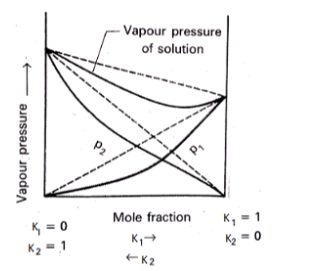
Read the following text carefully and answer the questions that follow: Raoult's law states that for a solution of volatile liquids, the partial vapour pressure of each component of the solution is directly proportional to its mole fraction present in solution.
Dalton's law of partial pressure states that the total pressure $(P_{total})$ over the solution phase in the container will be the sum of the partial pressures of the components of the solution and is given as: $P_{total} = P1 + P2$
Image
i. Is the above $-$ mentioned Raoult's law applicable for non $-$ volatile liquids?
ii. What type of deviation from Raoult's law does the above graph represent?
iii. Give an example of such system.
$OR$
iii. A solution of two liquids boils at a temperature more than the boiling point of either of them. What type of deviation will be shown by the solution formed in terms of Raoult's law?
What is ligand? Explain classification of ligand.
Write a note on collision theory of chemical reaction. ### What is meant by collision theory? Explain.
Give examples and suggest reasons for the following features of the transition metal chemistry :
(i) The lowest oxide of transition metal is basic, the highest is amphoteric/acidic.
(ii) A transition metal exhibits highest oxidation state in oxides and fluorides.
(iii) The highest oxidation state is exhibited in oxoanions of a metal.