Question
Comment on the statement that elements of the first transition series possess many properties different from those of heavier transition elements.

Answer

The properties of the elements of the first transition series differ from those of the heavier transition elements in many ways.
  1. The atomic sizes of the elements of the first transition series are smaller than those of the heavier elements (elements of 2ndand 3rdtransition series).
However, the atomic sizes of the elements in the third transition series are virtually the same as those of the corresponding members in the second transition series. This is due to lanthanoid contraction.
  1. +2 and +3 oxidation states are more common for elements in the first transition series, while higher oxidation states are more common for the heavier elements.
  2. The enthalpies of atomisation of the elements in the first transition series are lower than those of the corresponding elements in the second and third transition series.
  3. The melting and boiling points of the first transition series are lower than those of the heavier transition elements. This is because of the occurrence of stronger metallic bonding (M-M bonding).
  4. The elements of the first transition series form low-spin or high-spin complexes depending upon the strength of the ligand field. However, the heavier transition elements form only low-spin complexes, irrespective of the strength of the ligand field.

Need a full question paper?

Generate a complete, print-ready paper with questions like this in minutes — across 16+ boards, with answer keys.
Start Generating Free

Similar questions

  1. $30 g$ of urea $(M = 60 g mol^{-1})$ is dissolved in 846 g of water. Calculate the vapour pressure of water for this solution if vapour pressure of pure water at $298 K$ is $23.8$ mm Hg.
  2. Write two differences between ideal solutions and non-ideal solutions.
Write the $" \text{IUPAC}"$ names of the following coordination compounds:
$a. \left[ Pt \left( NH _3\right)_2 Cl \left( NO _2\right]\right.$
$b. K _3\left[ Cr \left( C _2 O _4\right)_3\right]$
$c. \left[ CoCl _2( en )_2\right] Cl$
$d. \left[ Co \left( NH _3\right)_5\left( CO _3\right)\right] Cl$
$e. Hg \left[ Co ( SCN )_4\right]$
Explain the elimination reaction of haloalkanes.
Discuss the different chemical properties of amines.
Write a detailed note on enzymes.
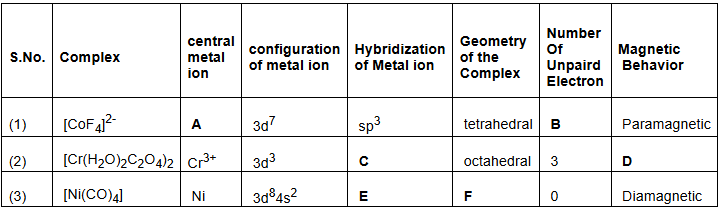
$(a).$ Using, Valence Bond Theory identify $A, B, C, D, E$ and $F$ in the following table:
Image
$(b).$ Write the ionic equations for the reaction of acidified $K_2Cr_2O_7$ with
$(i) \ H_2S$ and $(ii) \ FeSO_4$
Shyam went to a grocery shop to purchase some food items. The shopkeeper packed all the items in polythene bags and gave them to Shyam. But Shyam refused to accept the polythene bags and asked the shopkeeper to pack the items in paper bags. He informed the shopkeeper about the heavy penalty imposed by the government for using polythene bags. The shopkeeper promised that he would use paper bags in future in place of polythene bags.Answer the following:
  1. Write the values (at least two) shown by Shyam.
  2. Write one structural difference between low-density polythene and high-density polythene.
  3. Why did Shyam refuse to accept the items in polythene bags?
  4. What is a biodegradable polymer? Give an example.
Classify carbohydrates and also give examples of each.
A mixed oxide of iron and chromium,$ FeOCr_2O_3$ is fused with sodium carbonate in the presence of air to form a yellow coloured compound $(A)$. On acidification the compound $(A)$ forms an orange coloured compound $(B)$, which is a strong oxidising agent.
  1. Identify the compounds $(A)$ and $(B).$
  2. Write balanced chemical equation for each step.
What is abnormal molar mass? Explain.