Compare and explain three distinguishing features observed in Young’s double slit interference pattern with those seen for a coherently illuminated single slit producing diffraction pattern.
CBSE OUTSIDE DELHI - SET 2 GUHAWATI 2015
Download our app for free and get started
| Interference | Diffraction |
|
|

Download our appand get started for free
Experience the future of education. Simply download our apps or reach out to us for more information. Let's shape the future of learning together!No signup needed.*
Similar Questions
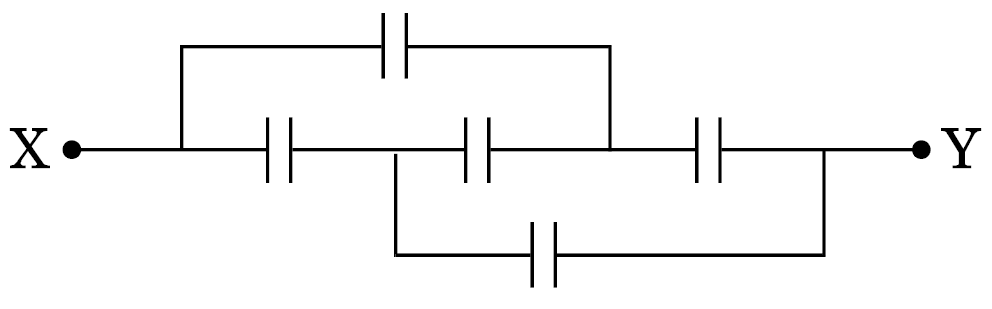
- 1Find the equivalent capacitance of the network shown in the figure, when each capacitor is of $1\mu\text{F}$. When the ends X and Y are connected to a 6 V battery, find out (i) The charge and (ii) The energy stored in the network.View Solution
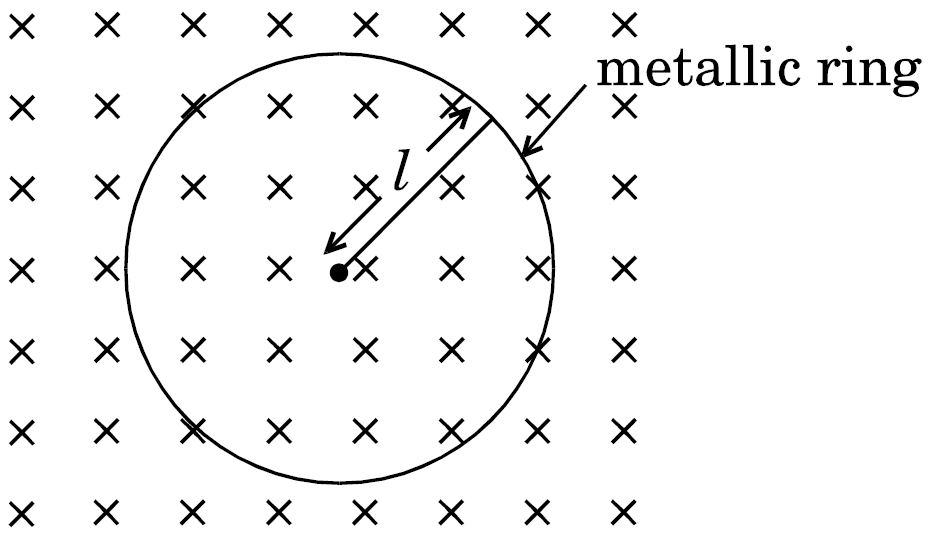
- 2View SolutionA metallic rod of length ‘l’ is rotated with a frequency ‘v’, with one end hinged at the centre and the other end at the circumference of a circular metallic ring, about an axis passing through the centre and perpendicular to the plane of the ring. A constant and uniform magnetic field B parallel to the axis is present everywhere.
- Obtain the expression for the emf induced between the centre and the ring.
- Given that the rod has resistance ‘R’, then how much power will be generated?
- 3View Solution
- What are the three basic units in communication systems? Write briefly the function of each of these.
- Write any three applications of the internet used in communication systems.
- 4A resistor of 100 $\Omega$ and a capacitor of $100 / \pi\mu\text{F}$ are connected in series to a 220 V, 50 Hz a.c. supply.View Solution
- Calculate the current in the circuit.
- Calculate the (rms) voltage across the resistor and the capacitor. Do you find the algebraic sum of these voltages more than the source voltage? If yes, how do you resolve the paradox?
- 5View SolutionState the principle of a cyclotron. Show that the time period of revolution of particles in a cyclotron is independent of their speeds. Why is this property necessary for the operation of a cyclotron?
- 6In a series LCR circuit connected to an ac source of variable frequency and voltage v $v_m= \sin, $ draw a plot showing the variation of current (I) with angular frequency ($\omega$) for two different values of resistance R1 and R2(R1 > R2 ). Write the condition under which the phenomenon of resonance occurs. For which value of the resistance out of the two curves, a sharper resonance is produced? Define Q-factor of the circuit and give its significance.View Solution
- 7An inductor-coil, a capacitor and an AC source of rms voltage 24V are connected in series. When the frequency of the source is varied, a maximum rms current of 6.0A is observed. If this inductor coil is connected to a battery of emf 12V and internal resistance $4.0\Omega,$ what will be the current?View Solution
- 8View Solution
- What is total internal reflection? Under what conditions does it occur?
- Find a relation between critical angle and refractive index.
- Name one phenomenon which is based on total internal reflection.
- 9View SolutionDraw a labelled diagram of an a.c. generator. Explain briefly its principle and working.
- 10View Solution
- Distinguish between a conductor and a semi conductor on the basis of energy band diagram.
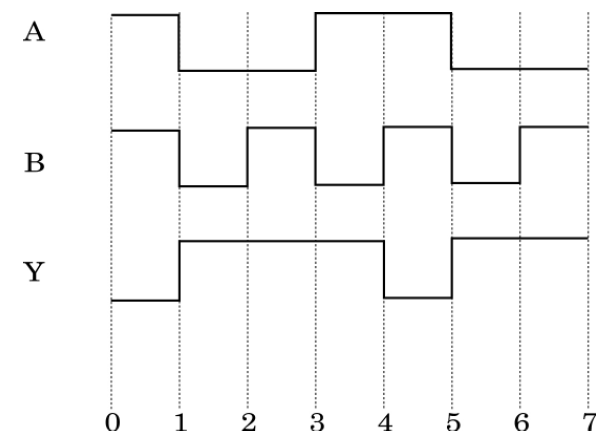
- The following figure shows the input waveforms (A, B) and the output waveform (Y) of a gate. Identify the gate, write its truth table and draw its logic symbol.