A resistor of 100 $\Omega$ and a capacitor of $100 / \pi\mu\text{F}$ are connected in series to a 220 V, 50 Hz a.c. supply.
- Calculate the current in the circuit.
- Calculate the (rms) voltage across the resistor and the capacitor. Do you find the algebraic sum of these voltages more than the source voltage? If yes, how do you resolve the paradox?
CBSE OUTSIDE DELHI - SET 2 CHENNAI 2015
Download our app for free and get started
- Current in the circuit $\text{I} = \frac{\text{V}}{\sqrt{\text{R}^{2} + \bigg(\frac{1}{\text{C}\omega}\bigg)^{2}}}$
$ = \frac{2.2}{\sqrt{2}}\text{A} = 1.55\text{A}$
- Voltage across the resistor$ = 100\times1.55 \text{V}$
Voltage across the capacitor $ = 100\times1.55 \text{V}$
$ = 155 \text{ volt}$
Yes,
The sum of the two voltages is greater than 220 V but the voltage across the resistor and the capacitor are not in phase.

Download our appand get started for free
Experience the future of education. Simply download our apps or reach out to us for more information. Let's shape the future of learning together!No signup needed.*
Similar Questions
- 1View SolutionA series LCR circuit is connected to an ac source. Using the phasor diagram, derive the expression for the impedance of the circuit. Plot a graph to show the variation of current with frequency of the source, explaining the nature of its variation.
- 2The figure shows a series LCR circuit with L = 5.0 H, C = 80 $\mu$F, R = 40 W connected to a variable frequency 240V source. CalculateView Solution
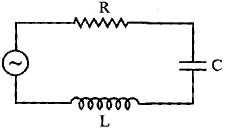
- The angular frequency of the source which drives the circuit at resonance.
- The current at the resonating frequency.
- The rms potential drop across the capacitor at resonance.
- 3An inductor 200mH, a capacitor $100\mu\text{F}$ and a resistor $10\Omega$ are connected in series to an a.c. source of 100V, having variable frequency.View Solution
- At what frequency of the applied voltage will the power factor of the circuit be 1?
- What will be the current amplitude at this frequency?
- Calculate the Q-factor of the circuit.
- 4View SolutionObtain the resonant frequency and Q-factor of a series LCR circuit with L = 3.0H, C = 27μF, and R = 7.4Ω. It is desired to improve the sharpness of the resonance of the circuit by reducing its ‘full width at half maximum’ by a factor of 2. Suggest a suitable way.
- 5View Solution
- Describe the working of photodiode by drawing the circuit diagram.
- Draw the characteristics of a photodiode for different illumination intensities.
- Why is photodiode operated in reverse bias even though the reverse bias current is much weaker than the current in forward bias?
- 6View SolutionState two important properties of photon which are used to write Einstein's photoelectric equation. Define (i) Stopping potential and (ii) Threshold frequency, using Einstein's equation and drawing necessary plot between relevant quantities.
- 7View SolutionDraw a schematic arrangement for winding of primary and secondary coils in a transformer with the two coils on separate limbs of the core. State its underlying principle and find the relation between the primary and secondary voltages in terms of the number of turns of the primary and secondary windings. How are the currents in the primary and secondary coils related to the voltages in the case of an ideal transformer?
- 8Half life of $^{238}\text{U}_{92}$against$\alpha$ decay is $4.5 \times 10^{9}$years. Calculate the activity of Ig sample of$^{238}\text{U}_{92}$? Given Avogadro's number $= 6 \times 10^{26}$atoms/kmol.View Solution
- 9An AC source of voltage $\text{V = Vm}\sin\omega\text{t}$ is applied across a series LCR circuit. Draw the phasor diagrams for this circuit, when,View Solution
- Capacitive impedance exceeds the inductive impedance.
- Inductive impedance exceeds capacitive impedance.
- 10View SolutionHow are electromagnetic waves produced? What is the source of energy of these waves? Draw a schematic sketch of the electromagnetic waves propagating along the + x-axis. Indicate the directions of the electric and magnetic fields. Write the relation between the velocity of propagation and the magnitudes of electric and magnetic fields.