MCQ
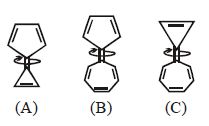
Compare carbon-carbon bond rotation energy across $A, B$ and $C$
- A$A > B > C$
- B$A > C > B$
- ✓$B > A > C$
- D$B > C > A$
Order of stability of ring: $6$ -membered $\,>\,5$- membered $\,>\,7$ membered $\,>\,4$- membered $>\, 3$-membered
Hence, $(B)$ will break most easily due to formation of stable rings. $(C)$ will not break easily due to formation of antiaromatic ring.
Generate a complete, print-ready paper with questions like this in minutes — across 16+ boards, with answer keys.
$\Psi_{2 s}=\frac{1}{2 \sqrt{2 \pi}}\left(\frac{1}{a_0}\right)^{1 / 2}\left(2-\frac{ r }{ a _0}\right) e ^{- r / 2 a _0}$
At $r=r_0$, radial node is formed. Thus, $r_0$ in terms of $a_0$