Question
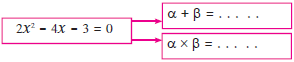
Complete the following activity to solve the quadratic equation
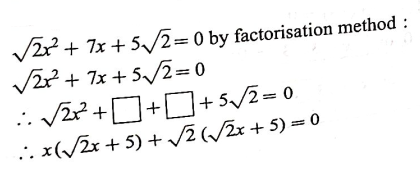
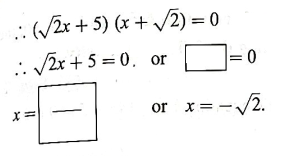
Image
Image

Answer

Get the step-by-step solution for this question inside the Vidyadip app.

Get the answer in the app

Need a full question paper?

Generate a complete, print-ready paper with questions like this in minutes — across 16+ boards, with answer keys.

Start Generating Free

Similar questions

Draw a circle and take any point P on the circle. Draw ray OP
Draw perpendicular to ray OP from point P
Find distance between point $Q(3,-7)$ and point $R(3,3)$
Solution: Suppose $Q\left(x_1, y_1\right)$ and point $R\left(x_2, y_2\right)$
$x_1=3, y_1=-7 \text { and } x_2=3, y_2=3$
Using distance formula,
$ d(Q, R)=\sqrt{\square}$
$\therefore d(Q, R)=\sqrt{\square-100}$
$\therefore d(Q, R)=\sqrt{\square}$
$\therefore d(Q, R)=\square $
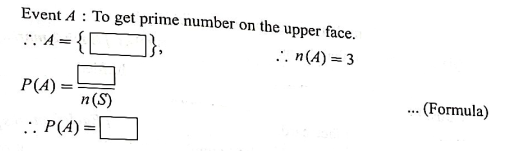
A die is rolled. Complete the following activity to find the probability of getting a prime number on the upper face of the die :
A die is rolled. S is the sample space.

Image
Image
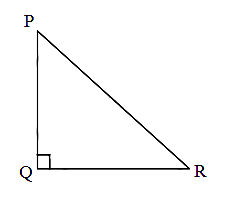
A ladder $10\ m$ long reaches a window $8\ m$ above the ground. Find the distance of the foot of the ladder from the base of wall. Complete the given activity.
Activity: As shown in figure suppose

PR is the length of ladder $=10 m$
At P - window, At Q - base of wall, At R - foot of ladder
$\therefore PQ =8 m$
$\therefore Q R=?$
In $\triangle P Q R, m \angle P Q R=90^{\circ}$
By Pythagoras Theorem,
$\therefore PQ ^2+\square= PR ^2$
Here, $P R=10, P Q=\square$
From equation (l)
$ 8^2+Q^2=10^2$
$Q R^2=10^2-8^2$
$Q R^2=100-64$
$Q R^2=\square$
$Q R=6 $
$\therefore$ The distance of foot of the ladder from the base of wall is $6 m$.
To draw tangents to the circle from the endpoints of the diameter of the circle.
Construct a circle with center O. Draw any diameter AB of it
Draw ray OA and ray OB
Construct perpendicular to ray OA from point A
Construct perpendicular to Ray OB from point B
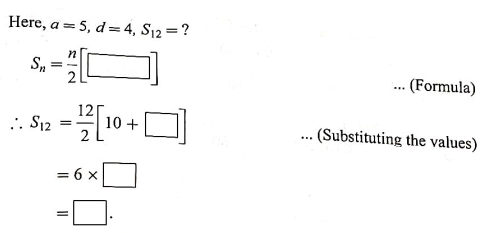
The first term of an A.P. is 5 and the common difference is 4 . Complete the following activity to find the sum of first 12 terms of this A.P.

Image
In ∆ABC, ∠C is an acute angle, seg AD ⊥ seg BC. Prove that:
AB² = BC² + AC² - 2BC×DC