Question
In ∆ABC, ∠C is an acute angle, seg AD ⊥ seg BC. Prove that:
AB² = BC² + AC² - 2BC×DC

Answer

self

Need a full question paper?

Generate a complete, print-ready paper with questions like this in minutes — across 16+ boards, with answer keys.
Start Generating Free

Similar questions

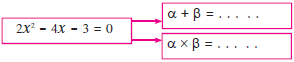
If α, β are roots of quadratic equation,
Find distance between point $A(-1,1)$ and point $B(5,-7)$ :
Solution: Suppose $A\left(x_1, y_1\right)$ and $B\left(x_2, y_2\right)$
$x_1=-1, y_1=1 \text { and } x_2=5, y_2=-7$
Using distance formula,
$ d(A, B)=\sqrt{\left(x_2-x_1\right)^2+\left(y_2-y_1\right)^2}$
$\therefore d(A, B)=\sqrt{\square+[(-7)+\square]^2}$
$\therefore d(A, B)=\sqrt{\square}$
$\therefore d(A, B)=\square $
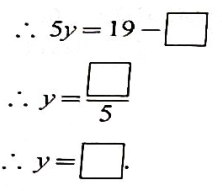
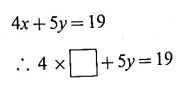
To draw the graph of $4 x+5 y=19$, complete the following activity to find $y$, when $x=1$.
Image
Image
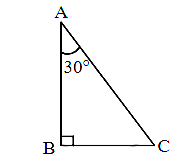
From given figure, In ∆ABC, If ∠ABC = 90° ∠CAB=30°, AC = 14 then for finding value of AB and BC, complete the following activity.

Activity: In $\triangle ABC$, If $\angle ABC =90^{\circ}, \angle CAB =30^{\circ}$
$
\therefore \angle B C A=\square
$
By theorem of $30^{\circ}-60^{\circ}-90^{\circ}$ triangle,
$\therefore \square=\frac{1}{2} AC$ and $\square=\frac{\sqrt{3}}{2} AC$
$\therefore BC =\frac{1}{2} \times \square$ and $AB =\frac{\sqrt{3}}{2} \times 14$
$\therefore BC =7$ and $AB =7 \sqrt{3}$
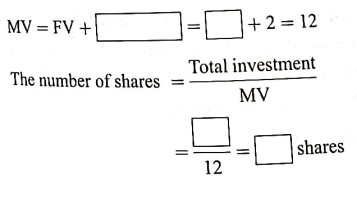
Smita invested ₹ 12,000 to purchase shares of FV 10 at a premium of 2. Find the number of shares she purchased. Complete the given activity to get the answer:
FV = ₹ 10, premium = ₹ 2
Image
In $\Delta LMN , I =5, m =13, n =12$ then complete the activity to show that whether the given triangle is right angled triangle or not.
*(l, $m , n$ are opposite sides of $\angle L , \angle M , \angle N$ respectively)
Activity: In $\triangle LMN , I =5, m =13, n =\square$
$
\therefore 1^2=\square, m^2=169, n^2=144 \text {. }
$
$
\therefore 1^2+n^2=25+144=\square
$
$
\therefore \square+1^2=m^2
$
$\therefore$ By Converse of Pythagoras theorem, $\triangle LMN$ is right angled triangle.
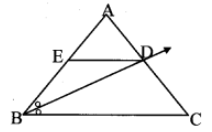
In $\triangle A B C$, ray $B D$ bisects $\angle A B C . A-D-C$, side $D E \|$ side $B C, A-E-B$, then prove that $\frac{A B}{B C}=\frac{A E}{E B}$
Image
In $\triangle A B C$, ray $B D$ bisects $\angle B$.
$\therefore \quad \frac{ AB }{ BC }=\frac{ AD }{ DC }$
In $\triangle ABC , DE \| BC$
$\therefore \quad \frac{ AE }{ EB }=\frac{ AD }{ DC }$
$\therefore \frac{ AB }{ ⬜ }=\frac{ ⬜ }{ EB }$
[Given]
[Angle biscetor theorem]
[Given]

[From (i) and (ii)]
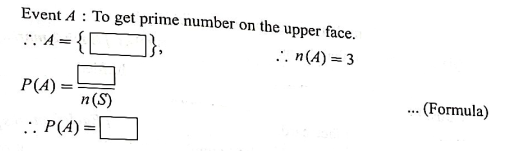
A die is rolled. Complete the following activity to find the probability of getting a prime number on the upper face of the die :
A die is rolled. S is the sample space.

Image
Image
To draw tangents to the circle from the endpoints of the diameter of the circle.
Construct a circle with center O. Draw any diameter AB of it
Draw ray OA and ray OB
Construct perpendicular to ray OA from point A
Construct perpendicular to Ray OB from point B
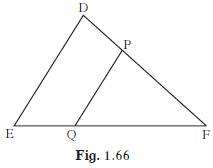
In figure 1.66, seg PQ || seg DE, A(Δ PQF) = 20 units, PF = 2 DP, then find A(DPQE) by completing the following activity.
A(Δ PQF) = 20 units, PF = 2 DP, Let us assume DP = x. ∴ PF = 2x
$DF = DP +\square=\square+\square=3 x$
In Δ FDE and Δ FPQ,
∠FDE ≅ ∠ .......... corresponding angles
∠FED ≅ ∠ ......... corresponding angles
∴ Δ FDE ~ Δ FPQ .......... AA test
$\therefore \frac{ A (\Delta FDE )}{ A (\Delta FPQ )}=\frac{\square}{\square}=\frac{(3 x )^2}{(2 x )^2}=\frac{9}{4}$
$A (\Delta FDE )=\frac{9}{4} A(\Delta FPQ )=\frac{9}{4} \times \square=\square$
$A (\square DPQE )= A (\Delta FDE )- A (\Delta FPQ )$
$\quad=\square-\square$
$\quad=\square$