Question
  1. Complete the following equations:
  1. $\text{Cr}_{2}\text{O}_{7}^{2-}+\text{2OH}^{-}\rightarrow$
  2. $\text{MnO}_{4}^{-}+\text{4H}^{+}+\text{3e}^{-}\rightarrow$
  1. Account for the following:
  1. Zn is not considered as a transition element.
  2. Transition metals form a large number of complexes.
  3. The $E ^{\circ}$ value for the $Mn ^{3+} / Mn ^{2+}$ couple is much more positive than that for $Cr ^{3+} / Cr ^{2+}$ couple.
Answer

  1.  
  1. $\text{Cr}_{2}\text{O}_{7}^{2-}+\text{2OH}^{-}\rightarrow\text{2CrO}_{4}^{2-}+\text{H}_{2}\text{O}$
  2. $\text{MnO}_{4}^{-}+\text{4H}^{+}+\text{3e}^{-}\rightarrow\text{MnO}_{2}+\text{2H}_{2}\text{O}$
  1.  
  1. $Zn/Zn^{2+}$ has fully filled d orbitals.
  2. This is due to smaller ionic sizes/higher ionic charge and availability of d orbitals.
  3. because $Mn ^{+2}$ is more stable $\left(3 d^5\right)$ than $Mn ^{3+}\left(3 d^4\right) . Cr ^{+3}$ is more stable due to $t _2 g^3 / d ^3$ configuration.

Need a full question paper?

Generate a complete, print-ready paper with questions like this in minutes — across 16+ boards, with answer keys.

Start Generating Free

Similar questions

Describe the methods of studying various first order reactions with examples.
Answer the following questions:
Assign reasons for the following:
  1. In the series Sc $(Z = 21)$ to Zn $(Z = 30),$ the enthalpy of atomisation of Zn is the lowest.
  2. Zr and Hf have almost identical radii.
  3. Transition metals show variable oxidation states.
  4. The $E^\circ M^{2+}/M$ value for copper is positive $(+0.34 V).$
  1. Draw the structures of the following:
  1. $H_2S_2O_7$.
  2. $HClO_3$.
  1. Explain the following observations:
  1. In the structure of $HNO_3$, the N–O bond.
$(121\ pm)$ is shorter than the N–OH bond $(140\ pm)$.
  1. All the P–Cl bonds in $PCl_5$​​​​​​​ are not equivalent.
  2. ICl is more reactive than $I_2$​​​​​​​.
Draw all the isomers of: (geometrical and optical)
i. $\left[ CoCl _2( en )_2\right]^{+}$
ii. $\left[ Co \left( NH _3\right) Cl ( en )^2\right]^{2+}$
iii. $\left[ Co \left( NH _3\right)_2 Cl _2( en )\right]^{+}$
Match the types of colloidal systems given in Column I with the name given in Column II.
  Column I   Column II
(i) Solid in liquid. (a) Foam.
(ii) Liquid in solid. (b) Sol.
(iii) Liquid in liquid. (c) Gel.
(iv) Gas in liquid. (d) Emulsion.

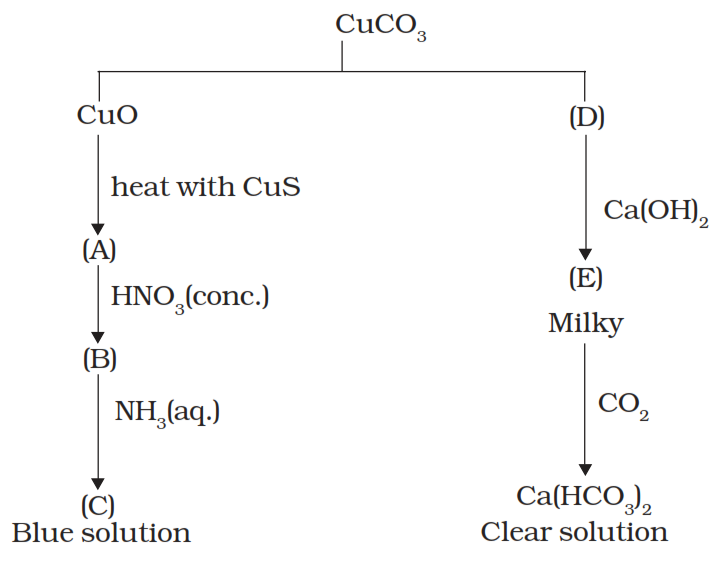
Identify $A$ to $E$ and also explain the reactions involved.
What is the role of adsorption in heterogenous catalysis?
Answer the following question:
Calculate the molality of a sulphuric acid solution in which the mole fraction of water is 0.85.
Describe the mechanism of replication of DNA.
Explain the IUPAC method of nomenclature coordination compounds with examples.