Question
Describe the methods of studying various first order reactions with examples.

Answer

self

Need a full question paper?

Generate a complete, print-ready paper with questions like this in minutes — across 16+ boards, with answer keys.
Start Generating Free

Similar questions

Sodium has a bcc structure with nearest neighbour distance 365.9pm. Calculate its density (Atomic mass of sodium = 23).
Discuss in detail DNA and RNA.
An element has a body-centred cubic bcc structure with a cell edge of $288\ pm$. The density of the element is $7.2g/ cm^3$​​​​​​​. How many atoms are present in $208\ g$ of the element?

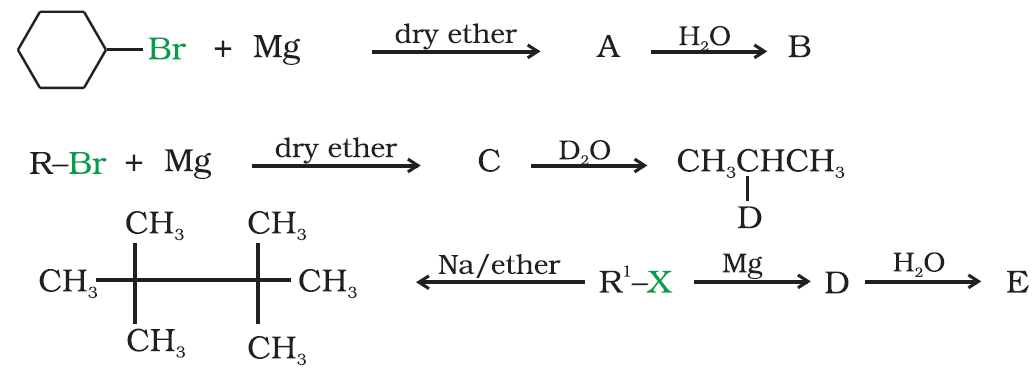
Identify A, B, C, D, E, R and $R^1$ in the following:
Write the IUPAC names of the following coordination compounds:
i. $\left[ Co \left( NH _3\right) 6\right] Cl _3$
ii. $\left[ Co \left( NH _3\right)_5 Cl \right] Cl _2$
iii. $K_3\left[ Fe ( CN )_6\right]$
iv. $K_3\left[ Fe \left( C _2 O _4\right)_3\right]$
v. $K_2\left[P_{d C l}^4\right]$
vi. $\left[ Pt \left( NH _3\right)_2 Cl \left( NH _2 CH _3\right)\right] Cl$
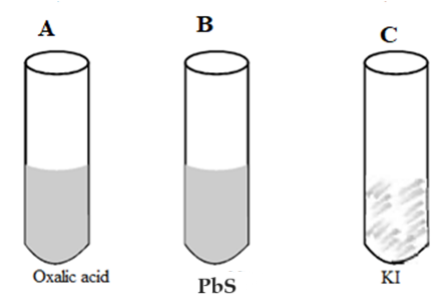
$(a).$ A purple colour compound $A,$ which is a strong oxidising agent and used for bleaching of wool, cotton, silk and other textile fibres was added to each of the three test tubes along with $H_2SO_4.$ It was followed by strong heating.
Image
In which of the above test tubes; $A, B$ or $C:$
$(i)$ Violet vapours will be formed
$(ii)$ The bubbles of gas evolved will extinguish a burning matchstick. Write an equation for each of the above observations.
$b.$ A metal ion $M^{n+}$ of the first transition series having $d^5$ configuration combines with three didentate ligands. Assuming $\Delta_0< P:$
$(i)$ Draw the crystal field energy level diagram for the $3d$ orbital of this complex.
$(ii)$ What is the hybridisation of $Mnt$ in this complex and why?
$(iii)$ Name the type of isomerism exhibited by this complex.
  1. The elements of 3d transition series are given as:
$Sc \ Ti V \ Cr \ Mn \ Fe \ Co \ Ni \ Cu \ Zn$

Answer the following:
  1. Which element has the highest m.p. and why?
  2. Which element is a strong oxidising agent in $+3$ oxidation state and why?
  3. Which element is soft and why?
  1. Write the equations involved in the preparation of Potassium dichromate from Sodium chromate$\left( Na _2 CrO _4\right)$.
What is called a battery? Explain its characteristics and describe dry cell and mercury cell.
An aromatic compound ‘A’ on treatment with $CHCl_3 / KOH$ gives two compounds ‘B’ and ‘C’. Both B and C give the same product ‘D’ when distilled with zinc dust. Oxidation of D gives E having molecular formula $C_7H_6O_2$. The sodium salt of E on heating with sodalime gives F which may also be obtained by distilling A with zinc dust. Identify A to F.
What do you understand by shape selective catalysis? Why are zeolites good shape selective catalysts?