Question

Complete the following reactions:
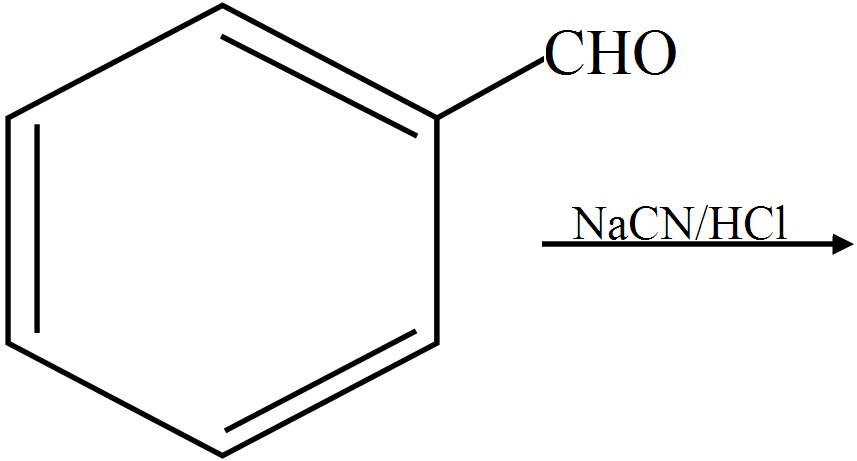
  1.  
  1. $(\text{C}_6\text{H}_5\text{CH}_2)_2\text{Cd}+2\text{CH}_3\text{COCl}\xrightarrow{\ \ \ \ \ \ \ }$
  2. $\text{CH}_3-\text{CH}-\text{COOH}\xrightarrow[(\text{ii})\ \text{H}_2\text{O}]{\ \ \ \ \ \ {(\text{i})\ \text{Br}_2/ \text{ Red P}_4} \ \ \ \ \ \ \ }$

Answer

  1. Reaction of benzaldehyde with NaCN/ HCl gives cyanohydrin.
  1. Treatment of acyl chlorides with dialkylcadmium gives a ketone.
$2\text{CH}_3-\text{CO}-\text{Cl}+(\text{C}_6\text{H}_5-\text{CH})\xrightarrow{\ \ \ \ \ \ \ \ \ \ \ }2\text{CH}_3-\text{CO}-\text{CH}_2-\text{C}_6\text{H}_5+\text{CdCl}_2\\\ \ \ \ \ \ \ \ \ \ \ \ \ \ \ \ \ \ \ \ \ \ \ \ \ \ \ \ \ \ \ \ \ \ \ \ \ \ \ \ \ \ \ \ \ \ \ \ \ \ \ \ \ \ \ \ \ \ \ \ \ \ \ \ \ \ \ \ \ ^{ \text{1}-\text{Phenylpropan}-2-\text{One}}$
  1. Carboxylic acid having α-hydrogen are halogenated at α-position on treatment with $Br_2$ in presence of red phosphorous to give α -halocarboxylic acids. This is Hell Volhard-Zelinsky reaction.
$\ \ \ \ \ \ \ \ \ \ \ \ \text{CH}_3\ \ \ \ \ \ \ \ \ \ \ \ \ \ \ \ \ \ \ \ \ \ \ \ \ \ \ \ \ \ \ \ \ \ \ \ \ \ \ \ \ \ \ \ \ \ \ \ \ \ \ \ \ \ \ \ \ \ \text{CH}_3\ \ \\ \ \ \ \ \ \ \ \ \ \ \ \ \ \ \ \ |\ \ \ \ \ \ \ \ \ \ \ \ \ \ \ \ \ \ \ \ \ \ \ \ \ \ \ \ \ \ \ \ \ \ \ \ \ \ \ \ \ \ \ \ \ \ \ \ \ \ \ \ \ \ \ \ \ \ \ \ \ \ \ |\\\text{CH}_3-\text{CH}-\text{COOH}\xrightarrow[(\text{ii})\ \text{H}_2\text{O}]{\ \ \ \ \ \ {(\text{i})\ \text{Br}_2/ \text{ Red P}_4} \ \ \ \ \ \ \ }\text{CH}_3-\text{C}-\text{COOH}\\ \ \ \ \ \ \ \ \ \ \ \ \ \ \ \ \ \ \ \ \ \ \ \ \ \ \ \ \ \ \ \ \ \ \ \ \ \ \ \ \ \ \ \ \ \ \ \ \ \ \ \ \ \ \ \ \ \ \ \ \ \ \ \ \ \ \ \ \ \ \ \ \ \ \ \ \ \ \ \ \ \ |\\ \ \ \ \ \ \ \ \ \ \ \ \ \ \ \ \ \ \ \ \ \ \ \ \ \ \ \ \ \ \ \ \ \ \ \ \ \ \ \ \ \ \ \ \ \ \ \ \ \ \ \ \ \ \ \ \ \ \ \ \ \ \ \ \ \ \ \ \ \ \ \ \ \ \ \ \ \ \ \ \text{Br}$

Need a full question paper?

Generate a complete, print-ready paper with questions like this in minutes — across 16+ boards, with answer keys.

Start Generating Free

Similar questions

Phosphorus has three allotropic forms —
  1. white phosphorus
  2. red phosphorus and
  3. black phosphorus.
Write the difference between white and red phosphorus on the basis of their structure and reactivity.
How many mL of $0.1$ M HCl are required to react completely with $1$ g mixture of $Na_2CO_3$ and $NaHCO_3$ containing equimolar amounts of both?
Explain chemical properties of $KMnO _4$
Give reasons for the following:
  1. Acetylation of aniline reduces its activation effect.
  2. $CH_3NH_2$ is more basic than $C_6H_5NH_2$.
  3. Although $-NH_2$ is o/p directing group, yet aniline on nitration gives a significant amount of m-nitroaniline.
Discuss the classification of monohydric alcohols containing $C_{sp}^3-OH$ bond.
For the first order thermal decomposition reaction, following data were obtained:
$C_2H_5Cl(g)$ $\xrightarrow{\text{ }\text{ }\text{ }\text{ }\text{ }\text{ }\text{ }\text{ }\text{ }}$ $C_2H_4(g) + HCl(g)$
Time/sec   Total pressure/atm
0   0.30
300   0.50
Calculate the rate constant.
(Given : log 2 = 0.301, log 3 = 0.4771, log 4 = 0.6021)
What are alloys? Name an important alloy which contains some of the lanthanoid metals. Mention its uses.
How would you account for the following:
  1. $NCl_3$ is an endothermic compound while $NF_3$ is an exothermic one.
  2. $XeF_2$ is a linear molecule without a bend.
  3. The electron gain enthalpy with negative sign for fluorine is less than that for chlorine, still fluorine is a stronger oxidising agent than chlorine.
Derive integrated rate equation for first order reaction containing gaseous components.
Predict the products formed when cyclohexanecarbaldehyde reacts with following reagents.
$i. \ MgBr$ and then $H_3O^+$
$ii.$ Tollens' reagent
$iii.$ Semicarbazide and weak acid
$iv.$ Excess ethanol and acid
$v. \ Zinc$ amalgam and dilute hydrochloric acid