Question
Derive integrated rate equation for first order reaction containing gaseous components.
Answer

$\rightarrow$ Let us consider a typical first order gas phase reaction.
$\rightarrow A(g) \rightarrow B(g) + C(g)$
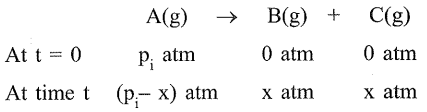
$\rightarrow$ Let $p_i$ be the initial pressure of $A$ and $p_t$ the total pressure at time $' t\ '$. Integrated rate equation for such a reaction can be derived as
$\rightarrow$ Total pressure $p _{ t }= p _{ A }+ p _{ B }+ p _{ C } ($pressure units$)$
$\rightarrow$ $p _{ A }, p _{ B }$ and $p _{ C }$ are partial pressures of $A , B$ and $C$ respectively. If $x$ atm can be the decrease in pressure of $A$ at time $t$ and one mole each of $B$ and $C$ is being formed. The increase in pressure of $B$ and $C$ will also be $X$ atm each
Image
where, $p_i$ is the initial pressure at time $t=0$
$p _{ t }=\left( p _{ i }- x \right)+ x + x = p _{ i }+ x$
$x =\left( p _{ t }- p _{ i }\right)$
where, $p_A=p_i-x=p_i-\left(p_t-p_i\right)=2 p_i-p_t$
$k =\left(\frac{2.303}{ t }\right)\left(\log \frac{ p _{ i }}{ p _{ A }}\right)$
$ =\frac{2.303}{ t } \log \frac{ p _{ i }}{2 p _{ i }- p _{ t }}$

Need a full question paper?

Generate a complete, print-ready paper with questions like this in minutes — across 16+ boards, with answer keys.

Start Generating Free

Similar questions

Calculate e.m.f of the following cell at 298 K :
$2 \mathrm{Cr}(\mathrm{~s})+3 \mathrm{Fe}^{2+}(0.1 \mathrm{M}) \rightarrow 2 \mathrm{Cr}^{3+}(0.01 \mathrm{M})+3 \mathrm{Fe}(\mathrm{~s})$
$\text { Given: } \mathrm{E}^{\circ}\left(\mathrm{Cr}^{3+} \mid \mathrm{Cr}\right)=-0.74 \mathrm{VE}^{\circ}\left(\mathrm{Fe}^{2+} \mid \mathrm{Fe}\right)=-0.44 \mathrm{~V}$
Write reactions to obtain acetic acid from ethanenitrile, acetyl chloride and ethyl ethonoate.
What is an adsorption isotherm? Describe Freundlich adsorption isotherm.
Write the name of monomers and their structures in the following:
  1. Buna-N
  2. PVC
  3. Neoprene
If 200 mol of $H _2$ (at NTP) and 0.60 g of Cu are obtained by passing electric current in the solution of acidified water and $CuSO _4$ respectively in two electrolytic cell connected in series, then what will be the equivalent weight of Cu ?
Nitrogen pentoxide decomposes according to equation: $\text{2N}_{2}\text{O}_{5}\text{(g)}\rightarrow\text{4NO}_{2}\text{(g)}+\text{O}_{2}\text{(g)}.$
This first order reactionwas allowed to proceed at 40° C and the data below were collected:
$[N_2O_5](M)$ Time (min)
0.400 0.00
0.289 20.0
0.209 40.0
0.151 60.0
0.109 80.0
  1. Calculate the rate constant. Include units with your answer.
  2. What will be the concentration of $N_2O_5$ after $100$ minutes?
  3. Calculate the initial rate of reaction.
The rate of a particular reaction triples when temperature changes from $50°C$ to $100°C$. Calculate the activation energy of the reaction.[log $3 = 0.4771; R = 8.314 JK^{-1} mol^{-1}$].
Explain boiling point of alkyl halides.
Mention a chemical property in which methanoic acid differs from acetic acid.
How would you bring about the following conversions?
i. Propanal to butanone
ii. Benzaldehyde to benzophenone
iii. Benzoyl chloride to benzonitrile