MCQ
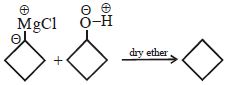
Compound $(P)$ is
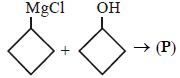
- A

- B
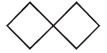
- C

- ✓

Generate a complete, print-ready paper with questions like this in minutes — across 16+ boards, with answer keys.
$\begin{array}{l} Cl - Cl ( g ) \longrightarrow Cl ^*( g )+ Cl ^*( g ) \Delta H ^{\circ}=58 kcal mol ^{-1} \\ H _3 C - Cl ( g ) \longrightarrow H _3 C ^*( g )+ Cl ^{\circ}( g ) \Delta H ^{\circ}=85 kcal mol ^{-1} \\ H - Cl ( g ) \quad \longrightarrow H ^*( g ) \quad+ Cl ^*( g ) \Delta H ^{\circ}=103 kcal mol ^{-1} \\\end{array}$
($1$) Correct match of the $C - H$ bonds (shown in bold) in Column $J$ with their BDE in Column $K$ is
|
Column $J$ Molecule |
Column $K$ $\operatorname{BDE}( kcal mol -1)$ |
| $(P)$ $H - C H \left( CH _3\right)_2$ | ${ (i) } 132$ |
| $(Q)$ $H - CH _2 Ph$ | ${ (ii) } 110$ |
| $(R)$ $H - C H = CH _2$ | ${ (iii) } 95$ |
| $(S)$ $H - C \equiv CH$ | ${ (iv) } 88$ |
$(A)$ $P - iii, Q - iv, R - ii, S - i$
$(B)$ $P - i, Q - ii, R - iii, S - iv$
$(C)$ $P - iii, Q - ii, R - i, S - iv$
$(D)$ $P - ii, Q - i, R - iv, S - iii$
($2$) For the following reaction
$CH _4( g )+ Cl _2( g ) \xrightarrow{\text { light }} CH _3 Cl ( g )+ HCl ( g )$
the correct statement is
$(A)$ Initiation step is exothermic with $\Delta H ^{\circ}=-58 kcal mol ^{-1}$
$(B)$ Propagation step involving ${ }^{\circ} CH _3$ formation is exothermic with $\Delta H ^{\circ}=-2 kcal mol ^{-1}$.
$(C)$ Propagation step involving $CH _3 Cl$ formation is endothermic with $\Delta H ^{\circ}=+27 kcal mol ^{-1}$.
$(D)$ The reaction is exothermic with $\Delta H ^{\circ}=-25 kcal mol ^{-1}$.