Question
Compute induced current and induced charge in electromagnetic induction and also write Fleming's right hand rule.
Answer

SELF

Need a full question paper?

Generate a complete, print-ready paper with questions like this in minutes — across 16+ boards, with answer keys.

Start Generating Free

Similar questions

One day Chetan’s mother developed a severe stomach ache all of a sudden. She was rushed to the doctor who suggested for an immediate endoscopy test and gave an estimate of expenditure for the same. Chetan immediately contacted his class teacher and shared the information with her. The class teacher arranged for the money and rushed to the hospital. On realising that Chetan belonged to a below average income group family, even the doctor offered concession for the test fee. The test was conducted successfully.
Answer the following questions based on the above information:
  1. Which principle in optics is made use of in endoscopy?
  2. Briefly explain the values reflected in the action taken by the teacher.
  3. In what way do you appreciate the response of the doctor on the given situation?
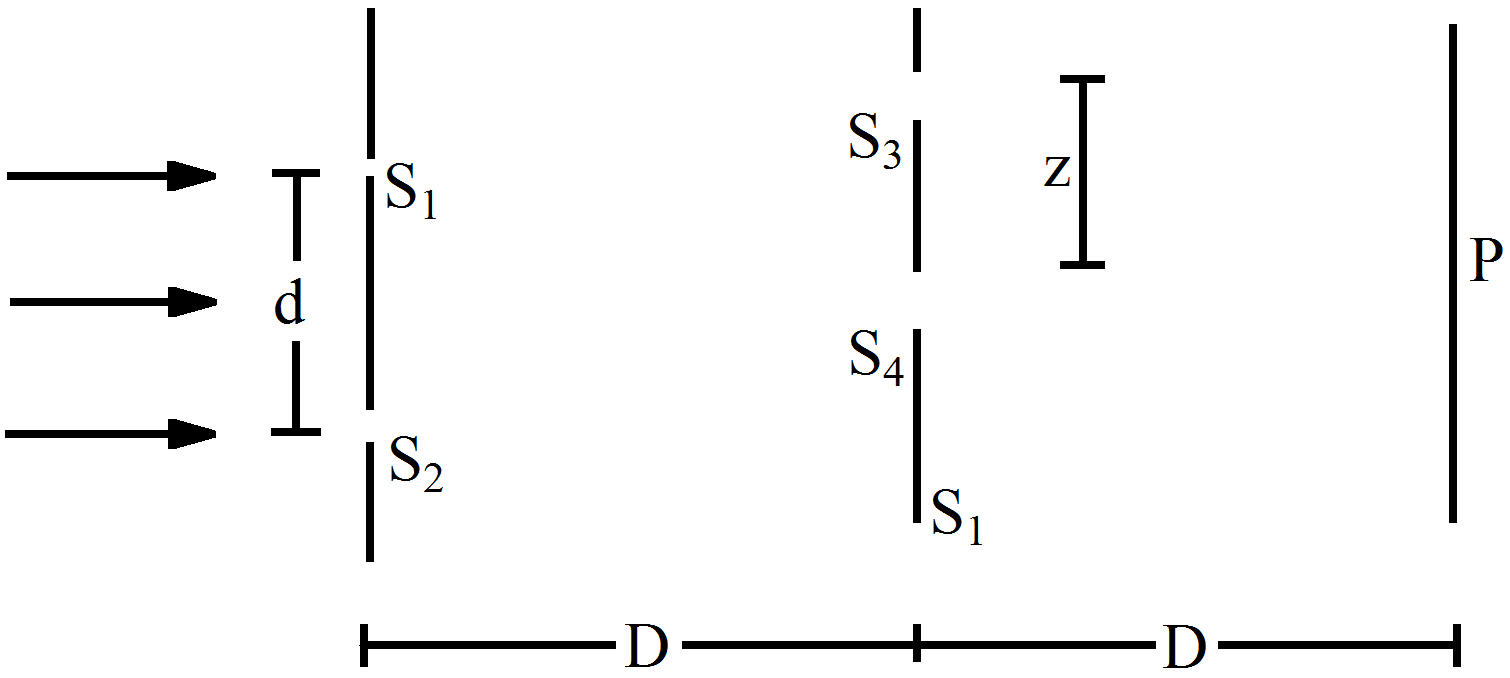
Consider the arrangement shown in figure. By some mechanism, the separation between the slits $S_3$ and $S_4$ can be changed. The intensity is measured at the point P which is at the common perpendicular bisector

of $S_1S_2$ and $S_3S_4$. When $\text{z}=\frac{\text{D}\lambda}{2\text{d}},$ intensity measured at P is I. Find this intensity when z is equal to:
  1. $\frac{\text{D}\lambda}{\text{d}}$
  2. $\frac{3\text{D}\lambda}{2\text{d}}$
  3. $\frac{2\text{D}\lambda}{\text{d}}$
An electric kettle used to prepare tea, takes 2 minutes to boil 4 cups of water (1 cup contains 200cc of water) if the room temperature is 25C.
  1. If the cost of power consumption is Rs. 1.00 per unit (1 unit - 1000 watt-hour), calculate the cost of boiling 4 cups of water.
  2. What will be the corresponding cost if the room temperature drops to 5°C?
A source contains two phosphorous radio nuclides $^{32}_{15}\text{P }(\text{T}_{1/2}=14.3\text{d})$ and $^{33}_{15}\text{P }(\text{T}_{1/2}=25.3\text{d})$ Initially, 10% of the decays come from $^{33}_{15}\text{P}.$ How long one must wait until 90% do so?
A charged particle is accelerated through a potential difference of 12kV and acquires a speed of $1.0 \times 10^6m s^{−1}.$ It is then injected perpendicularly into a magnetic field of strength 0.2T. Find the radius of the circle described by it.
The current−voltage characteristic of an ideal p-n junction diode is given by $\text{i}=\text{i}_0\Big(\text{e}^{\frac{\text{eV}}{\text{kT}}}-1\Big)$ where, the drift current $i_0$ equals $10\mu\text{A}.$ Take the temperature T to be 300K.
  1. Find the voltage $V_0$ for which $\text{e}^{\frac{\text{eV}}{\text{KT}}}=100.$ One can neglect the term 1 for voltages greater than this value.
  2. Find an expression for the dynamic resistance of the diode as a function of V for $V > V_0.$
  3. Find the voltage for which the dynamic resistance is $0.2\Omega.$
Two coherent point sources $S_1$ and $S_2$ vibrating in phase emit light of wavelength $\lambda$. The separation between the sources is $2\lambda$. Consider a line passing through $S_2$ and perpendicular to the line $S_1S_2$. What is the smallest distance from $S_2$ where a minimum of intensity occurs?
An electron emitted by a heated cathode and accelerated through a potential difference of 2.0 kV, enters a region with uniform magnetic field of 0.15 T. Determine the trajectory of the electron if the field,
  1. is transverse to its initial velocity,
  2. makes an angle of 30º with the initial velocity.
Derive an expression for the electric potential at a point due to an electric dipole. Mention the contrasting features of electric potential of a dipole at a point as compared to that due to a single charge.
The conduction band of a solid is partially filled at 0K. Will it be a conductor, a semiconductor or an insulator?