Question
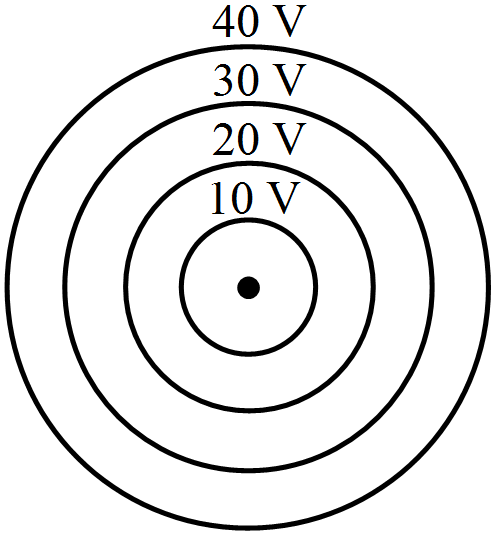
Concentric equipotential surfaces due to a charged body placed at the centre are shown. Identify the polarity of the charge and draw the electric field lines due to it.
Answer


For a single charge the potential is given by $\text{V}=\frac{1}{4\pi\varepsilon_0}\frac{\text{q}}{\text{r}}$


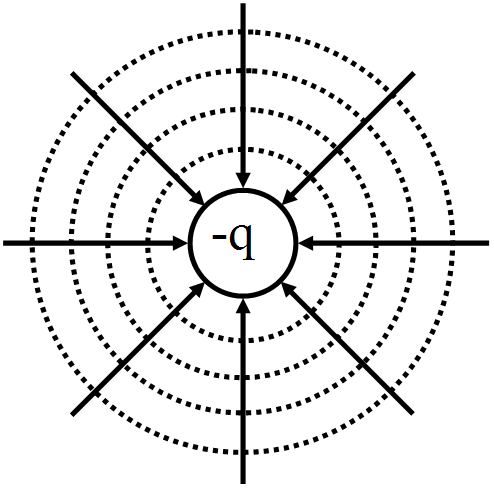
This shows that V is constant if r is constant. Greater the radius smaller will be the potential. In the given figure, potential is increasing. This shows that the polarity of charge is negative (-q). The direction of electric field will be radially inward. The field lines are directed from higher to lower potential.
Need a full question paper?

Generate a complete, print-ready paper with questions like this in minutes — across 16+ boards, with answer keys.
Start Generating Free

Similar questions

A circular loop of radius r carrying a current i is held at the centre of another circular loop of radius R(>> r) carrying a current I. The plane of the smaller loop makes an angle of 30° with that of the larger loop. If the smaller loop is held fixed in this position by applying a single force at a point on its periphery, what would be the minimum magnitude of this force?
A thin but long, hollow, cylindrical tube of radius r carries a current i along its length. Find the magnitude of the magnetic field at a distance $\frac{\text{r}}{2}$ from the surface (a) inside the tube (b) outside the tube.
For sound waves, the Doppler formula for frequency shift differs slightly between the two situations: (i) source at rest; observer moving, and (ii) source moving; observer at rest. The exact Doppler formulas for the case of light waves in vacuum are, however, strictly identical for these situations. Explain why this should be so. Would you expect the formulas to be strictly identical for the two situations in case of light travelling in a medium?
Does focal length of a lens depend on the colour of the light used? Does focal length of a mirror depend on the colour?
Draw a schematic ray diagram of reflecting telescope showing how rays coming from a distant object are received at the eye-piece. Write its two important advantages over a refracting telescope.
  1. Derive an expression for drift velocity of free electrons.
  2. How does drift velocity of electrons in a metallic conductor vary with increase in temperature? Explain.
Does a nucleus lose mass when it suffers gamma decay?
A long straight wire in the horizontal plane carries a current of 50 A in north to south direction. Give the magnitude and direction of B at a point 2.5 m east of the wire.
In a single slit diffraction experiment, light of wavelength $\lambda$ illuminates the slit of width ‘a’ and the diffraction pattern is observed on a screen.
  1. Show the intensity distribution in the pattern with the angular position $\theta.$
  2. How are the intensity and angular width of central maxima affected when,
  1. Width of slit is increased,
  2. Separation between slit and screen is decreased?