Question
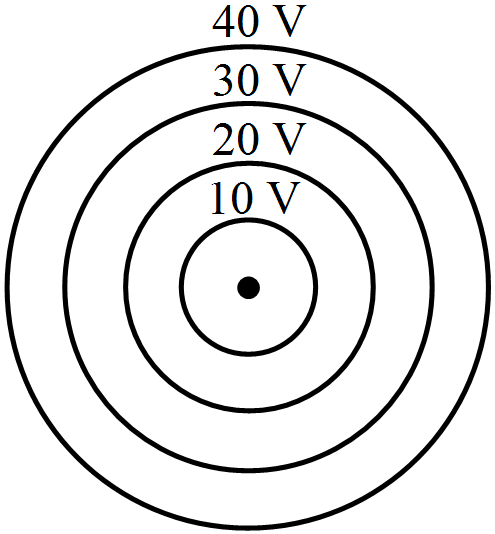
Concentric equipotential surfaces due to a charged body placed at the centre are shown. Identify the polarity of the charge and draw the electric field lines due to it.
Answer


For a single charge the potential is given by $\text{V}=\frac{1}{4\pi\varepsilon_0}\frac{\text{q}}{\text{r}}$
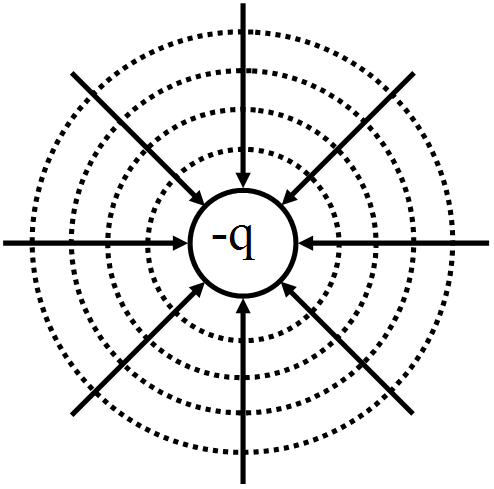
This shows that V is constant if r is constant. Greater the radius smaller will be the potential. In the given figure, potential is increasing. This shows that the polarity of charge is negative (-q). The direction of electric field will be radially inward. The field lines are directed from higher to lower potential.

Need a full question paper?

Generate a complete, print-ready paper with questions like this in minutes — across 16+ boards, with answer keys.

Start Generating Free

Similar questions

Write and explain the super position principle (of waves).
Draw the electric field lines due to a uniformly charged thin spherical shell when charge on the shell is (a) positive and (b) negative.
  1. A giant refracting telescope at an observatory has an objective lens of focal length 15 m. If an eyepiece of focal length 1.0 cm is used, what is the angular magnification of the telescope?
  2. If this telescope is used to view the moon, what is the diameter of the image of the moon formed by the objective lens? The diameter of the moon is $3.48 \times 10^6m,$ and the radius of lunar orbit is $3.8 \times 10^8m.$
Classify metals, conductors and semiconductors.
(I) Draw a ray diagram for the formation of image by a Cassegrain telescope.
(II) Why these types of telescopes are preferred over refracting type telescopes.
Explain with the help of a diagram, how a depletion layer and barrier potential are formed in a junction diode.
  1. Define the term intensity of radiation' in photon picture.
  2. Plot a graph showing the variation of photo current vs collector potential for three different intensities $I_1 >  I_2 > I_3$, two of which $(I_1$ and $I_2)$ have the same frequency v and the third has frequency $v_1 > v.$
  3. Explain the nature of the curves on the basis of Einstein's equation.
The intensity of sound from a point source is $1.0 \times 10^{-6}W/m^2$ at a distance of 5.0m from the source. What will be the intensity at a distance of 25m from the source?
A uniform square plate of mass 2.0kg and edge 10cm rotates about one of its diagonals under the action of a constant torque of 0.10N-m. Calculate the angular momentum and the kinetic energy of the plate at the end of the fifth second after the start.
  1. In what way is diffraction from each slit related to the interference pattern in a double slit experiment?
  2. Two wavelengths of sodium light 590 nm and 596 nm are used, in turn, to study the diffraction taking place at a single slit of aperture 2 \times $10^{–4}\ m.$ The distance between the slit and the screen is 1.5 m. Calculate the separation between the positions of the first maxima of the diffraction pattern obtained in the two cases.