Question
Write and explain the super position principle (of waves).

Answer

• Super Position Principle :
"At a particular point in the medium, the resultant displacement produced by a number of waves is the vector sum of the displacements produced by each of the waves."
Image

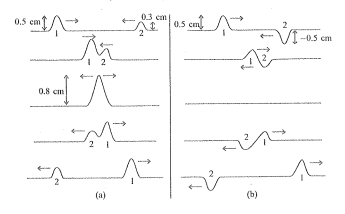
As shown in fig. (a), two waves are moving towards each other on a string.
Suppose, the maximum displacement of the particle under the effect of first wave is 0.5 cm and in the second wave, the maximum displacement is 0.3 cm .
Here, both the waves are moving towards each other.
As the two waves are approaching each other, at any instant both the waves will overlap in some region of the string. Then they move with their original shape and in their original direction.
The net maximum displacement of the particle of string in overlapped region would be 0.5 cm $+0.3 cm=0.8 cm$
Suppose, two persons snap the end of the string such that wave pulse generates at both the ends of the string as shown in fig. (b). In the first wave pulse the maximum displacement of the particle is 0.5 cm in upward and in the other wave pulse the maximum displacement of the particle is 0.5 cm in the downward direction.
When the wave pulses approach each other, at some instant, they overlay on the string and displacement of all the particles will be 0.5 cm $+(-0.5 cm)=0$.
Here, the velocities of the particles will not be zero.
In this situation, string becomes stright everywhere, then both the wave pulses will emerge and move in their original direction.


Need a full question paper?

Generate a complete, print-ready paper with questions like this in minutes — across 16+ boards, with answer keys.
Start Generating Free

Similar questions

The momentum p of a particle changes with time t according to the relation $\frac{\text{dp}}{\text{dt}}=(10\text{N})+(2\text{N/s)t}.$ If the momentum is zero at t = 0, what will the momentum be at t = 10s?
If the separation between the slits in a Young's double slit experiment is increased, what happens to the fringe-width? If the separation is increased too much, will the fringe pattern remain detectable?
A table with smooth horizontal surface is placed in a cabin which moves in a circle of a large radius R (figure In). A smooth pulley of small radius is fastened to the table. Two masses m and 2m placed on the table are connected through a string going over the pulley. Initially the masses are held by a person with the strings along the outward radius and then the system is released from rest (with respect to the cabin). Find the magnitude of the initial acceleration of the masses as seen from the cabin and the tension in the string.
A voltage $V = V_o$ sin $\omega\text{t}$ is applied to a series LCR circuit. Derive the expression for the average power dissipated over a cycle. Under what condition is (i) no power dissipated even though the current flows through the circuit, (ii) maximum power dissipated in the circuit?
  1. Draw a neat labelled ray diagram of a compound microscope. Explain briefly its working.
  2. Why must both the objective and the eye-piece of a compound microscope have short focal lengths?
How many time constants will elapse before the power delivered by a battery drops to half of its maximum value in an RC circuit?
Hydrogen atom in its ground state is excited by means of monochromatic radiation of wavelength $975 \stackrel{\circ}{A}$.
$i.$ How many different lines are possible in the resulting spectrum?
$ii.$ Calculate the longest wavelength amongst them. You may assume the ionization energy for hydrogen atom as $13.6 eV .$
With the help of a simple diagram, explain the working of a silicon solar cell, giving all three basic processes involved. Draw its I-V characteristic.
Write down the Coulomb's law and get the vector form of it.
A river 400m wide is flowing at a rate of 2.0m/s. A boat is sailing at a velocity of 10m/s with respect to the water, in a direction perpendicular to the river.
  1. Find the time taken by the boat to reach the opposite bank.
  2. How far from the point directly opposite to the starting point does the boat reach the opposite bank?