Question
  1. In what way is diffraction from each slit related to the interference pattern in a double slit experiment?
  2. Two wavelengths of sodium light 590 nm and 596 nm are used, in turn, to study the diffraction taking place at a single slit of aperture 2 \times $10^{–4}\ m.$ The distance between the slit and the screen is 1.5 m. Calculate the separation between the positions of the first maxima of the diffraction pattern obtained in the two cases.
Answer

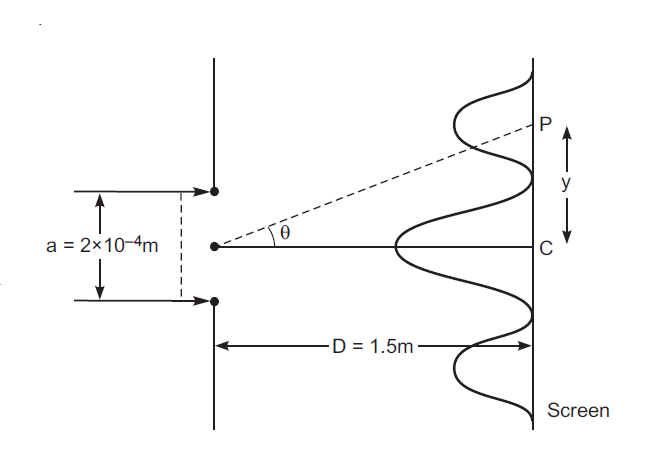
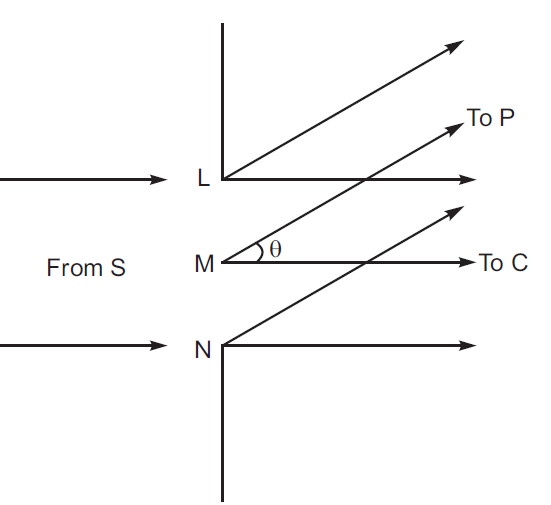
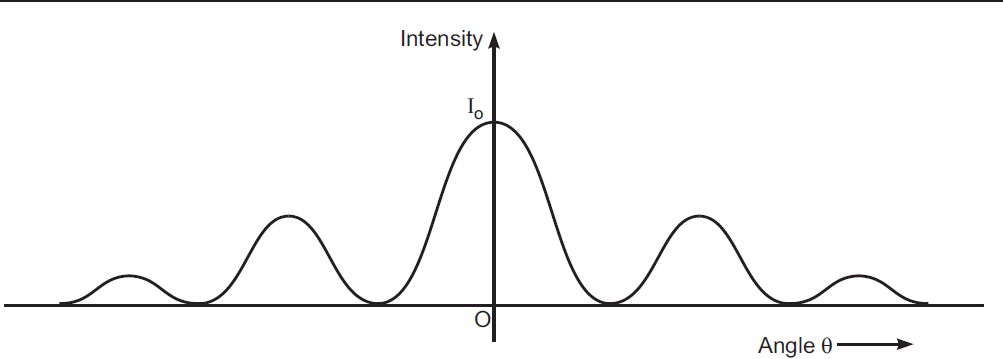
  1. When a plane wavefront of monochromatic light illuminates, the slit LN, each point in the slit LN becomes the source of secondary wavelets. The secondary wavelets originating from different points superpose on each, while travelling towards the point C and point P; at angle$\theta$. However the superposition of the secondary wavelets produces a diffraction pattern of varying intensity, as shown in fig.

  1. For maxima other than central maxima
a.$\theta = \bigg(\text{n} + \frac{1}{2}\bigg)\lambda$
and $\theta = \frac{\text{y}}{\text{D}}$
$\therefore\text{a}.\frac{\text{y}}{\text{D}} = \bigg(\text{n} + \frac{1}{2}\bigg)\lambda$

For light of wavelength $\lambda_{1}$= 590 nm
$2 \times10^{-14}\times\frac{\text{y}_{1}}{1.5} =\big(1+ \frac{1}{2}\big)\times590$
$\text{y}_{1} = \frac{3}{2}\times\frac{590\times10^{-9}\times1.5}{2\times10^{-4}}$
= 6.64 mm
For light of wavelength $\lambda_{2}$=596 mm
$2 \times10^{-4}\times\frac{\text{y}_{2}}{1.5} =\big(1+ \frac{1}{2}\big)\times596\text{nm}$
$\Rightarrow\text{y}_{2} =\frac{3}{2}\times\frac{596\times10^{-9}\times1.5}{2\times10^{-4}}$
= 6.705 mm
Separation between two positions of first maxima
$\Delta\text{y} = \text{y}_{2} - \text{y}_{1}$
= 6.705 – 6.64
= 0.065 mm.

Need a full question paper?

Generate a complete, print-ready paper with questions like this in minutes — across 16+ boards, with answer keys.

Start Generating Free

Similar questions

A piece of wire carrying a current of 6.00A is bent in the form of a circular arc of radius 10.0cm, and it subtends an angle of 120° at the centre. Find the magnetic field B due to this piece of wire at the centre.
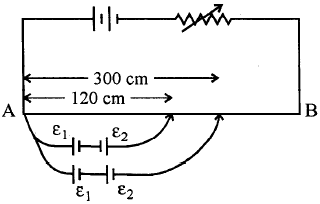
In the figure a long uniform potentiometer wireABis having a constant potential gradient along its length. The null points for the two primary cells of emfs $\varepsilon_{1}$ and $\varepsilon_{2}$
connected in the manner shown are obtained at a distance of 120 cm and 300 cm from the end A. Find (i) $\varepsilon_{1}$/$\varepsilon_{2}$and (ii) position of null point for the cell $\varepsilon_{1}$. How is the sensitivity of a potentiometer increased?
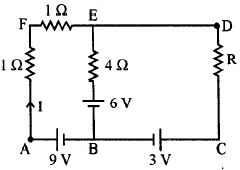
Using Kirchoffs rules determine the value of unknown resistance R in the circuit so that no current flows through 4 $\Omega$ resistance.Also find the potential difference between A and D.
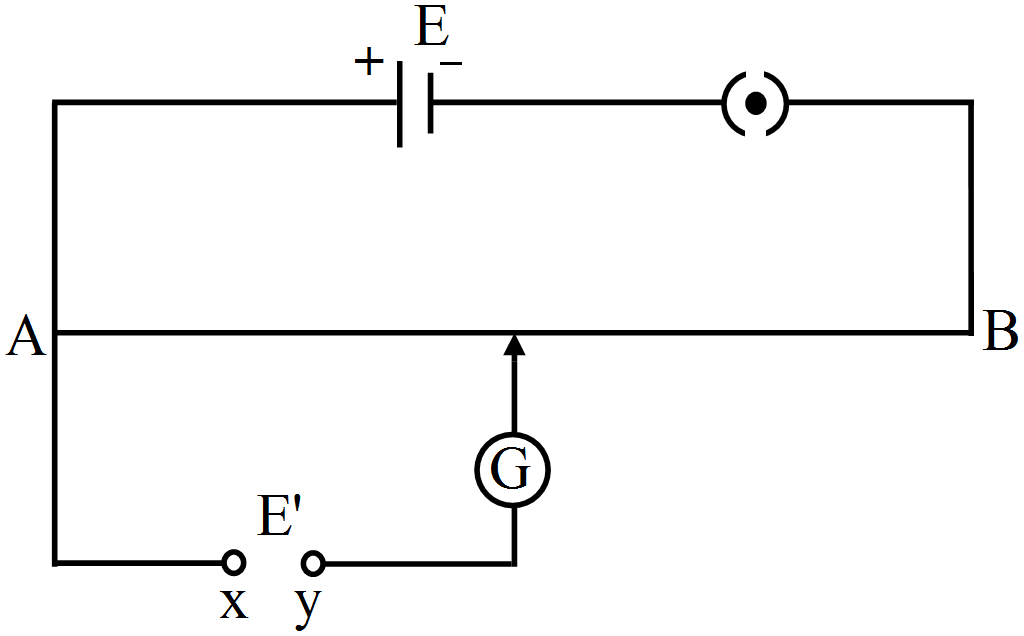
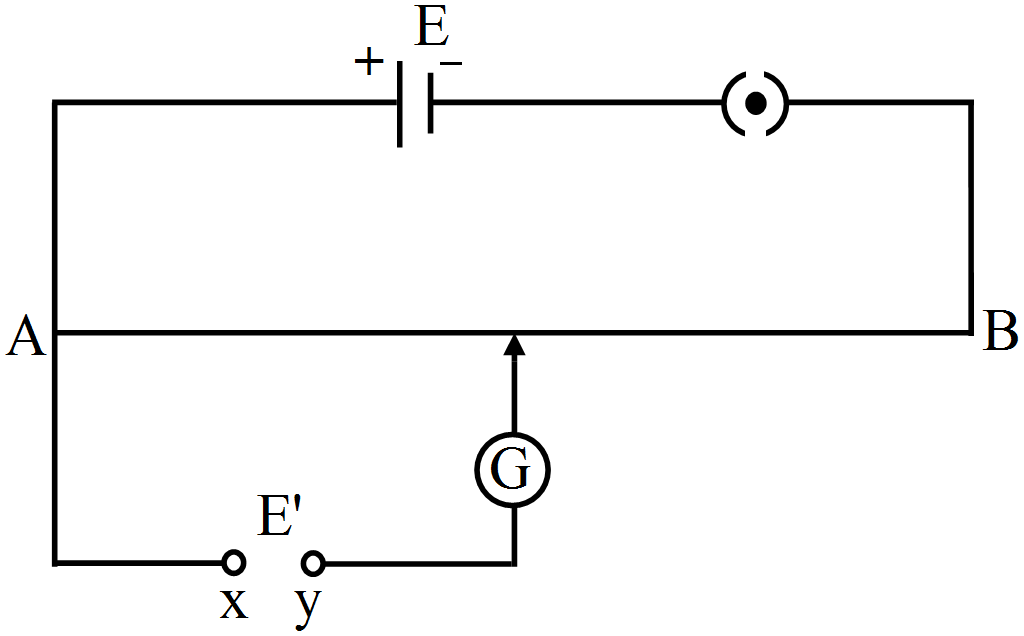
For the potentiometer circuit shown in the given figure, points X and Y represent the two terminals of an unknown emf E'. A student observed that when the jockey is moved from the end A to the end B of the potentiometer wire, the deflection in the galvanometer remains in the same direction.
What may be the two possible faults in the circuit that could result in this observation? If the galvanometer deflection at the end B is (i) more, (ii) less than at the end A, which of the two faults, listed above, would be there in the circuit? Give reason in support of your answer in each case.
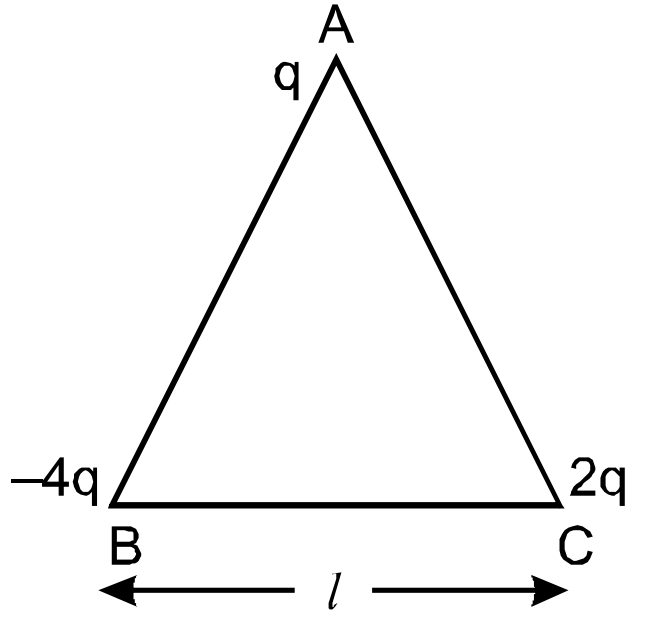
  1. Three point charges q, -4q and 2q are placed at the vertices of an equilateral triangle ABC of side ‘l’ as shown in the figure. Obtain the expression for the magnitude of the resultant electric force acting on the charge q.
  1. Find out the amount of the work done to separate the charges at infinite distance.
Suppose white light falls on a double slit but one slit is covered by a violet filter (allowing $\lambda=400\text{nm}$). Describe the nature of the fringe pattern observed.
When a photon is emitted from an atom, the atom recoils. The kinetic energy of recoil and the energy of the photon come from the difference in energies between the states involved in the transition. Suppose, a hydrogen atom changes its state from n = 3 to n = 2. Calculate the fractional change in the wavelength of light emitted, due to the recoil.
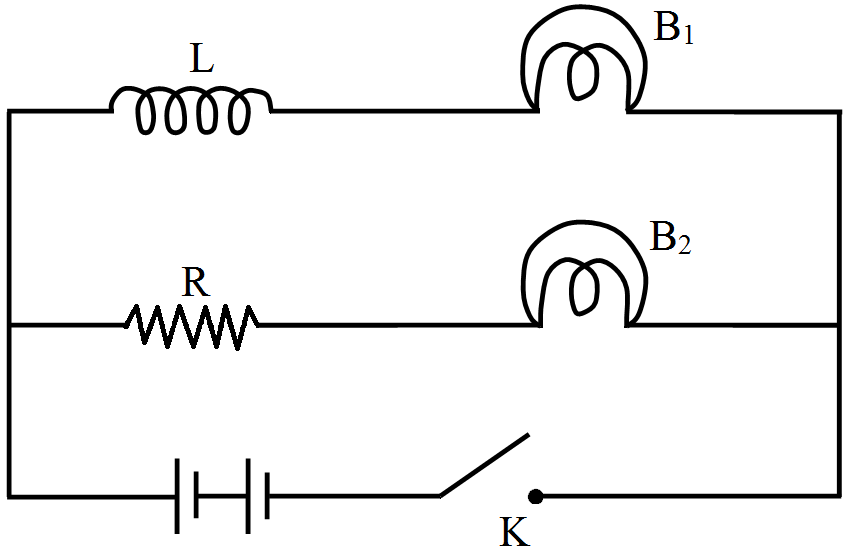
In the given circuit, the value of resistance effect of the coil L is exactly equal to the resistance R. Bulbs $B_1$ and $B_2$ are exactly identical. Answer the following questions based on above information:
  1. Which one of the two bulbs lights up earlier, when key K is closed and why?
  2. What will be the comparative brightness of the two bulbs after sometime if the key K is kept closed and why?
A table with smooth horizontal surface is placed in a cabin which moves in a circle of a large radius R (figure In). A smooth pulley of small radius is fastened to the table. Two masses m and 2m placed on the table are connected through a string going over the pulley. Initially the masses are held by a person with the strings along the outward radius and then the system is released from rest (with respect to the cabin). Find the magnitude of the initial acceleration of the masses as seen from the cabin and the tension in the string.
The near vision of an average person is 25cm. To view an object with an angular magnification of 10, what should be the power of the microscope?

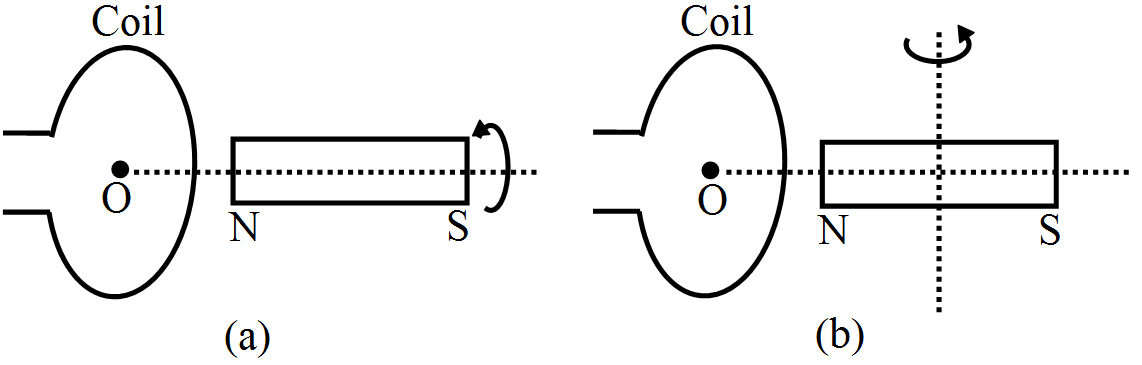
A cylindrical bar magnet is kept along the axis of a circular coil and near it as shown in figure. Will there be any induced emf at the terminals of the coil, when the magnet is rotated:
  1. About its own axis.
  2. About an axis perpendicular to the length of the magnet?