MCQ
Conservation of momentum in a collision between particles can be understood from
  • A
    Newton's second law only
  • B
    both Newton's second and third law
  • C
    Newton's first law only
  • D
    conservation of energy

Answer

B. both Newton's second and third law
Explanation:
Conservation of momentum in a collision between particles can be understood from both Newton's second and third law.

Need a full question paper?

Generate a complete, print-ready paper with questions like this in minutes — across 16+ boards, with answer keys.
Start Generating Free

Similar questions

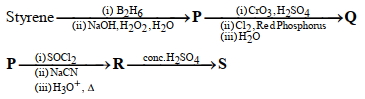
Consider the following reaction scheme and choose the correct option($s$) for the major products $Q$, $R$ and $S$.
A body is thrown up in a lift with a velocity $u$ relative to the lift and the time of flight is found to be $ t.$ The acceleration with which the lift is moving up is
In dispersion without deviation
A player kicks a football with an initial speed of $25\, {ms}^{-1}$ at an angle of $45^{\circ}$ from the ground. What are the maximum height and the time taken by the football to reach at the highest point during motion ? (Take g $=10 \,{ms}^{-2}$ )
A myopia patient uses
In a Young's double slit experiment the wavelength of red light is $7.8 \times 10^{-5} \,cm$ and that of blue light is $5.2 \times 10^{-5} \,cm$. The value of $n$ for which $(n+1)$ th blue bright band coincides with $n$th bright red band is ..........
Assertion : The number of electrons in a $p-$ type silicon semiconductor is less than the number of electrons in a pure silicon semiconductor at room temperature.
Reason : It is due to law of mass action
When a beam of light is used to determine the position of an object, the maximum accuracy is achieved if the light is
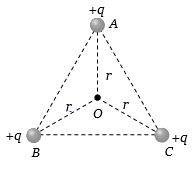
$ABC$ is an equilateral triangle. Charges $ + \,q$ are placed at each corner. The electric intensity at $O$ will be
The radii of the two columns in $U$ tube are $r_1$ and $r_2$. When a liquid of density $\rho $ (angle of contact is $0^o$ ) is filled in it the level difference of liquid in two arms is $h$. The surface tension of liquid is ($g =$ acceleration due to gravity)