MCQ 14 Marks
A star initially has $10^{40}$ deuterons. It produces energy via the processes, and ${ }_1 H ^2+$ ${ }_1 H ^3 \rightarrow{ }_1 H ^3+p$. If the average power radiated by the star is $10^{16} W$, the deuteron supply of the star is exhausted in a time of the order of:-
The masses of the nuclei are as follows:
$\begin{array}{l}
M\left(H^2\right)=2.014 amu ; \\
M\left(H^2\right)=1.007 amu ; M(n)=1.008 amu ; M\left(He^4\right)=4.001 amu
\end{array}$
- A
$10^{16} s$
- B
$10^6 s$
- C
$10^8 s$
- D
$10^{12} s$
AnswerD. $10^{12} s$
Explanation:
$\begin{array}{l}
{ }_1 H^2+{ }_1 H^2 \rightarrow{ }_1 H^3+p \\
{ }_1 H^2+{ }_1 H^3 \rightarrow{ }_2 He^4+n
\end{array}$
By adding given two equation $3{ }_1 H ^2 \rightarrow 2 He ^4+ p + n$
$\Delta m=3(2.014)-[4.001+1.007+1.008]=0.026$
3 deuterons release $3.87 \times 10^{-12} J$
$\begin{array}{l}
\therefore 10^{40} \text { deuterons release }=\frac{3.87 \times 10^{-12} \times 10^{40}}{3} \\
=1.29 \times 10^{28} J
\end{array}$
Power, $P =\frac{E}{t} \Rightarrow t =\frac{E}{P}=\frac{1.29 \times 10^{28}}{10^{16}}=1.29 \times 10^{12}$
View full question & answer→MCQ 24 Marks
An $\alpha$-particle of energy 5 MeV is scattered through $180^{\circ}$ by a fixed uranium nucleus. The distance of the closest approach is of the order of:
- A
$10^{-15} cm$
- B
$1 \stackrel{\circ}{A}$
- C
$10^{-12} cm$
- D
$10^{-10} cm$
AnswerC. $10^{-12} cm$
Explanation:
At the distance of closest approach
$\begin{array}{l}
KE=\frac{1}{4 \pi \varepsilon_0}\left(\frac{2 Z e^2}{r}\right) \\
\text { i.e., } 5 \times 10^6 \times 1.6 \times 10^{-19} \\
=\frac{9 \times 10^9 \times\left(2 \times 1.6 \times 10^{-19}\right)\left(92 \times 1.6 \times 10^{-19}\right)}{r} \\
\therefore r=5.2 \times 10^{-12} cm
\end{array}$
View full question & answer→MCQ 34 Marks
The radiation corresponding to $3 \rightarrow 2$ transition of hydrogen atom falls on a metal surface to produce photoelectrons. These electrons are made to enter a magnetic field of $3 \times 10^{-4} T$. If the radius of the largest circular path followed by these electrons is 10.0 mm , the work function of the metal is close to
AnswerB. 1.1 eV
Explanation:
When an electron moves in a circular path, then
$\begin{array}{l}
r=\frac{m v}{e B} \quad \Rightarrow \quad \frac{r^2 e^2 B^2}{2}=\frac{m^2 v^2}{2} \\
KE_{\max }=\frac{(m v)^2}{2 m} \Rightarrow \frac{r^2 e^2 B^2}{2 m}=(KE)_{\max }
\end{array}$
Work function of the metal (W), i.e. $W = hv - KE _{\max }$
$1.89-\phi=\frac{r^2 e^2 B^2}{2 m} \frac{1}{2} eV =\frac{r^2 e B^2}{2 m} eV [ hv \rightarrow 1.89 eV$, for the transition on from third to second orbit of H -atom]
$\begin{array}{l}
=\frac{100 \times 10^{-6} \times 1.6 \times 10^{-19} \times 9 \times 10^{-8}}{2 \times 9.1 \times 10^{-31}} \\
\phi=1.89-\frac{16 \times 9}{2 \times 91}=1.89-0.79=1.1 eV
\end{array}$
View full question & answer→MCQ 44 Marks
An $\alpha$-particle and a deuteron are moving with velocities v and 2 v respectively. What will be the ratio of their de Broglie wavelengths?
- A
$\sqrt{2}: 1$
- B
$1: \sqrt{2}$
- C
$2: 1$
- D
$1: 1$
AnswerD. $1: 1$
Explanation:
Given that; the velocity of $\alpha$-particle [nucleus of ${ }_2 He ^4$ ] $= v$ the velocity of the deuteron $\left({ }_1 D^2\right)=2 v$
We know that, the de Broglie wavelength,
$\lambda=\frac{h}{m v} \ldots$ (i)
So, the de Broglie wavelength for $\alpha$-particle,
$\lambda_\alpha=\frac{h}{4 \times v}\left[m_\alpha=4\right] \ldots(ii)$
and the de Broglie wavelength for deutron,
$\lambda_D=\frac{h}{2 \times 2 v}\left[m_{D}=2\right] . .(iii)$
On dividing eqn. (ii) by eqn. (iii)
$\begin{array}{l}
\frac{\lambda_a}{\lambda_D}=\frac{h / 4 v}{h / 4 v}=\frac{1}{1} \\
\text { or } \lambda_\alpha: \lambda_D=1: 1
\end{array}$
View full question & answer→MCQ 54 Marks
Consider the diffraction pattern obtained from the sunlight incident on a pinhole of diameter $0.1 \mu m$. If the diameter of the pinhole is slightly increased, it will affect the diffraction pattern such that
- A
Its size increases, but intensity decreases
- B
Its size increases, and intensity increases
- C
Its size decreases, but intensity increase
- D
Its size decreases, and intensity decreases
AnswerC. Its size decreases, but intensity increase
Explanation:
$\because \sin \theta=\frac{1.22 \lambda}{D}$, where D is opening diameter.
When opening size diameter of the pinhole is increased, the diffraction size decreases but intensity increases.
View full question & answer→MCQ 64 Marks
The f-number of a camera lens is 4.5. Which of the following statements is correct?
- A
The ratio of focal length to the aperture is 4.5.
- B
The aperture of the lens is 4.5 cm.
- C
The focal length of the lens is 4.5 cm.
- D
It is the reciprocal of the focal length expressed in metre
AnswerA. The ratio of focal length to the aperture is 4.5 .
Explanation:
The ratio of focal length to the aperture is 4.5 .
View full question & answer→MCQ 74 Marks
Beyond which frequency, the ionosphere bends any incident electromagnetic radiation but do not reflect it back towards the earth?
AnswerD. 40 MHz
Explanation:
The ionosphere can reflect electromagnetic waves of frequency less than 40 MHz but not of frequency more than 40 MHz .
View full question & answer→MCQ 84 Marks
In an AC generator, a coil with N turns all of the same area A and total resistance R, rotates with frequency $\omega$ in a magnetic field $B$. The maximum value of emf generated in the coil will be:
- A
$NAB \omega$
- B
- C
- D
NABR $\omega$
AnswerA. $NAB \omega$
Explanation:
In an $A C$ generator, the emf generated is maximum when flux is maximum. It is possible if angle between area vector of the coil and magnetic field is $0^{\circ}$. In such case the emf generated is $e = NBA \omega \cos \omega t$. On neglecting $\cos \omega t$, maximum value of emf generated in the coil is e $= NBA \omega$
View full question & answer→MCQ 94 Marks
A boat is moving due east in a region where the earth's magnetic field is $5.0 \times 10^{-5} N$ $A ^{-1} m^{-1}$ due north and horizontal. The boat carries a vertical aerial 2 m long. If the speed of the boat is $1.50 m s ^{-1}$, the magnitude of the induced emf in the wire of aerial is:
AnswerA. 0.15 Mv
Explanation:
$\begin{array}{l}\text { Here, } Bh =5.0 \times 10^{-5} NA ^{-1} m^{-1}, \\ l =2 m \text { and } v =1.5 m s ^{-1} \\ \text { Induced emf, } \varepsilon= B _{ H } vl =5 \times 10 \times 1.50 \times 2 \\ =15 \times 10^{-5} V=0.15 mV \end{array}$
View full question & answer→MCQ 104 Marks
A galvanometer is connected to the secondary coil. The galvanometer shows an instantaneous deflection of 7 divisions when current is started in the primary coil of the solenoid. Now, if the primary coil is suddenly rotated through $180^{\circ}$, then the new instantaneous deflection will be:
AnswerB. 14 unit
Explanation:
When current is started, change in current is from O to I . On suddenly rotating through $180^{\circ}$, change in current is from I to -I or change in current is 2 I .
$\phi_s=M \Delta I$
$\text { As } I_{S}=\frac{E_s}{R}=\frac{1}{R} \frac{d \phi}{d t}$
is doubled, so deflection is doubled, i.e., it becomes equal to 14 units.
View full question & answer→MCQ 114 Marks
The Curie-Weiss law is obeyed by iron:
- A
above the Curie temperature
- B
at the Curie temperature only
- C
- D
below the Curie temperature
AnswerA. above the Curie temperature
Explanation:
We know from the Curie-Weiss law that susceptibility of a ferromagnetic substance above its Curie temperature is inversely proportional to the excess of temperature above the Curie temperature. Since iron is a ferromagnetic substance, therefore Curie-Weiss law is obeyed by it at a temperature above the Curie temperature.
View full question & answer→MCQ 124 Marks
The hysteresis cycle for the material of transformer core is:
AnswerB. tall and narrow
Explanation:
The transformer core is soft iron material which has small coercivity and large retentivity. Therefore its hysteresis loop is tall and narrow.
View full question & answer→MCQ 134 Marks
A circular coil of radius 4 cm has 50 turns. In this coil a current of 2 A is flowing. It is placed in a magnetic field of 0.1 weber $/ m$. The amount of work done in rotating it through 1800 from its equilibrium position will be:
AnswerC. 0.1 J
Explanation:
Work done in rotating a coil through angle $\theta$ from it's equilibrium position: $W = MB (1-\cos \theta), \theta=180^{\circ}$ and $M = NAi$
Now, $W =2 iNAB$
$\begin{array}{l}
=2 \times 2 \times 50 \times \pi\left(4 \times 10^{-2}\right)^2 \times 0.1 \\
=0.1 J
\end{array}$
View full question & answer→MCQ 144 Marks
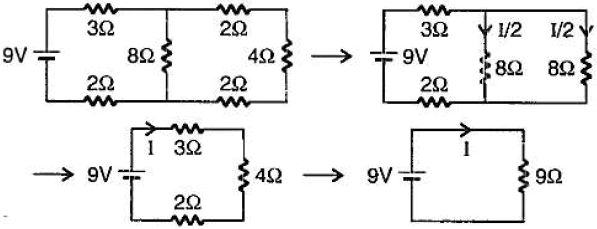
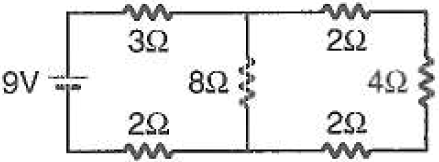
In the electrical circuit shown in figure, the current through the $4 \Omega$ resistor is:
View full question & answer→MCQ 154 Marks
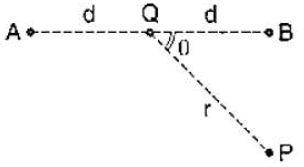
The work done in taking a unit positive charge from P to A is $W _{ A }$ and from P to B is $W_B$. Then:
- A
$W _{ A }> W _{ B }$
- B
$W _{ A }+ W _{ B }=0$
- C
$W_A=W_B$
- D
$W_A
AnswerC. $W _{ A }= W _{ B }$
Explanation:
As potential at A and B is the same $V _{ A }= V _{ B }=\frac{k Q}{d}$. and $W = q \Delta V$
$\Delta V$ in both the cases is same. So work done in both the cause will be the same.
View full question & answer→MCQ 164 Marks
Two copper balls, each weighing 10 gm , are kept in air 10 cm apart. If one electron from every $10^6$ atoms is transferred from one ball to the other, the coulomb force between them is: (atomic weight of copper is 63.5 )
- A
$2.0 \times 10^6 N$
- B
$2.0 \times 10^{10} N$
- C
$2.0 \times 10^4 N$
- D
$2.0 \times 10^8 N$
AnswerD. $2.0 \times 10^8 N$
Explanation:
$2.0 \times 10^8 N$
View full question & answer→MCQ 174 Marks
Two solid bars are having Young's modulus $Y _1$ and $Y _2$ in the ratio $\left( Y _1 / Y _2\right)=4$. If th bars are made up of the material with the same density, then the ratio of the speed of longitudinal waves in the solid bars, i.e. $\left( v _1 / v _2\right)$ is:
AnswerC. 2
Explanation:
$v=\sqrt{\frac{Y}{\rho}}$
where $Y =$ Young's modulus
$\rho=$ Mass density
Since solid bars are made up of the materials with same density,
hence $\rho_1=\rho_2$ and $\frac{v_1}{v_2}=\sqrt{\frac{Y_1}{Y_2}}=\sqrt{4}=2$
View full question & answer→MCQ 184 Marks
An echo is heard when the minimum distance of the reflecting surface is:
AnswerD. 17 m
Explanation:
The minimum distance for echo hearing is,
$\Delta x=\frac{1}{2}(v \times \Delta t)$
velocity of sound $v =340 m / sec$, minimum time to return sound $t =0.1 sec$ so required distance $=\frac{1}{2}\left(340 \times \frac{1}{10}\right)=17 m$
View full question & answer→MCQ 194 Marks
What effect occurs on the frequency of a pendulum, if it is taken from the earth's surface to deep into a mine?
- A
- B
- C
First increases then decreases
- D
AnswerD. Decreases
Explanation:
Decreases
View full question & answer→MCQ 204 Marks
A spring (spring constant $= k$ ) is cut into 4 equal parts and two parts are connected in parallel. What is the effective spring constant?
AnswerB. 8 k
Explanation:
If a spring constant $k$ is divided into $n$ equal parts, the spring constant of each part become nk. So, effective spring constant.
$\begin{array}{l}
k=k_1+k_2 \\
=4 k+4 k=8 k
\end{array}$
View full question & answer→MCQ 214 Marks
Which of the following gases possesses maximum rms velocity, all being at the same temperature?
AnswerB. Hydrogen
Explanation:
For all gases at the same temperature,
$v_{rms} \propto \frac{1}{\sqrt{M}}$
So, vrms is maximum for the lightest gas, i.e., hydrogen.
View full question & answer→MCQ 224 Marks
Three samples of the same gas $A, B$ and $C \left(\gamma=\frac{3}{2}\right)$ have initially equal volume. Now the volume of each sample is doubled. The process is adiabatic for A, isobaric for B and isothermal for C. If the final pressures are equal for all the three samples, the ratio of their initial pressures is:
- A
$\sqrt{2}: 1: 2$
- B
$2: 1: \sqrt{2}$
- C
$2 \sqrt{2}: 2: 1$
- D
$2 \sqrt{2}: 1: 2$
AnswerD. $2 \sqrt{2}: 1: 2$
Explanation:
Let the initial pressure of the three samples $P _{ A }, P _{ B }$ and $P _{ C }$, then
$\begin{array}{l}
P_{A}(V)^{3 / 2}=(2 V)^{3 / 2} P\left(\because P_{B}=P\right) \\
\text { or } P_{A}=P(2)^{3 / 2} \\
P_{C}(V)=P(2 V) \\
\text { or } P_{C}=2 P \\
\therefore P_{A}: P_{B}: P_{C} \\
=(2)^{3 / 2}: 1: 2=2 \sqrt{2}: 1: 2
\end{array}$
View full question & answer→MCQ 234 Marks
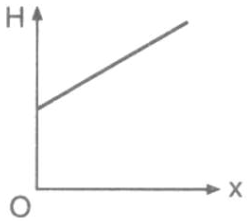
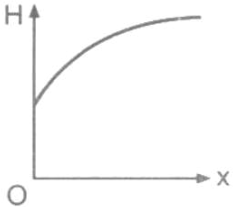
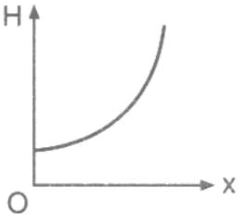
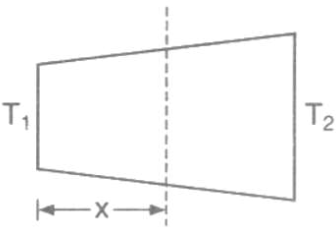
Radius of a conductor increases uniformly from the left to right end as shown in the figure. Material of the conductor is isotropic and its curved surface is thermally isolated from surroundings. Its ends are maintained at temperatures $T_1$ and $T_2\left(T_1>\right.$ $T _2$ ). If, in steady-state, heat flow rate is equal to H , then which of the following graphs is correct?
AnswerC.
Explanation:
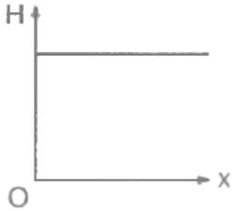
Since the curved surface of the conductor is thermally insulated, therefore, in steady-state, the rate of heat flow at every section will be the same. Hence, the curve between $H$ and $x$ will be a straight line parallel to x -axis. View full question & answer→MCQ 244 Marks
For an ideal monoatomic gas, the universal gas constant R is n times the molar heat capacity at constant pressure $C _{ p }$. Here n is:
AnswerA. 0.4
Explanation:
For ideal monoatomic gas
$\begin{array}{l}
C_{p}=\frac{5 R}{2} \\
\text { or } R=\frac{2}{5} C_{p}=0.4 C_{p} \\
\therefore n=0.4
\end{array}$
View full question & answer→MCQ 254 Marks
10 gm of ice at $-20^{\circ} C$ is added to 10 gm of water at $50^{\circ} C$. Specific heat of water $=1$ $cal / gm -{ }^{\circ} C$, specific heat of ice $=0.5 cal / gm -{ }^{\circ} C$. Latent heat of ice $=80 cal / gm$. Then, the amount of water at the resulting temperature is:
View full question & answer→MCQ 264 Marks
Two metal strips that constitute a thermostat must necessarily differ in their:
- A
- B
- C
- D
coefficient of linear expansion
AnswerD. coefficient of linear expansion
Explanation:
For metallic strip to bend on change in temperature the coefficient of linear expansion should be different.
View full question & answer→MCQ 274 Marks
The stress-strain curves for brass, steel and rubber are shown in the figure. The lines $A , B$ and C are for
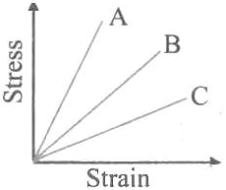
- A
steel, brass and rubber,respectively.
- B
steel, rubber and brass respectively.
- C
rubber, brass and steel respectively.
- D
brass, steel and rubber respectively.
AnswerA. steel, brass and rubber,respectively.
Explanation:
$Y=\tan \theta$
According to figure, $\theta_{ A }>\theta_{ B }>\theta_{ C }$
i.e., $\tan \theta_{ A }>\tan \theta_{ B }>\tan \theta_{ C }$
or $Y _{ A }> Y _{ B }> Y _{ C }$
$\therefore A, B$, and C graph are for steel, brass and rubber respectively.
View full question & answer→MCQ 284 Marks
If the earth suddenly shrinks to half of its present radius, the acceleration due to gravity will be:
- A
$\frac{g}{2}$
- B
- C
$2 g$
- D
$\frac{g}{4}$
AnswerB.4g
Explanation:
$g =\frac{G M}{R^2}$, If radius shrinks to half of its present value, then g will become four times.
View full question & answer→MCQ 294 Marks
If radius of 5 planets varies whose masses are $M _1, M _2, M _3, M _4$ and $M _5$, then which of the following graphs represents variation of acceleration due to gravity at the surface with radius, for these 5 planets?
$\left(M_1>M_2>M_3>M_4>M_5\right)$
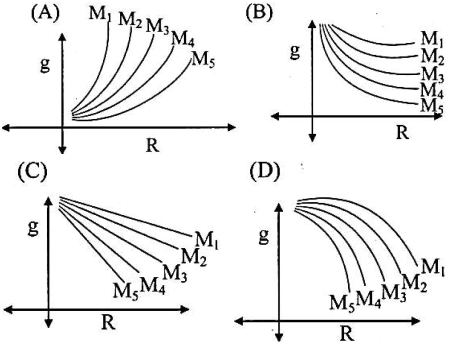
AnswerA. Option (B)
Explanation:
$As, g=\frac{GM}{R^2}$
For constant mass, $g \propto \frac{1}{R^2}$
$\therefore$ Graph g vs R is a parabola.
Now, for constant radius,
$\begin{array}{l}
\therefore g \propto M \\
\text { As } M_1>M_2>M_3>M_4>M_5 \\
\therefore g_1>g_2>g_3>g_4>g_5 .
\end{array}$
View full question & answer→MCQ 304 Marks
A particle of mass 10 g is kept on the surface of a uniform sphere of mass 100 kg and radius 10 cm. Find the work to be done against the gravitational force between them to take the particle far away from the sphere. (You may take $G =6.67 \times 10^{-11} n N-\left.m ^2 / kg ^2\right)$
AnswerA. $6.67 \times 10^{-10} J$
Explanation:
$\begin{array}{l} W =\Delta U=0-\left(-\frac{G M m}{R}\right) \\ =\frac{6.67 \times 10^{-11} \times 100 \times 10 \times 10^{-3}}{10 \times 10^{-2}} \\ =6.67 \times 10^{-10} J\end{array}$
View full question & answer→MCQ 314 Marks
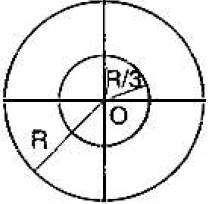
From a circular disc of radius R and mass 9M, a small disc of mass M and radius $\frac{R}{3}$ is removed concentrically. The moment of inertia of the remaining disc about an axis perpendicular to the plane of the disc and passing through its centre is:
- A
$4 MR ^2$
- B
$\frac{40}{9} M R^2$
- C
$\frac{4}{9} M R^2$
- D
$M R^2$
View full question & answer→MCQ 324 Marks
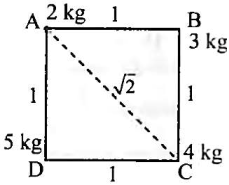
Four bodies of masses 2 kg, 3 kg, 4 kg and 5 kg are placed at points A, B, C, and D respectively of a square ABCD of side 1 metre. The radius of gyration of the system about an axis passing through A and perpendicular to plane is
- A
$\sqrt{\frac{4}{3}} m$
- B
- C
$\sqrt{\frac{8}{7}} m$
- D
$2 \sqrt{2} m$
View full question & answer→MCQ 334 Marks
On a frictionless surface, a block of mass M moving at speed v collides elastically with another block of the same mass M which is initially at rest. After the collision, the first block moves at an angle $\theta$ to its initial direction and has a speed $\frac{v}{3}$.The second block's speed after the collision is .
- A
$\frac{3}{4} v$
- B
$\frac{\sqrt{3}}{2} v$
- C
$\frac{2 \sqrt{2}}{3} V$
- D
$\frac{3}{\sqrt{2}} v$
AnswerC. $\frac{2 \sqrt{2}}{3} v$
Explanation:
In elastic collision
$( K . E .)_{\text {before collision }}=( K . E .)_{\text {After collision }}$
speed of second body after collision $v _2$ can be found as
$\begin{array}{l}
\frac{1}{2} mv^2+0=\frac{1}{2} m\left(\frac{v}{3}\right)^2+\frac{1}{2} m\left(v_2\right)^2 \\
\therefore v^2=\frac{v^2}{9}+v_2^2 \\
\therefore \frac{8 v^2}{9}=v_2^2 \\
\therefore v_2=\frac{2 \sqrt{2}}{3} v
\end{array}$
View full question & answer→MCQ 344 Marks
A body starts from rest and acquires a velocity V in time T. The work done on the instantaneous power delivered to the body in time t is proportional to:
- A
$\frac{V^2}{T} t^2$
- B
$\frac{v^2}{T^2} t$
- C
$\frac{V}{T} t$
- D
$\frac{V^2}{T^2} t^2$
AnswerB. $\frac{V^2}{T^2} t$
Explanation:
$\text { Power }=\frac{\text { work done }}{\text { time }}=\frac{V^2 t^2}{T^2 t}$
i.e., Power $\propto \frac{V^2 t}{T^2}$
View full question & answer→MCQ 354 Marks
A man in a lift throws up a ball, with velocity v m/s relative to the lift and catches it after t sec. The vertical acceleration of the lift is:
- A
$9.8 m / s ^2$ downwards
- B
$\left(9.8-\frac{v}{t}\right) m / s ^2$ downwards
- C
$\left(9.8-\frac{2 v}{t}\right) m / s ^2$ downwards
- D
$\left(9.8-\frac{2 v}{t}\right) m / s ^2$ upwards
AnswerC. $\left(9.8-\frac{2 v}{t}\right) m / s ^2$ downwards
Explanation:
Variation of apparent weight of the body with acceleration of the lift:
If lift is moving upward,
$F=m(g+a)$
Also, $v = u +\frac{1}{2}$ at
$\Rightarrow a=\frac{2 v}{t}$
$\therefore$ Acceleration of the lift $= g +\frac{2 v}{t}$
If lift is moving downward,
$F=m(g-a)$
$\therefore$ Acceleration of the lift $= g -\frac{2 v}{t}=9.8-\frac{2 v}{t} m / s ^2$
View full question & answer→MCQ 364 Marks
A simple pendulum is suspended from the ceiling of a stationary elevator and its period of oscillation is T. The elevator is then set into motion and the new time period is found to be longer. Then, the elevator is:
- A
- B
- C
moving upward with uniform speed
- D
moving downward with uniform speed
AnswerA. accelerated downward
Explanation:
accelerated downward
View full question & answer→MCQ 374 Marks
Conservation of momentum in a collision between particles can be understood from
- A
- B
both Newton's second and third law
- C
- D
AnswerB. both Newton's second and third law
Explanation:
Conservation of momentum in a collision between particles can be understood from both Newton's second and third law.
View full question & answer→MCQ 384 Marks
A ball is thrown upwards and it returns to ground describing a parabolic path. Which of the following quantities remains constant throughout the motion?
i. Kinetic energy of the ball
ii. Speed of the ball
iii. Horizontal component of velocity
iv. Vertical component of velocity
AnswerA. only iii
Explanation:
The horizontal component of velocity remains constant throughout the motion, as it is not affected by the acceleration due to gravity which is directed vertically downwards.
View full question & answer→MCQ 394 Marks
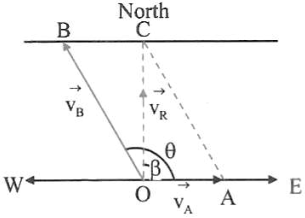
A river is flowing from west to east at a speed of $4 m / min$. In what direction should a man on the south bank of the river, capable of swimming at $8 m / min$ in still water, swim to cross the river in the shortest time?
View full question & answer→MCQ 404 Marks
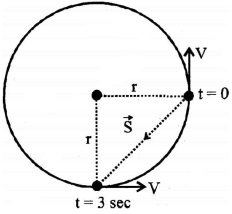
A body is moving with constant speed, in a circle of radius 10 m . The body completes one revolution in 4 s . At the end of 3rd second, the displacement of body (in m) from its starting point is:
- A
$5 \pi$
- B
$10 \sqrt{2}$
- C
$15 \pi$
- D
View full question & answer→MCQ 414 Marks
A person walked up a stalled escalator in 90s. When standing on the same escalator, now moving, he is carried up in 60 s . How much time would it take him to walk up the moving escalator?
AnswerB. 36 s
Explanation:
Let distance be S
$\begin{array}{l}
V_{\operatorname{man}}=\frac{s}{90} \\
V_{\text {escalator }}=\frac{s}{60}
\end{array}$
$V _{\text {man }}$ on moving escalator w.r.t ground $V _{\operatorname{man}}+ V _{\text {escalator }}= s \left(\frac{1}{90}+\frac{1}{60}\right)=\frac{ s }{36}$
$\text { Time }=\frac{s}{v}=\frac{s}{\frac{s}{36}}=36$
View full question & answer→MCQ 424 Marks
A body covered a distance of 5 m along a semicircular path. The ratio of distance to displacement is:
- A
$7: 5$
- B
$12: 5$
- C
$11: 7$
- D
$8: 3$
AnswerC. 11 : 7
Explanation:
$s=\frac{2 \pi r}{2}=\pi r$
displacement $=2 r$
$\therefore \frac{s}{\text { displacement }}=\frac{\pi}{2}=\frac{11}{7}$
View full question & answer→MCQ 434 Marks
The dimensions of self-inductance are:
- A
$\left[ ML ^2 T^{-2} A^{-2}\right]$
- B
$\left[ ML ^2 T^{-2} A^{-1}\right]$
- C
$\left[ MLT ^{-2} A^{-2}\right]$
- D
$\left[ ML ^2 T^{-1} A^{-2}\right]$
AnswerA. $\left[ ML ^2 T^{-2} A^{-2}\right]$
Explanation:
$\begin{array}{l}\text { Induced emf }| e |=L \frac{d I}{d t} \\ \therefore[L]=\frac{[e]}{[d I / d t]}=\frac{[W / q]}{[d I / d t]}=\frac{\left[ ML ^2 T^{-2} / AT \right]}{\left[ AT ^{-1}\right]} \\ =\left[ ML ^2 T^{-2} A^{-2}\right] .\end{array}$
View full question & answer→MCQ 444 Marks
The energy (E), angular momentum (L), and universal gravitational constant (G) are chosen as fundamental quantities. The dimensions of universal gravitational constant in the dimensional formula of Planck's constant (h) is:
AnswerB. 0
Explanation:
$\begin{array}{l}
h \propto G^x L^y E^z \\
{\left[M^1 L^2 T^{-1}\right]=\left[M^{-1} L^3 T^{-2}\right]^{x}\left[M^1 L^2 T^{-1}\right]^{y}\left[M^1 L^2 T^{-2}\right]^{z}} \\
{\left[M^1 L^2 T^{-1}\right]=k\left[M^{-1} L^3 T^{-2}\right]^{x}\left[M^1 L^2 T^{-1}\right]^{y}\left[M^1 L^2 T^{-2}\right]^{z}}
\end{array}$
Comparing the powers, we get;
$\begin{array}{l}
1=-x+y+z \ldots \text { (i) } \\
2=3 x+2 y+2 z \ldots \text { (ii) } \\
-1=-2 x-y-2 z \ldots \text { (iii) }
\end{array}$
On solving eqns. (i), (ii) and (iii), we get;
$x=0$
View full question & answer→MCQ 454 Marks
If C, R, L and I denote capacity, resistance, inductance and electric current respectively, the quantities having the same dimensions of time are:
i. CR
ii. $\frac{L}{R}$
iii. $\sqrt{L C}$
iv. $LI ^2$
AnswerC i, ii and iii
Explanation:
Capacitance, $=\left[ M ^{-1} L^{-2} T^4 I ^2\right]$
Resistance, $R =\left[ ML ^2 T^{-3} r ^{-2}\right]$
Inductance, $L =\left[ ML ^2 T^{-2} r ^2\right]$
Electric current, $I =[ I ]$
$\therefore$ Dimensional formulae of CR, $\frac{L}{R}$ and $\sqrt{L C}$ is same as that of time.
View full question & answer→